## Code Comparison: Original vs. Perturbed Function
### Overview
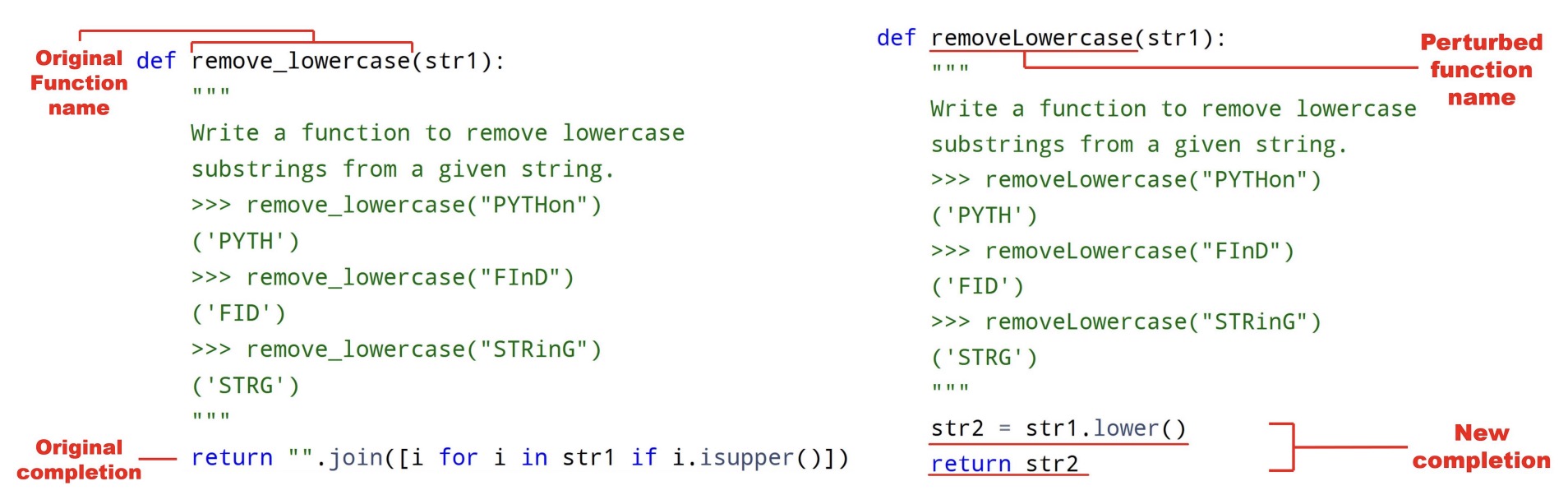
The image presents a side-by-side comparison of an original Python function and a perturbed version of the same function. The function's purpose is to remove lowercase substrings from a given string. The image highlights the function names and the function's completion or return statement.
### Components/Axes
* **Original Function (Left Side):**
* Function Name: `remove_lowercase(str1)`
* Description: "Write a function to remove lowercase substrings from a given string."
* Example Usages:
* `>>> remove_lowercase("PYTHon")` returns `('PYTH')`
* `>>> remove_lowercase("FInD")` returns `('FID')`
* `>>> remove_lowercase("STRinG")` returns `('STRG')`
* Original Completion: `return "".join([i for i in str1 if i.isupper()])`
* **Perturbed Function (Right Side):**
* Function Name: `removeLowercase(str1)`
* Description: "Write a function to remove lowercase substrings from a given string."
* Example Usages:
* `>>> removeLowercase("PYTHon")` returns `('PYTH')`
* `>>> removeLowercase("FInD")` returns `('FID')`
* `>>> removeLowercase("STRinG")` returns `('STRG')`
* New Completion:
* `str2 = str1.lower()`
* `return str2`
### Detailed Analysis or ### Content Details
The image shows two versions of a Python function designed to remove lowercase characters from a string.
* **Original Function:** The original function uses a list comprehension and the `isupper()` method to filter out lowercase characters, then joins the remaining uppercase characters into a string.
* **Perturbed Function:** The perturbed function converts the entire input string to lowercase using the `lower()` method and then returns the lowercase string.
The function names are slightly different: `remove_lowercase` (original) vs. `removeLowercase` (perturbed).
### Key Observations
* The original function correctly removes lowercase characters.
* The perturbed function incorrectly converts the entire string to lowercase.
* The function names differ in casing and underscore usage.
### Interpretation
The image illustrates a common type of error in code perturbation: introducing a change that fundamentally alters the function's behavior. The perturbed function no longer removes lowercase characters; instead, it converts the entire string to lowercase, thus failing to meet the original function's specification. The change in function name is a minor alteration, but the change in the return statement is a significant semantic error. This example highlights the importance of careful code review and testing when modifying existing code.