\n
## Diagram: Comparison of Original and Perturbed Python Function Implementations
### Overview
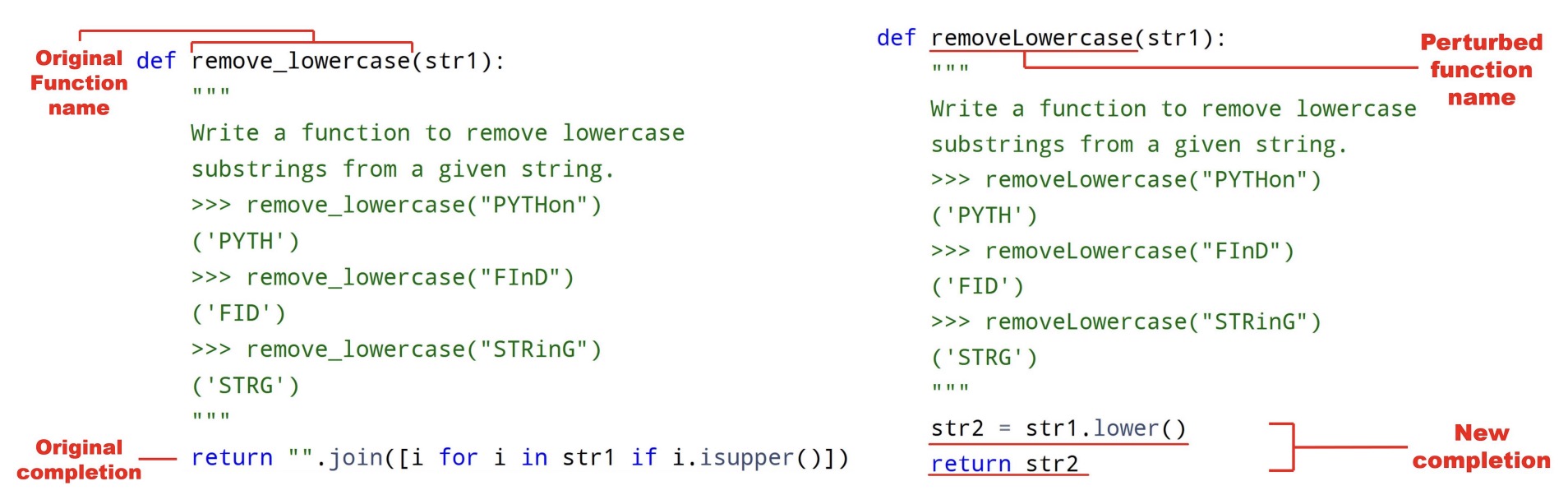
The image displays a side-by-side comparison of two Python function definitions that share the same documented purpose but differ in implementation and naming. The left side shows an "Original" version, and the right side shows a "Perturbed" version. Red annotations highlight the specific differences between the two code blocks.
### Components/Axes
The diagram is divided into two primary vertical sections:
1. **Left Section (Original):** Contains the original function definition and its completion.
2. **Right Section (Perturbed):** Contains the modified function definition and its new completion.
**Annotations (in Red):**
* **Top Left:** "Original Function name" with a line pointing to `remove_lowercase`.
* **Top Right:** "Perturbed function name" with a line pointing to `removeLowercase`.
* **Bottom Left:** "Original completion" with a line pointing to the `return` statement.
* **Bottom Right:** "New completion" with a bracket encompassing two lines of code.
### Detailed Analysis
#### **Left Side: Original Function**
* **Function Definition:** `def remove_lowercase(str1):` (in blue text)
* **Docstring (in green):**
```
"""
Write a function to remove lowercase
substrings from a given string.
>>> remove_lowercase("PYTHon")
('PYTH')
>>> remove_lowercase("FInD")
('FID')
>>> remove_lowercase("STRinG")
('STRG')
"""
```
* **Original Completion (in black):** `return "".join([i for i in str1 if i.isupper()])`
#### **Right Side: Perturbed Function**
* **Function Definition:** `def removeLowercase(str1):` (in blue text)
* **Docstring (in green):**
```
"""
Write a function to remove lowercase
substrings from a given string.
>>> removeLowercase("PYTHon")
('PYTH')
>>> removeLowercase("FInD")
('FID')
>>> removeLowercase("STRinG")
('STRG')
"""
```
* **New Completion (in black):**
```python
str2 = str1.lower()
return str2
```
### Key Observations
1. **Function Name Change:** The function name is altered from snake_case (`remove_lowercase`) to camelCase (`removeLowercase`).
2. **Docstring Consistency:** The docstring's descriptive text and all three provided examples (`"PYTHon"`, `"FInD"`, `"STRinG"`) are identical in both versions, except for the function name called within the examples.
3. **Radical Implementation Change:** The core logic of the function is completely different:
* **Original:** Uses a list comprehension with `i.isupper()` to filter and keep only uppercase characters, then joins them. This correctly implements the docstring's goal of removing lowercase substrings.
* **Perturbed:** Converts the entire input string `str1` to lowercase using `.lower()` and returns the result. This implementation **does not** fulfill the documented purpose; it returns a fully lowercased string instead of removing lowercase parts.
4. **Output Discrepancy:** Despite the radically different and incorrect implementation in the perturbed version, the docstring examples would produce the same expected output (`('PYTH')`, `('FID')`, `('STRG')`) if the original function name were called. This highlights a potential inconsistency or error in the perturbed code's documentation.
### Interpretation
This diagram illustrates a concept likely related to **code robustness, adversarial examples, or automated program repair**. It shows how a function's interface (name and documentation) can be superficially altered ("perturbed") while its underlying implementation is changed in a way that breaks its intended functionality.
The key takeaway is the disconnect between the **contract** (the docstring promising to remove lowercase substrings) and the **implementation** (the code that actually lowercases everything). The perturbed version passes the "interface test" by having a similar name and identical documentation, but fails the "functional test." This is a classic example of how code can appear correct at a glance while being fundamentally broken, emphasizing the importance of testing implementations against their specifications, not just their signatures. The annotations serve as a guide to pinpoint exactly where the semantic drift has occurred.