## Heatmap: Correlation Between Initial Programs and Feedback-Repairs
### Overview
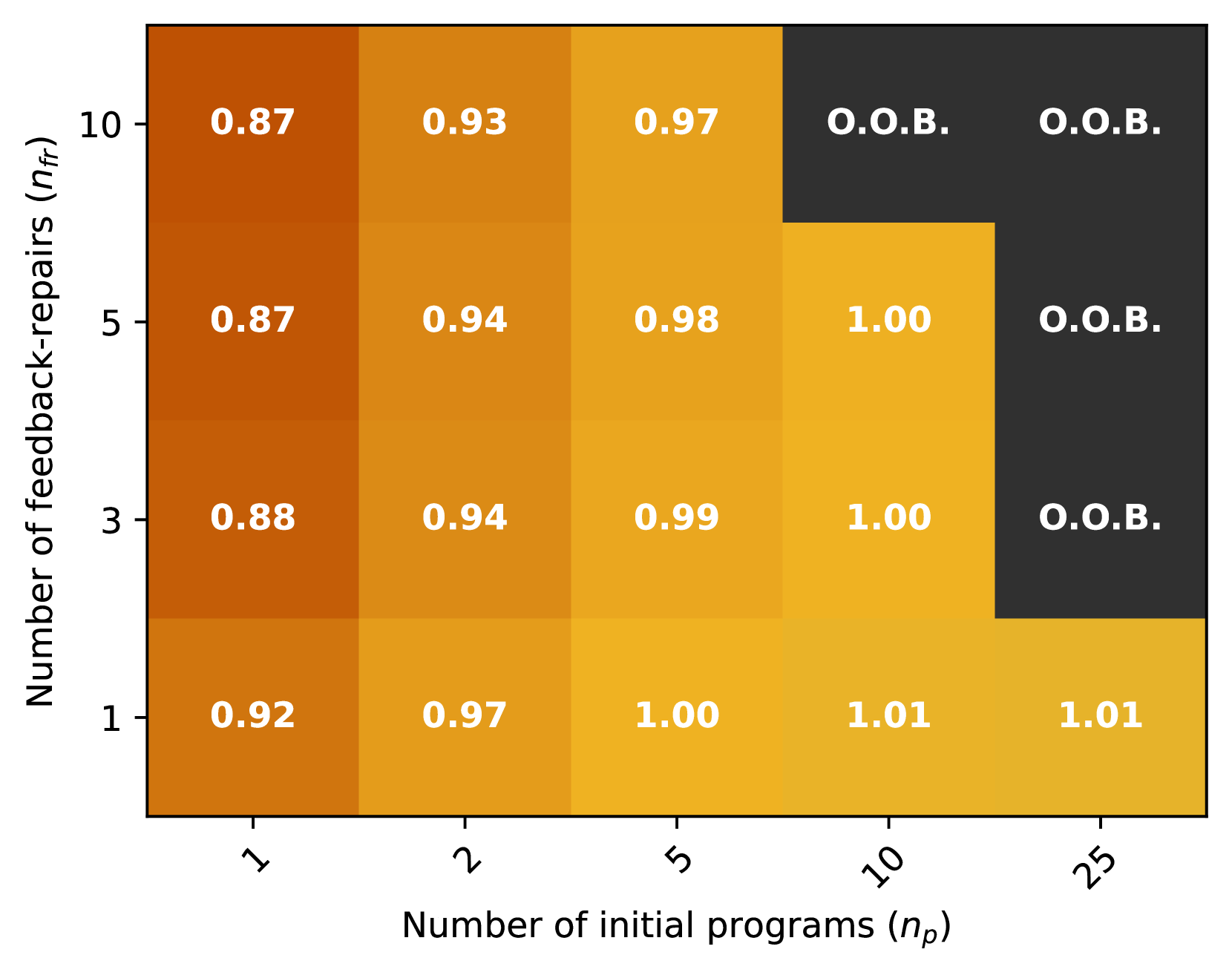
The image is a heatmap visualizing the relationship between the number of initial programs (`n_p`) and feedback-repairs (`n_fr`). Values are represented as numerical coefficients, with darker shades indicating higher values. Some cells are labeled "O.O.B." (likely "Out of Bounds"), suggesting values beyond the observed range.
### Components/Axes
- **X-axis (Horizontal)**: "Number of initial programs (`n_p`)" with categories: 1, 2, 5, 10, 25.
- **Y-axis (Vertical)**: "Number of feedback-repairs (`n_fr`)" with categories: 1, 3, 5, 10.
- **Color Gradient**: Light orange (low values) to dark brown (high values). "O.O.B." cells are black.
- **Annotations**: Numerical values in white text within each cell.
### Detailed Analysis
#### Data Table Structure
| `n_p` \ `n_fr` | 1 | 2 | 5 | 10 | 25 |
|----------------|---------|---------|---------|---------|---------|
| **1** | 0.92 | 0.97 | 1.00 | 1.01 | 1.01 |
| **3** | 0.88 | 0.94 | 0.99 | 1.00 | O.O.B. |
| **5** | 0.87 | 0.94 | 0.98 | 1.00 | O.O.B. |
| **10** | 0.87 | 0.93 | 0.97 | O.O.B. | O.O.B. |
#### Key Observations
1. **Trend Verification**:
- Values generally increase with both `n_p` and `n_fr`, suggesting a positive correlation.
- For `n_fr = 1`, values rise from 0.92 (at `n_p = 1`) to 1.01 (at `n_p = 10` and `25`).
- For `n_fr = 10`, values plateau at 1.00 for `n_p = 5` and `10`, then become "O.O.B." for `n_p = 25`.
2. **Notable Patterns**:
- The highest observed value is **1.01** (at `n_p = 10` and `25` for `n_fr = 1`).
- "O.O.B." annotations appear exclusively for `n_p = 25` and `n_fr ≥ 10`, indicating a threshold beyond which data is unobserved.
3. **Anomalies**:
- The value at `n_p = 1`, `n_fr = 3` (0.88) is lower than adjacent cells, suggesting a potential outlier or measurement error.
### Interpretation
- **System Behavior**: The data implies that increasing both initial programs and feedback-repairs generally improves the measured coefficient, but there is a critical threshold (`n_p = 25`, `n_fr ≥ 10`) where the system cannot accommodate further increases.
- **Practical Implications**: The "O.O.B." values suggest operational limits, possibly due to resource constraints or system instability at higher scales.
- **Peircean Insight**: The plateau at 1.00 for `n_fr = 10` and `n_p ≤ 10` may indicate an optimal balance, while values exceeding this (e.g., 1.01) could represent over-optimization or measurement artifacts.
### Spatial Grounding
- **Legend**: Implicit in the color gradient (no explicit legend). Darker shades = higher values.
- **Text Placement**: Numerical values are centered in cells; "O.O.B." annotations are in black, matching the darkest cells.
### Component Isolation
- **Header**: Axis labels (`n_p`, `n_fr`).
- **Main Chart**: Grid of cells with values and "O.O.B." markers.
- **Footer**: No additional elements.
### Final Notes
The heatmap effectively highlights scalability limits, with values exceeding 1.00 potentially indicating normalized metrics or error margins. The "O.O.B." annotations warrant further investigation into system constraints.