## Text Document: Entity and Relationship Extraction Task
### Overview
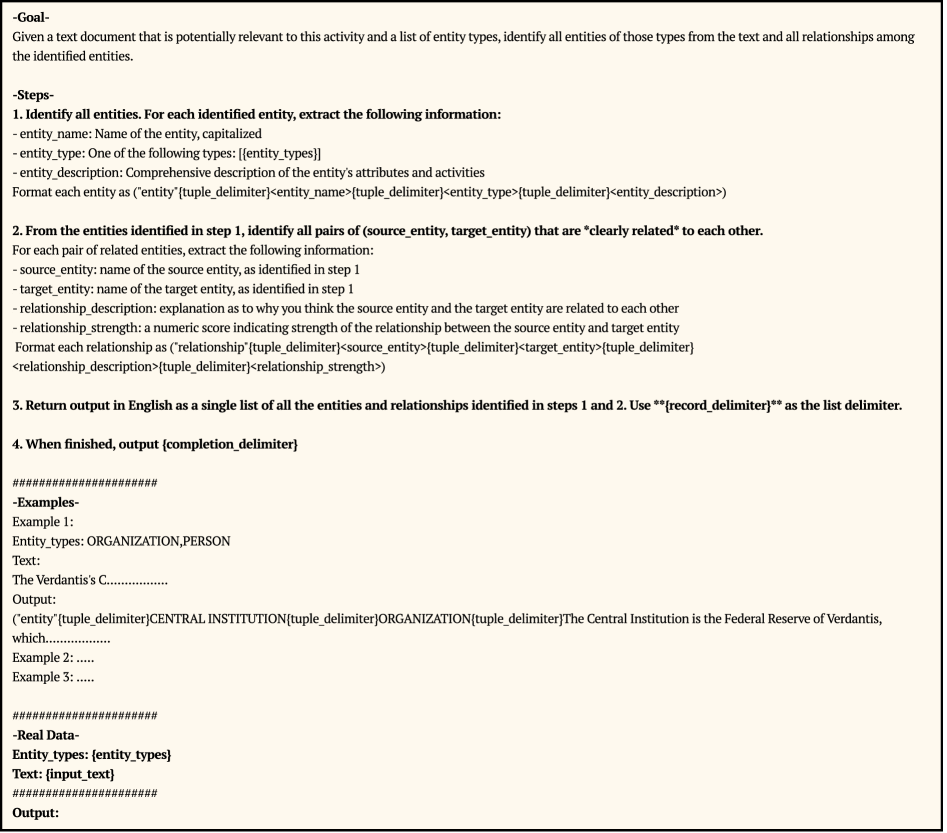
The image presents a set of instructions for extracting entities and relationships from a given text document, along with examples and placeholders for real data input and output. The goal is to identify entities of specified types, extract relevant information about them, identify relationships between pairs of entities, and output the results in a structured format.
### Components/Axes
* **Goal:** Describes the overall objective of the task.
* **Steps:** Outlines the procedure for entity and relationship extraction.
* Step 1: Entity Identification and Information Extraction
* `entity_name`: Name of the entity, capitalized.
* `entity_type`: One of the following types: `{entity_types}`.
* `entity_description`: Comprehensive description of the entity's attributes and activities.
* Format: `"entity"{tuple_delimiter}<entity_name>{tuple_delimiter}<entity_type>{tuple_delimiter}<entity_description>`
* Step 2: Relationship Identification and Information Extraction
* `source_entity`: Name of the source entity (from Step 1).
* `target_entity`: Name of the target entity (from Step 1).
* `relationship_description`: Explanation of the relationship.
* `relationship_strength`: Numeric score indicating relationship strength.
* Format: `"relationship"{tuple_delimiter}<source_entity>{tuple_delimiter}<target_entity>{tuple_delimiter}<relationship_description>{tuple_delimiter}<relationship_strength>`
* Step 3: Output Generation
* Output in English as a single list.
* Use `{record_delimiter}` as the list delimiter.
* Step 4: Completion
* Output `{completion_delimiter}` when finished.
* **Examples:** Provides sample input and output.
* Example 1:
* `Entity_types`: ORGANIZATION, PERSON
* `Text`: The Verdantis's C...
* `Output`: `"entity"{tuple_delimiter}CENTRAL INSTITUTION{tuple_delimiter}ORGANIZATION{tuple_delimiter}The Central Institution is the Federal Reserve of Verdantis, which...`
* Example 2: (Incomplete)
* Example 3: (Incomplete)
* **Real Data:** Placeholders for actual input and output.
* `Entity_types`: `{entity_types}`
* `Text`: `{input_text}`
* `Output`: (Placeholder)
### Detailed Analysis or ### Content Details
The document defines a structured approach to extract entities and relationships from text. It specifies the information to be extracted for each entity and relationship, along with the format for representing them. The examples provide a basic illustration of the expected input and output. The "Real Data" section indicates where the actual data should be inserted for processing.
### Key Observations
* The task involves identifying entities and relationships based on predefined entity types.
* The output format is clearly defined using placeholders like `{tuple_delimiter}`, `{record_delimiter}`, and `{completion_delimiter}`.
* The example provided is incomplete, suggesting that the full output would contain more entities and relationships.
* The `relationship_strength` is a numeric score, implying a quantitative assessment of the relationship.
### Interpretation
The document outlines a natural language processing (NLP) task focused on information extraction. The goal is to convert unstructured text into structured data by identifying entities, their types, and the relationships between them. This type of task is crucial for various applications, including knowledge graph construction, information retrieval, and text summarization. The use of delimiters ensures that the extracted information can be easily parsed and processed by downstream systems. The inclusion of a relationship strength score allows for ranking and filtering of relationships based on their importance or confidence level.