\n
## Text Document: Entity and Relationship Extraction Instructions
### Overview
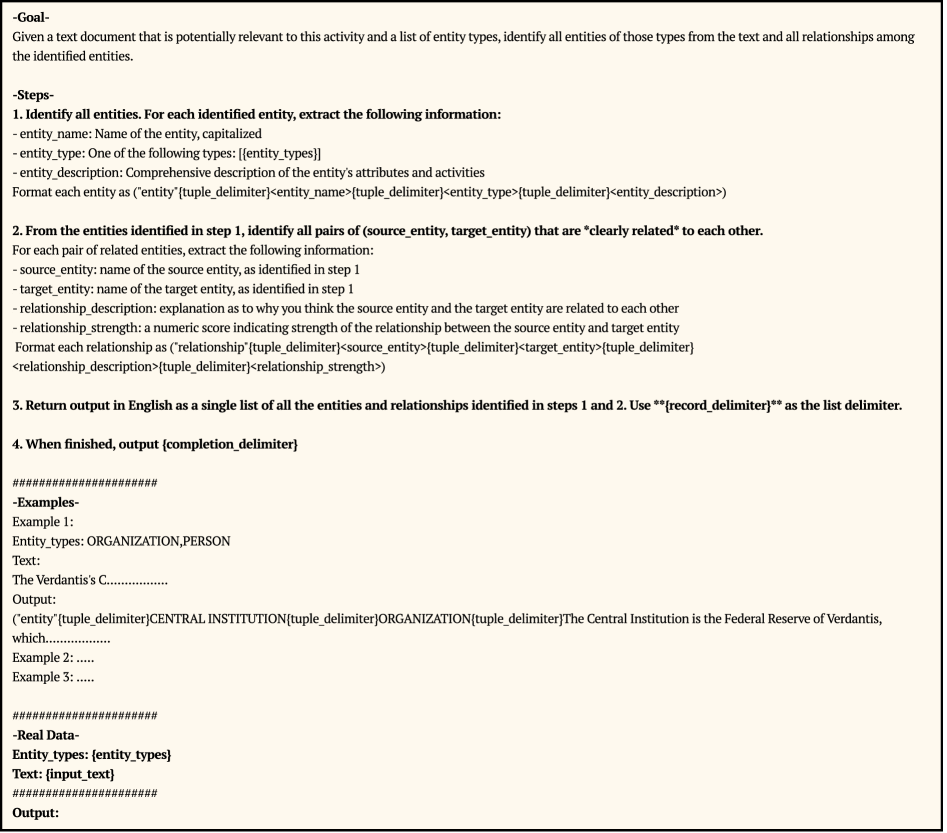
The image presents a set of instructions for a task involving entity and relationship extraction from text documents. It outlines a four-step process, including examples and a designated output format. The document appears to be a guide for a natural language processing (NLP) or information extraction task.
### Components/Axes
The document is structured into sections delineated by horizontal lines and headings. Key components include:
* **Goal:** Describes the overall objective of the task.
* **Steps:** A numbered list detailing the procedure.
* **Examples:** Illustrative cases demonstrating the expected output.
* **Real Data:** A placeholder for input text and the corresponding output.
* **Delimiter:** The document specifies the use of "tuple\_delimiter" and "record\_delimiter" for formatting the output.
### Detailed Analysis or Content Details
The instructions can be broken down as follows:
**Step 1: Entity Identification**
* **Entity Name:** Capitalized name of the entity.
* **Entity Type:** One of the specified types (listed as `[entity_types]`).
* **Entity Description:** Comprehensive description of the entity's attributes and activities.
* **Output Format:** `<entity>"(tuple\_delimiter)<entity\_name>"(tuple\_delimiter)<entity\_type>"(tuple\_delimiter)<entity\_description>`
**Step 2: Relationship Extraction**
* **Source Entity:** Name of the source entity.
* **Target Entity:** Name of the target entity.
* **Relationship Description:** Explanation of why the source and target entities are related.
* **Relationship Strength:** A numeric score indicating the relationship's strength.
* **Output Format:** `<relationship>"(tuple\_delimiter)<source\_entity>"(tuple\_delimiter)<target\_entity>"(tuple\_delimiter)<relationship\_description>"(tuple\_delimiter)<relationship\_strength>`
**Step 3: Output Format**
* The output should be a single list of all entities and relationships.
* The delimiter for the list is `**record_delimiter**`.
**Examples:**
* **Example 1:**
* Text: "The Verdantis's ...."
* Output: `<entity>"(tuple\_delimiter)CENTRAL INSTITUTION"(tuple\_delimiter)ORGANIZATION"(tuple\_delimiter)The Central Institution is the Federal Reserve of Verdantis, which...`
* **Example 2:** (Incomplete)
* **Example 3:** (Incomplete)
**Real Data:**
* Entity types: `(entity_types)`
* Text: `(input_text)`
* Output: `(output)`
### Key Observations
* The document emphasizes a structured output format using specific delimiters.
* The examples are incomplete, suggesting the document is a template or work in progress.
* The task requires both identifying entities and understanding the relationships between them.
* The inclusion of "relationship strength" suggests a need for quantifying the connection between entities.
### Interpretation
This document serves as a detailed guide for a task focused on extracting structured information from text. It's designed to facilitate the creation of a knowledge graph or database by identifying key entities and the relationships that connect them. The use of "tuple\_delimiter" and "record\_delimiter" indicates a preference for a machine-readable output format, likely for integration with a database or other NLP systems. The incomplete examples suggest that the document is a template or a draft, and the specific entity types and input text would be provided separately. The emphasis on relationship strength suggests a desire to capture the nuance and importance of different connections between entities. The overall goal is to transform unstructured text into a structured representation of knowledge.