## Technical Document: Entity and Relationship Extraction Protocol
### Overview
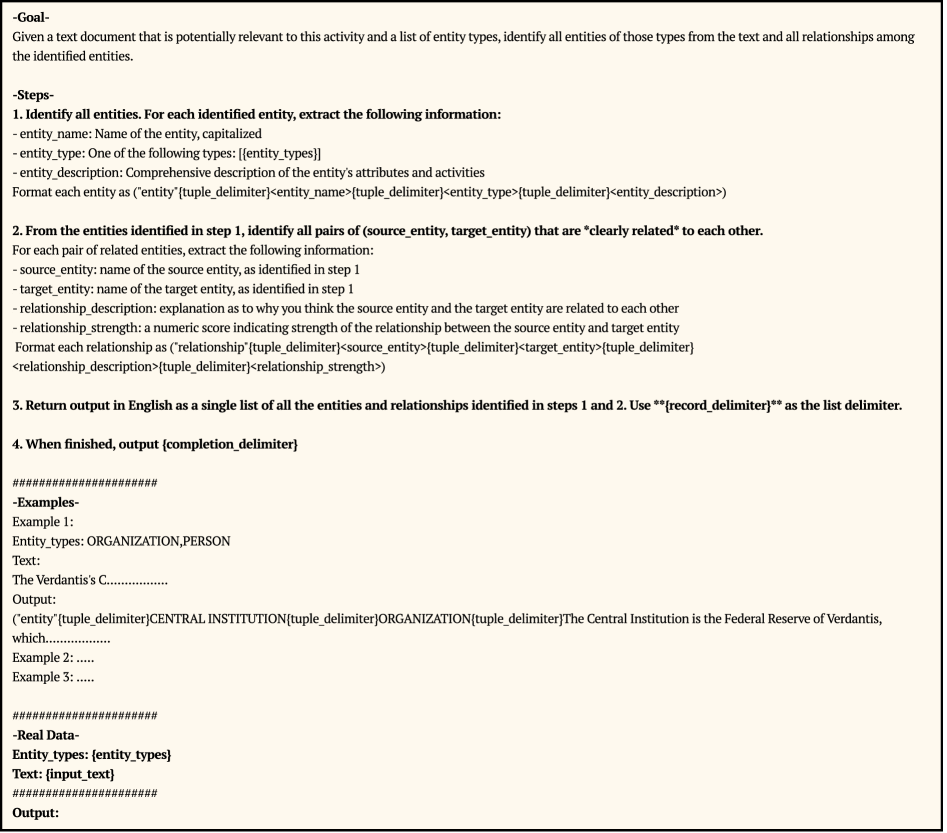
The image displays a technical instruction document outlining a structured process for extracting entities and their relationships from a given text. The document defines a goal, a multi-step procedure, formatting specifications, and provides examples. It is designed as a template or prompt for a text-processing task.
### Components/Axes
The document is organized into clearly labeled sections:
- **-Goal-**: States the primary objective.
- **-Steps-**: Contains numbered procedural instructions (1 through 4).
- **-Examples-**: Provides illustrative sample inputs and outputs.
- **-Real Data-**: A template section with placeholders for actual input.
- **Output**: A final label indicating where the result should be placed.
### Detailed Analysis
**Text Transcription:**
```
-Goal-
Given a text document that is potentially relevant to this activity and a list of entity types, identify all entities of those types from the text and all relationships among the identified entities.
-Steps-
1. Identify all entities. For each identified entity, extract the following information:
- entity_name: Name of the entity, capitalized
- entity_type: One of the following types: [{entity_types}]
- entity_description: Comprehensive description of the entity's attributes and activities
Format each entity as ('entity'{tuple_delimiter}<entity_name>{tuple_delimiter}<entity_type>{tuple_delimiter}<entity_description>)
2. From the entities identified in step 1, identify all pairs of (source_entity, target_entity) that are "clearly related" to each other.
For each pair of related entities, extract the following information:
- source_entity: name of the source entity, as identified in step 1
- target_entity: name of the target entity, as identified in step 1
- relationship_description: explanation as to why you think the source entity and the target entity are related to each other
- relationship_strength: a numeric score indicating strength of the relationship between the source entity and target entity
Format each relationship as ('relationship'{tuple_delimiter}<source_entity>{tuple_delimiter}<target_entity>{tuple_delimiter}<relationship_description>{tuple_delimiter}<relationship_strength>)
3. Return output in English as a single list of all the entities and relationships identified in steps 1 and 2. Use **{record_delimiter}** as the list delimiter.
4. When finished, output {completion_delimiter}
##############################
-Examples-
Example 1:
Entity_types: ORGANIZATION,PERSON
Text:
The Verdantis's C...............
Output:
('entity'{tuple_delimiter}CENTRAL INSTITUTION{tuple_delimiter}ORGANIZATION{tuple_delimiter}The Central Institution is the Federal Reserve of Verdantis, which...............
Example 2: .....
Example 3: .....
##############################
-Real Data-
Entity_types: {entity_types}
Text: {input_text}
##############################
Output:
```
**Key Elements and Formatting Rules:**
1. **Entity Extraction (Step 1):**
* Requires: `entity_name` (capitalized), `entity_type` (from a provided list), `entity_description`.
* Output Format: A tuple delimited by `{tuple_delimiter}`.
2. **Relationship Extraction (Step 2):**
* Requires: `source_entity`, `target_entity`, `relationship_description`, `relationship_strength` (numeric score).
* Output Format: A tuple delimited by `{tuple_delimiter}`.
3. **Final Output Assembly (Step 3 & 4):**
* All entities and relationships must be combined into a single list.
* The list delimiter is specified as `**{record_delimiter}**`.
* The process concludes with `{completion_delimiter}`.
4. **Placeholders:** The document uses several placeholders intended to be replaced with actual data:
* `{entity_types}`: A list of entity categories to look for.
* `{tuple_delimiter}`: The character(s) separating fields within an entity or relationship tuple.
* `{record_delimiter}`: The character(s) separating individual entity/relationship records in the final list.
* `{completion_delimiter}`: A marker signaling the end of the output.
* `{input_text}`: The source text to be analyzed.
5. **Examples:** The "Examples" section is partially visible. "Example 1" shows a sample where the entity type `ORGANIZATION` is extracted from a text about "The Verdantis's C...", with the name "CENTRAL INSTITUTION" and a description. Examples 2 and 3 are truncated.
### Key Observations
* The document is a precise, formal specification for a natural language processing (NLP) or information extraction task.
* It enforces strict formatting using custom delimiters, suggesting the output is meant for machine parsing.
* The "Real Data" section is a blank template, indicating this image is likely a prompt or instruction set to be used with a specific input.
* The visible example demonstrates the transformation of unstructured text ("The Verdantis's C...") into a structured tuple format.
### Interpretation
This document defines a **schema and protocol for structured information extraction**. Its purpose is to convert free-form text into a machine-readable format consisting of two linked data types: **Entities** (discrete objects like people or organizations) and **Relationships** (the connections between them).
The protocol emphasizes:
1. **Standardization:** Capitalized names, predefined types, and comprehensive descriptions ensure consistency.
2. **Quantification:** The `relationship_strength` score adds a measurable dimension to the connections, moving beyond simple binary relatedness.
3. **Machine Readability:** The heavy reliance on custom delimiters (`{tuple_delimiter}`, `{record_delimiter}`) is designed for easy parsing by a subsequent program or system, not for human readability.
4. **Contextual Analysis:** The requirement for a "comprehensive description" and a "relationship_description" forces the extractor to perform reasoning and justification, not just pattern matching.
In essence, this is a blueprint for building a knowledge graph or a structured database from unstructured text. The "Real Data" section is the input slot, making this entire document a reusable template for a specific analytical task. The missing delimiters and entity types in the template would need to be supplied by the user or a preceding system before execution.