## Textual Document: Entity and Relationship Extraction Framework
### Overview
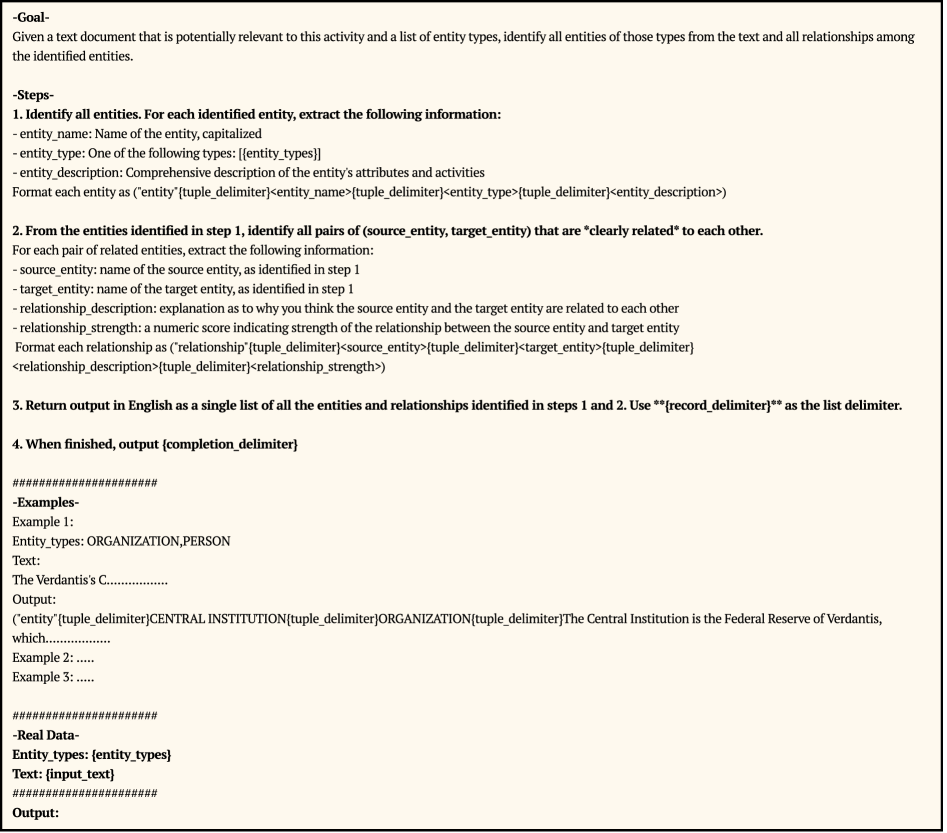
This document outlines a structured methodology for extracting entities and relationships from text documents. It defines a four-step process for identifying entities, their attributes, and their interconnections, with explicit formatting rules for output.
### Components/Axes
- **Sections**:
1. `-Goal-` (Objective definition)
2. `-Steps-` (Four-step extraction process)
3. `-Examples-` (Illustrative cases)
4. `-Real Data-` (Placeholder for input/output)
### Content Details
#### -Goal- Section
- **Objective**: Extract entities and relationships from text.
- **Key Phrases**:
- "Given a text document... identify all entities... and all relationships."
- "Format each entity as `(tuple_delimiter)entity_name>(tuple_delimiter)entity_description`."
#### -Steps- Section
**Step 1: Identify Entities**
- **Required Information per Entity**:
- `entity_name` (capitalized)
- `entity_type` (from predefined list: `[entity_types]`)
- `entity_description` (comprehensive attributes/activities)
- **Format**: `(tuple_delimiter)entity_name>(tuple_delimiter)entity_description`
**Step 2: Identify Relationships**
- **Pairs**: Source-target entity pairs with "clear" relationships.
- **Extracted Data**:
- `source_entity`, `target_entity`
- `relationship_description` (explanation of connection)
- `relationship_strength` (numeric score)
- **Format**: `(tuple_delimiter)relationship>(tuple_delimiter)source_entity>(tuple_delimiter)target_entity>(tuple_delimiter)relationship_description>(tuple_delimiter)relationship_strength`
**Step 3: Output Entities and Relationships**
- **Output Structure**: Single list of entities and relationships.
- **Delimiter**: `**{record_delimiter}**`
**Step 4: Completion**
- **Output**: `(tuple_delimiter)completion_delimiter`
#### -Examples- Section
- **Example 1**:
- **Entity Types**: `ORGANIZATION`, `PERSON`
- **Text**: "The Verdantis’s C............."
- **Output**: `(tuple_delimiter)CENTRAL INSTITUTION>(tuple_delimiter)The Central Institution is the Federal Reserve of Verdantis, which............`
#### -Real Data- Section
- **Entity Types**: `[entity_types]`
- **Text**: `[input_text]`
- **Output**: `[Output]`
### Key Observations
1. **Structured Output**: All entities/relationships use consistent tuple-delimited formatting.
2. **Placeholder Usage**: Examples and real data sections contain generic placeholders (e.g., `[input_text]`).
3. **Relationship Strength**: Explicitly requires a numeric score, though no scale (e.g., 0-10) is defined.
### Interpretation
This framework appears designed for natural language processing (NLP) tasks, emphasizing:
- **Precision**: Strict formatting rules for machine-readable outputs.
- **Scalability**: Predefined entity types and relationship templates suggest adaptability to domain-specific data.
- **Ambiguity in Strength Metrics**: The lack of a defined scale for `relationship_strength` could lead to inconsistent interpretations.
The document prioritizes systematic extraction over contextual nuance, making it suitable for automated pipelines but potentially limiting qualitative analysis. The examples demonstrate hierarchical relationships (e.g., institutions and their roles), hinting at applications in organizational analysis or knowledge graph construction.