\n
## Diagram: Proof Search and Tactic Generation
### Overview
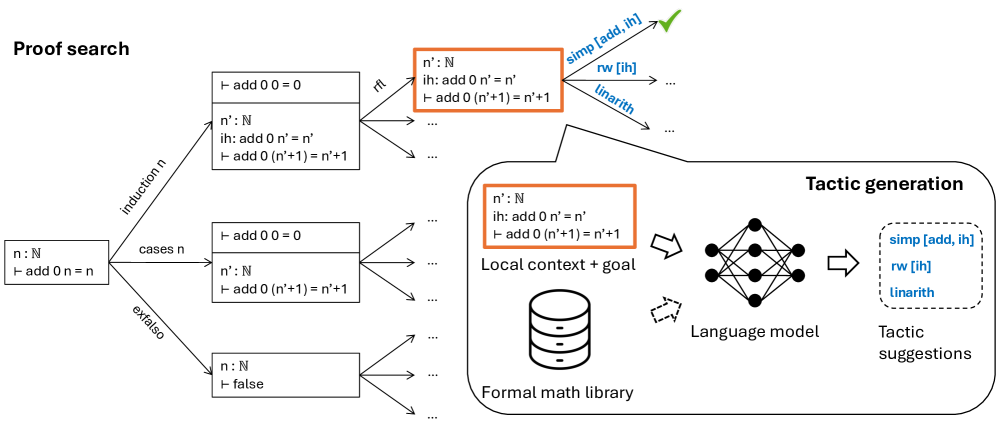
This diagram illustrates the process of automated theorem proving, specifically focusing on proof search and tactic generation. It depicts a flow from a problem statement through a series of transformations and interactions with a language model and formal math library, ultimately leading to tactic suggestions. The diagram is divided into two main sections: "Proof search" on the left and "Tactic generation" on the right, connected by a central processing stage.
### Components/Axes
The diagram consists of several key components:
* **Proof search:** This section shows a branching process starting with an initial goal and exploring different proof strategies (induction, cases, exfalso).
* **Local context + goal:** A central box representing the current state of the proof.
* **Language model:** Represented as a network of nodes and connections.
* **Formal math library:** Depicted as stacked cylinders.
* **Tactic generation:** This section shows the output of the process, providing tactic suggestions.
* **Arrows:** Indicate the flow of information and transformations.
* **Text boxes:** Contain mathematical statements and tactic names.
### Detailed Analysis or Content Details
**Proof Search (Left Side):**
1. **Initial Goal:** A rectangular box labeled "n: N\n⊢ add 0 n = n" (where "⊢" likely means "proves").
2. **Induction:** An arrow labeled "induction n" leads to a new box labeled "n': N\nih: add 0 n' = n'\n⊢ add 0 (n'+1) = n'+1".
3. **Cases:** An arrow labeled "cases n" leads to a new box labeled "⊢ add 0 0 = 0".
4. **Exfalso:** An arrow labeled "exfalso" leads to a new box labeled "n: N\n⊢ false".
5. **Intermediate Goal:** A box labeled "m': N\nih: add 0 m' = m'\n⊢ add 0 (m'+1) = m'+1".
**Central Processing:**
* The "Local context + goal" box contains the statement "n': N\nih: add 0 n' = n'\n⊢ add 0 (n'+1) = n'+1".
* An arrow connects this box to the "Language model".
**Tactic Generation (Right Side):**
* An arrow connects the "Language model" to a box labeled "Tactic suggestions".
* The "Tactic suggestions" box contains the following tactics:
* "simp [add, ih]"
* "rw [ih]"
* "linarith"
**Additional Text:**
* "Proof search" (top-left)
* "Tactic generation" (top-right)
* "Formal math library" (bottom-center)
### Key Observations
The diagram illustrates a cyclical process. The proof search explores different strategies, the current state is represented in the "Local context + goal", the "Language model" processes this information, and then generates "Tactic suggestions" to guide the proof search. The "Formal math library" provides a foundation of known theorems and definitions. The diagram suggests that the language model plays a crucial role in bridging the gap between the proof state and the appropriate tactics.
### Interpretation
This diagram depicts a system for automated theorem proving. The "Proof search" side represents the exploration of possible proof paths, while the "Tactic generation" side represents the intelligent suggestion of proof steps. The language model acts as a reasoning engine, leveraging the "Formal math library" to generate effective tactics. The diagram highlights the integration of symbolic reasoning (proof search) with machine learning (language model) to automate the process of theorem proving. The use of "induction", "cases", and "exfalso" indicates the system supports common proof techniques. The tactics "simp", "rw", and "linarith" are standard tactics in interactive theorem provers, suggesting the system aims to provide suggestions compatible with such tools. The diagram suggests a system that learns from a formal math library and applies that knowledge to guide the proof search process. The cyclical nature of the diagram implies an iterative refinement process, where tactic suggestions are used to advance the proof search, and the results are fed back into the language model to improve future suggestions.