## Screenshot: Prompt for Response Generation
### Overview
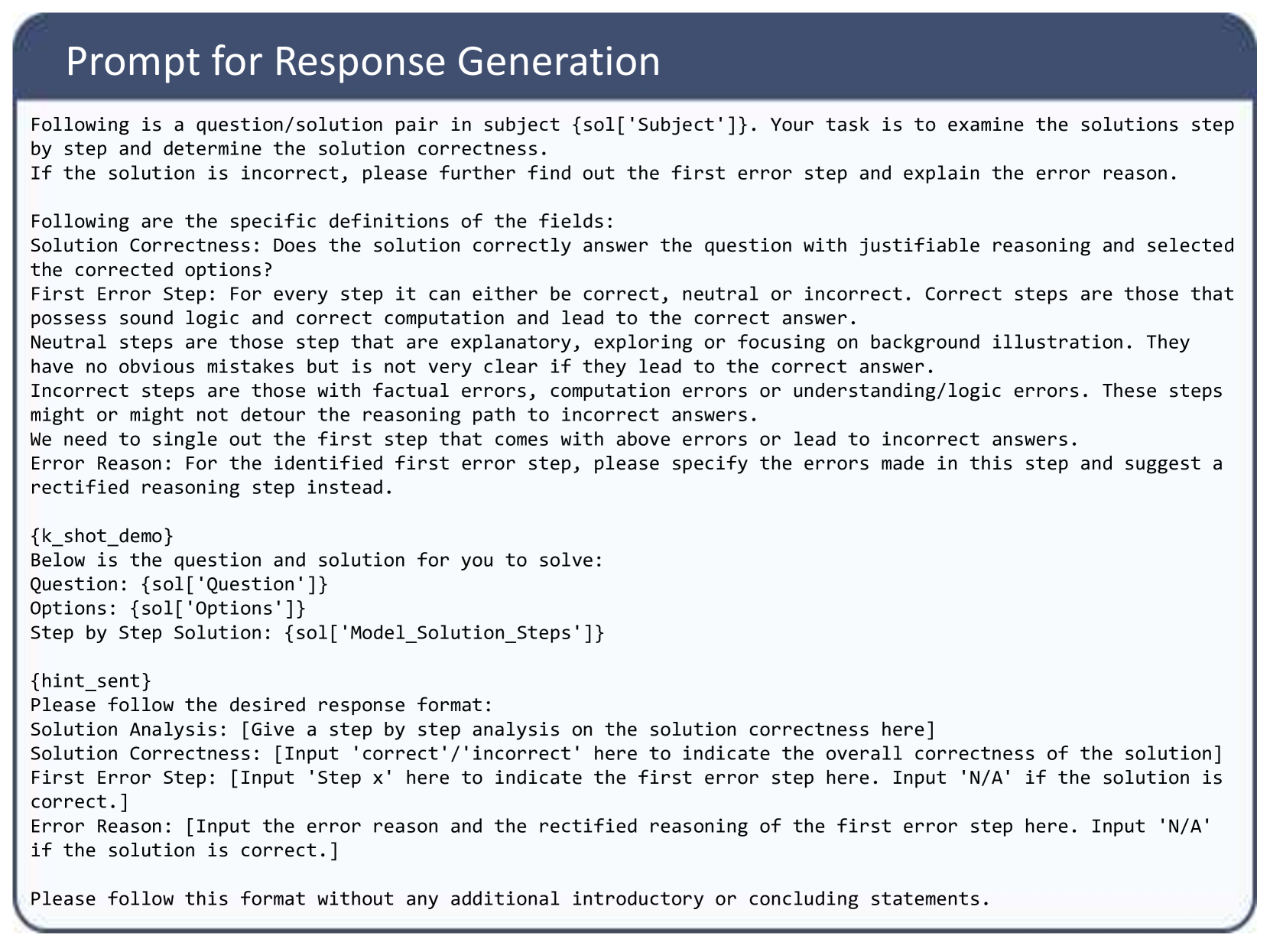
The image displays a structured prompt template for evaluating the correctness of a solution to a question/solution pair. It outlines criteria for analyzing solution steps, identifying errors, and providing rectified reasoning. The template includes placeholders for dynamic content (e.g., `{sol['Subject']}`) and specifies a strict response format.
### Components/Axes
1. **Header**:
- Title: "Prompt for Response Generation" (dark blue background).
2. **Main Content**:
- **Task Description**:
- Examine solutions step-by-step to determine correctness.
- If incorrect, identify the first error step and explain the error.
- **Definitions**:
- **Solution Correctness**: Whether the solution answers the question with justifiable reasoning and selected options.
- **First Error Step**: Classifies steps as correct (sound logic), neutral (explanatory but unclear), or incorrect (factual/logic errors).
- **Error Reason**: Requires specifying errors in the first erroneous step and suggesting a rectified reasoning step.
- **Example Placeholders**:
- `{k_shot_demo}`: Contains a question, options, and step-by-step solution.
- `{hint_sent}`: Instructions for response format.
3. **Response Format**:
- Structured output sections:
- **Solution Analysis**: Step-by-step analysis of correctness.
- **Solution Correctness**: Input `'correct'`/`'incorrect'`.
- **First Error Step**: Input step number or `'N/A'` if correct.
- **Error Reason**: Input error reason and rectified reasoning or `'N/A'` if correct.
### Detailed Analysis
- **Textual Structure**:
- The prompt is divided into sections with clear headings (e.g., "Definitions," "Example Placeholders").
- Placeholders (e.g., `{sol['Question']}`, `{sol['Options']}`) indicate dynamic content insertion points.
- **Key Instructions**:
- Emphasis on identifying the *first* error step with sound logic for classification.
- Neutral steps are those that are explanatory but lack clarity in leading to the correct answer.
- Incorrect steps involve factual errors, computation mistakes, or flawed logic.
### Key Observations
- The template enforces a strict format for responses, requiring explicit inputs for correctness, error steps, and reasoning.
- Placeholders suggest integration with a system that dynamically populates questions, solutions, and hints.
- The definitions differentiate between neutral and incorrect steps, highlighting the importance of logical rigor.
### Interpretation
This prompt is designed for a technical evaluation system, likely used in AI or automated grading contexts. It ensures systematic analysis of solutions by:
1. **Classifying Steps**: Distinguishing between correct, neutral, and incorrect reasoning to pinpoint errors.
2. **Rectifying Errors**: Providing a framework to suggest corrected reasoning, improving model outputs iteratively.
3. **Dynamic Adaptability**: Placeholders allow customization for different subjects or question types.
The structure prioritizes precision in error detection, which is critical for training or validating AI models in educational or problem-solving domains. The absence of visual elements (e.g., charts) indicates the focus is purely on textual analysis and structured output generation.