## Causal Diagram: Directed Acyclic Graph
### Overview
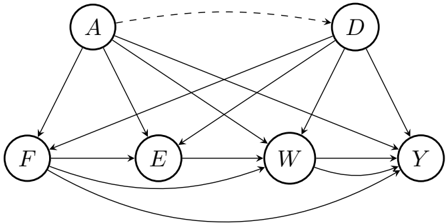
The image presents a directed acyclic graph (DAG) illustrating causal relationships between variables. The graph consists of nodes representing variables (A, D, F, E, W, Y) and directed edges (arrows) indicating causal influence. A dashed arrow indicates a potential or uncertain relationship.
### Components/Axes
* **Nodes:**
* A: Variable A, located at the top-left.
* D: Variable D, located at the top-right.
* F: Variable F, located at the bottom-left.
* E: Variable E, located to the right of F.
* W: Variable W, located to the right of E.
* Y: Variable Y, located at the bottom-right.
* **Edges (Arrows):**
* Solid arrows indicate a direct causal relationship.
* Dashed arrow indicates a potential or uncertain causal relationship.
### Detailed Analysis or ### Content Details
The diagram shows the following relationships:
* A -> F: A has a causal effect on F.
* A -> E: A has a causal effect on E.
* A -> W: A has a causal effect on W.
* A --> D: A has a potential causal effect on D (dashed line).
* D -> W: D has a causal effect on W.
* D -> Y: D has a causal effect on Y.
* F -> E: F has a causal effect on E.
* F -> W: F has a causal effect on W.
* F -> Y: F has a causal effect on Y.
* E -> W: E has a causal effect on W.
* W -> Y: W has a causal effect on Y.
### Key Observations
* Variable 'A' has multiple outgoing causal links, influencing 'F', 'E', 'W', and potentially 'D'.
* Variable 'Y' is influenced by 'D', 'F', and 'W'.
* The dashed line between 'A' and 'D' suggests a possible or uncertain causal relationship.
* The graph is acyclic, meaning there are no feedback loops.
### Interpretation
The diagram represents a causal model where the arrows indicate the direction of influence between variables. The dashed arrow between A and D suggests a hypothesized or less certain causal link compared to the solid arrows. The structure of the graph can be used to analyze potential confounding variables and to design causal inference strategies. The absence of cycles is a key property of DAGs, ensuring that the causal relationships are well-defined and do not lead to logical contradictions.