## Line Chart: Step Index vs. Steps (%) for Math Models
### Overview
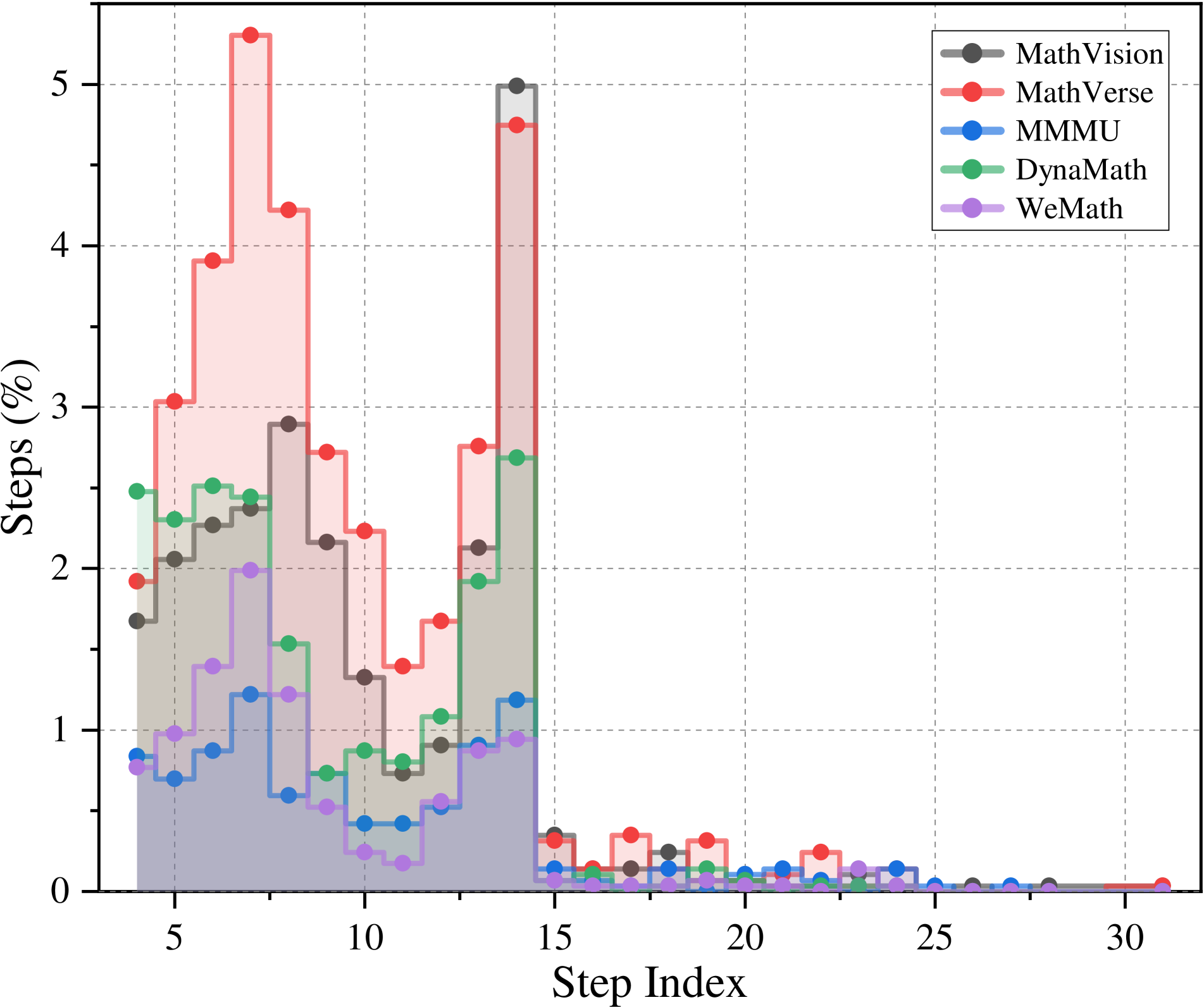
This image presents a line chart comparing the percentage of steps taken by five different math models (MathVision, MathVerse, MMMU, DynaMath, and WeMath) across a step index ranging from approximately 0 to 30. The y-axis represents the percentage of steps, while the x-axis represents the step index. The chart uses different colored lines to represent each model, with markers indicating data points.
### Components/Axes
* **X-axis Title:** Step Index
* **Y-axis Title:** Steps (%)
* **X-axis Scale:** Linear, ranging from 0 to 30, with tick marks at integer values.
* **Y-axis Scale:** Linear, ranging from 0 to 5, with tick marks at integer values.
* **Legend:** Located in the top-right corner, listing the following models and their corresponding colors:
* MathVision (Gray)
* MathVerse (Red)
* MMMU (Blue)
* DynaMath (Green)
* WeMath (Purple)
* **Gridlines:** Vertical gridlines are present throughout the chart, aiding in reading values.
### Detailed Analysis
Let's analyze each line individually, noting trends and approximate data points.
* **MathVision (Gray):** The line starts at approximately 1.5% at Step Index 0, increases to a peak of around 3.2% at Step Index 5, then gradually decreases to approximately 0.8% by Step Index 25, remaining relatively flat until Step Index 30.
* **MathVerse (Red):** This line exhibits a sharp increase from approximately 1.5% at Step Index 0 to a peak of around 5% at Step Index 10. It then rapidly declines to approximately 0.5% by Step Index 15 and remains relatively flat around 0.3% for the remainder of the chart.
* **MMMU (Blue):** The line begins at approximately 0.8% at Step Index 0, increases to a peak of around 2.5% at Step Index 7, then decreases to approximately 0.5% by Step Index 15. It remains relatively flat around 0.3% for the rest of the chart.
* **DynaMath (Green):** This line starts at approximately 1.2% at Step Index 0, increases to a peak of around 3% at Step Index 12, then declines to approximately 0.5% by Step Index 20, remaining relatively flat around 0.3% until Step Index 30.
* **WeMath (Purple):** The line begins at approximately 0.7% at Step Index 0, increases to a peak of around 1.2% at Step Index 5, then decreases to approximately 0.3% by Step Index 10. It remains relatively flat around 0.2% for the remainder of the chart.
### Key Observations
* MathVerse demonstrates the most significant initial increase in steps, peaking at 5% before rapidly declining.
* MathVision shows a more gradual increase and decrease in steps compared to MathVerse.
* MMMU, DynaMath, and WeMath exhibit similar patterns of initial increase followed by a plateau around 0.3-0.5%.
* All models converge to a very low percentage of steps (around 0.2-0.3%) after Step Index 20.
* The peak step percentages occur at different step indices for each model, indicating varying timings for maximum activity.
### Interpretation
The chart likely represents the progress or activity of different mathematical models as they iterate through a problem-solving process. The "Step Index" could refer to the iteration number, and "Steps (%)" could represent the percentage of computational effort or progress made at each step.
The initial rapid increase in MathVerse suggests it quickly focuses its computational effort, but then quickly stabilizes. The more gradual increase in MathVision suggests a more sustained, but less intense, effort. The convergence of all models to low step percentages after Step Index 20 indicates that the problem may have been solved or that the models have reached a point of diminishing returns.
The differences in peak step percentages and timings suggest that each model employs a different strategy for solving the problem. MathVerse is aggressive, MMMU is steady, and WeMath is conservative. The chart provides a comparative analysis of the efficiency and behavior of these models during the problem-solving process. The data suggests that MathVerse is the most active initially, but all models eventually reach a similar level of inactivity.