## Component Diagram: Cloud-User Interaction Flow
### Overview
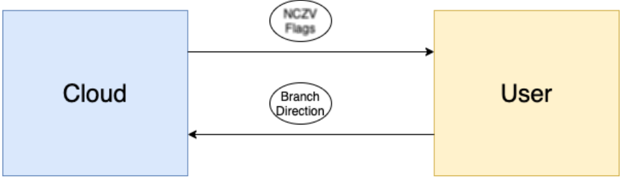
The diagram illustrates a bidirectional interaction between a "Cloud" component and a "User" component, mediated by two labeled ovals: "NCZV Flags" and "Branch Direction." Arrows indicate directional flow between the components, suggesting a networked or process-driven relationship.
### Components/Axes
- **Left Box**: Labeled "Cloud" (light blue background, black text).
- **Right Box**: Labeled "User" (light orange background, black text).
- **Oval 1**: Positioned above the arrow from "Cloud" to "User," labeled "NCZV Flags."
- **Oval 2**: Positioned below the arrow from "User" to "Cloud," labeled "Branch Direction."
- **Arrows**:
- Top arrow: From "Cloud" to "User," passing through "NCZV Flags."
- Bottom arrow: From "User" to "Cloud," passing through "Branch Direction."
### Detailed Analysis
- **Cloud Component**: Positioned on the left, serving as the origin for the top arrow. No additional attributes or sub-components are visible.
- **User Component**: Positioned on the right, acting as the destination for the top arrow and the origin for the bottom arrow.
- **NCZV Flags**: An oval element acting as a mediator or checkpoint in the Cloud-to-User flow. The term "NCZV" may denote a specific protocol, validation mechanism, or flagging system (context-dependent).
- **Branch Direction**: An oval element mediating the User-to-Cloud flow. The label implies a decision point or routing mechanism determining the path of data or processes.
### Key Observations
1. **Bidirectional Flow**: The diagram emphasizes two-way communication between Cloud and User, with distinct mediators for each direction.
2. **Mediator Roles**:
- "NCZV Flags" likely governs permissions, authentication, or routing rules for Cloud-to-User interactions.
- "Branch Direction" may represent conditional logic (e.g., A/B testing, failover paths) for User-to-Cloud responses.
3. **Simplified Representation**: No numerical data, scales, or legends are present, focusing purely on structural relationships.
### Interpretation
This diagram likely represents a simplified architecture for a cloud-based system interacting with end-users. The "NCZV Flags" could enforce security policies or prioritize traffic, while "Branch Direction" might handle dynamic routing based on user behavior or system state. The bidirectional arrows suggest real-time synchronization or feedback loops, common in distributed systems. The absence of quantitative data implies the diagram is conceptual, emphasizing process flow over measurable metrics. The use of distinct colors (light blue for Cloud, light orange for User) visually reinforces the separation of roles, aiding in quick comprehension of the system's architecture.