## Diagram: Cloud-User Interaction Flow
### Overview
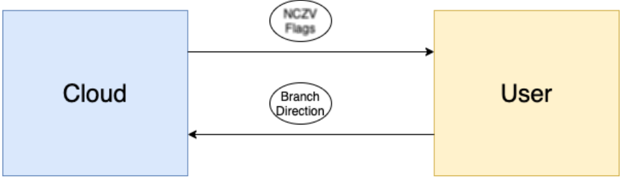
The image is a simple block diagram illustrating a bidirectional communication flow between two entities: a "Cloud" system and a "User." It depicts a closed-loop interaction where information is exchanged in both directions.
### Components/Axes
The diagram consists of two primary rectangular blocks and two directional arrows with labels.
1. **Left Block (Cloud):**
* **Label:** "Cloud"
* **Color:** Light blue fill with a thin black border.
* **Position:** Left side of the diagram.
2. **Right Block (User):**
* **Label:** "User"
* **Color:** Light yellow (beige) fill with a thin black border.
* **Position:** Right side of the diagram.
3. **Top Arrow (Cloud → User):**
* **Direction:** Horizontal, pointing from the Cloud block to the User block.
* **Label:** An oval containing the text "NCZV Flags" is positioned above the center of this arrow.
* **Function:** Represents data or signals sent from the Cloud to the User.
4. **Bottom Arrow (User → Cloud):**
* **Direction:** Horizontal, pointing from the User block to the Cloud block.
* **Label:** An oval containing the text "Branch Direction" is positioned above the center of this arrow.
* **Function:** Represents data or signals sent from the User back to the Cloud.
### Detailed Analysis
The diagram defines a specific communication protocol or data exchange pattern:
* **Message 1 (Downstream):** The Cloud sends "NCZV Flags" to the User. The term "Flags" typically indicates status indicators, configuration settings, or control signals. "NCZV" is an acronym or specific identifier whose meaning is not defined within the image.
* **Message 2 (Upstream):** The User sends "Branch Direction" back to the Cloud. "Branch Direction" suggests a decision point, routing instruction, or feedback that influences subsequent processing or logic flow within the Cloud system.
The spatial arrangement is clear and symmetrical, with the two entities placed at opposite ends and the communication channels running parallel between them.
### Key Observations
* The diagram is purely conceptual and contains no numerical data, metrics, or performance indicators.
* The labels "NCZV Flags" and "Branch Direction" are domain-specific terms. Their precise technical meaning would require external context not provided in the image.
* The flow is a simple, closed loop: Cloud → User → Cloud. There are no external inputs or outputs shown.
### Interpretation
This diagram illustrates a fundamental request-response or feedback control loop between a centralized system (Cloud) and an endpoint (User).
* **What the data suggests:** The Cloud appears to be in an initiating or controlling role, sending flags that likely set conditions or provide information. The User then responds with a "Branch Direction," which implies it is making a decision or providing routing information based on the received flags. This pattern is common in systems involving conditional logic, dynamic routing, or stateful interactions.
* **How elements relate:** The two blocks are interdependent. The User's action ("Branch Direction") is presumably contingent on the "NCZV Flags" it receives. Conversely, the Cloud's next state or action would likely depend on the "Branch Direction" feedback it gets from the User.
* **Notable patterns/anomalies:** The simplicity of the diagram is its primary feature. It abstracts away all complexity to highlight only this core exchange. The lack of defined boundaries or additional systems suggests this is a zoomed-in view of a specific interaction within a larger architecture. The acronym "NCZV" is a critical unknown; its definition would be essential for a full technical understanding of the system's operation.