## Diagram Type: Flowchart
### Overview
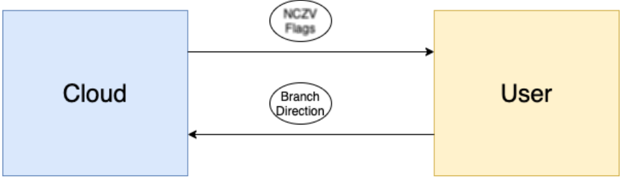
The image is a flowchart that illustrates the relationship between the Cloud, User, and various flags and directions. The flowchart uses arrows to indicate the direction of data flow or process.
### Components/Axes
- **Cloud**: Represented by a blue rectangle on the left side of the flowchart.
- **User**: Represented by a yellow rectangle on the right side of the flowchart.
- **NCZV Flags**: Represented by an oval shape with the text "NCZV Flags" inside it, located above the Cloud.
- **Branch Direction**: Represented by an oval shape with the text "Branch Direction" inside it, located below the Cloud.
- **Arrows**: Used to indicate the direction of data flow or process between the Cloud and User.
### Detailed Analysis or ### Content Details
- The Cloud is connected to the User with two arrows, one pointing from the Cloud to the User and another pointing from the User to the Cloud.
- The NCZV Flags are connected to the Cloud with an arrow pointing from the NCZV Flags to the Cloud.
- The Branch Direction is connected to the User with an arrow pointing from the Branch Direction to the User.
### Key Observations
- The flowchart suggests a two-way relationship between the Cloud and User, with data or process flowing in both directions.
- The NCZV Flags and Branch Direction are connected to the Cloud, indicating that they may influence or be influenced by the Cloud.
- The arrows indicate that the data or process is moving from the Cloud to the User and vice versa.
### Interpretation
The flowchart suggests a complex system where the Cloud and User are interconnected through various flags and directions. The NCZV Flags and Branch Direction may play a role in determining the flow of data or process between the Cloud and User. The two-way relationship between the Cloud and User suggests that the system is dynamic and responsive to changes in either component.