## Bar Charts: RMS Error vs. iSNR for Different Methods
### Overview
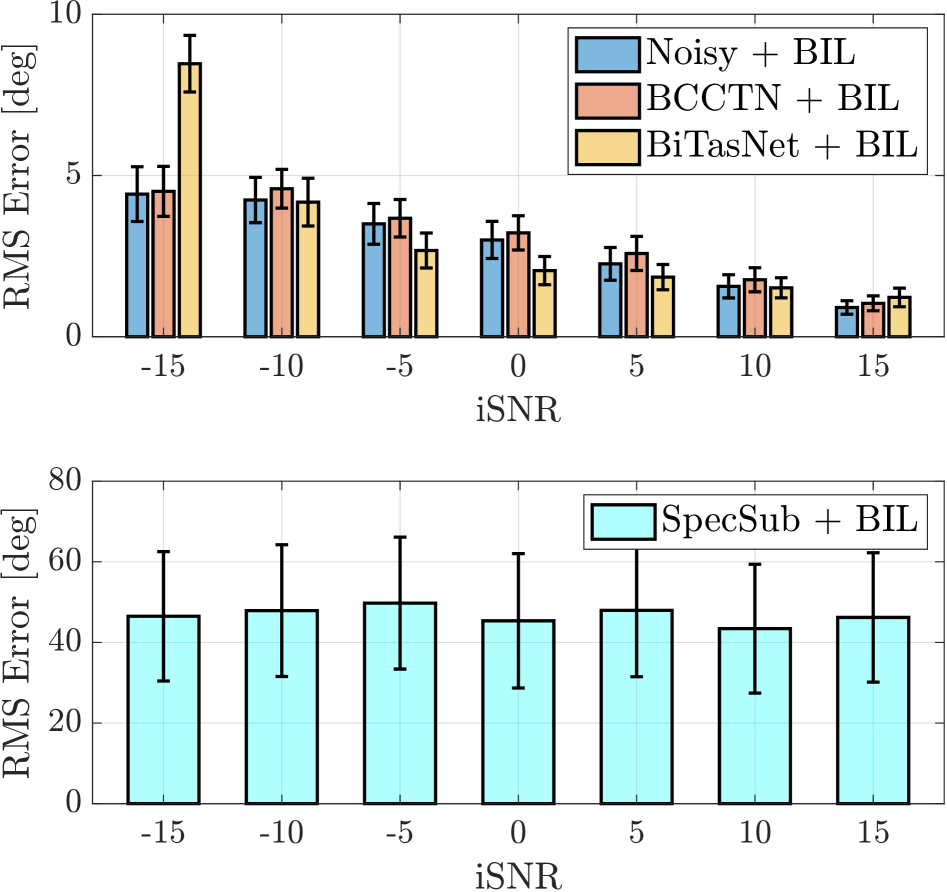
The image contains two bar charts comparing Root Mean Square (RMS) angular error (in degrees) across different signal-to-noise ratio (iSNR) values for three computational methods. The top chart compares three methods (Noisy + BIL, BCCTN + BIL, BiTasNet + BIL), while the bottom chart isolates the SpecSub + BIL method. Error bars represent standard deviation.
### Components/Axes
**Top Chart:**
- **X-axis (iSNR):** Discrete values from -15 to 15 in increments of 5 (iSNR = -15, -10, -5, 0, 5, 10, 15).
- **Y-axis (RMS Error [deg]):** Range 0–10 degrees.
- **Legend (Top-right):**
- Blue: Noisy + BIL
- Red: BCCTN + BIL
- Yellow: BiTasNet + BIL
**Bottom Chart:**
- **X-axis (iSNR):** Same values as top chart (-15 to 15).
- **Y-axis (RMS Error [deg]):** Range 0–80 degrees.
- **Legend (Top-right):**
- Cyan: SpecSub + BIL
### Detailed Analysis
**Top Chart Trends:**
1. **iSNR = -15:**
- BiTasNet + BIL (yellow) has the highest error (~9.0° ± 1.5°).
- Noisy + BIL (blue) and BCCTN + BIL (red) are similar (~4.5° ± 0.8°).
2. **iSNR = -10:**
- All methods converge (~4.0° ± 0.7° for blue/red, ~3.8° ± 0.6° for yellow).
3. **iSNR = -5 to 15:**
- Errors decrease monotonically for all methods.
- At iSNR = 15, all methods achieve ~1.5° ± 0.3° error.
**Bottom Chart Trends:**
- **SpecSub + BIL (cyan):**
- Consistent error across all iSNR values (~45° ± 5°).
- Largest error bars (up to ±7° at iSNR = -5).
### Key Observations
1. **Method Performance:**
- BiTasNet + BIL outperforms others at low iSNR but converges at high iSNR.
- SpecSub + BIL shows consistently poor performance regardless of iSNR.
2. **Error Variability:**
- SpecSub + BIL has the highest uncertainty (larger error bars).
- Noisy + BIL and BCCTN + BIL show tighter confidence intervals.
### Interpretation
The data suggests that computational methods for angular estimation exhibit SNR-dependent performance. BiTasNet + BIL demonstrates adaptive robustness, improving accuracy as SNR increases. In contrast, SpecSub + BIL fails to leverage SNR improvements, maintaining high error across all conditions. This implies that method architecture (e.g., noise handling in BiTasNet vs. static processing in SpecSub) critically impacts real-world applicability in low-SNR environments. The convergence of methods at high iSNR highlights the importance of SNR in reducing estimation errors.