## System Diagram: Hybrid Dynamical System Framework
### Overview
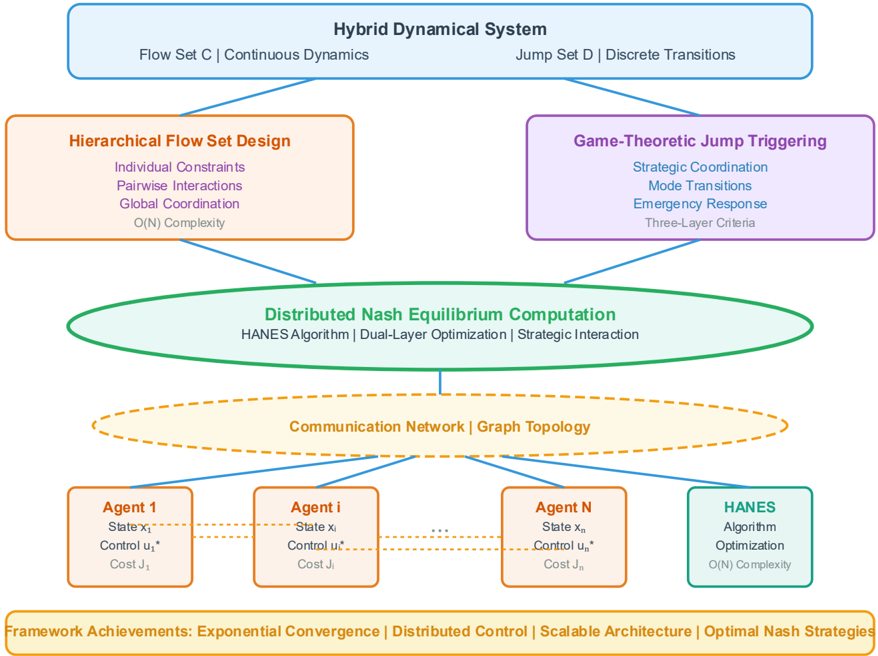
The image is a system diagram illustrating a hybrid dynamical system framework. It outlines the components and their interactions, from high-level system design to individual agent control, emphasizing distributed Nash equilibrium computation.
### Components/Axes
* **Top Level (Blue Rectangle):** "Hybrid Dynamical System" with sub-components "Flow Set C | Continuous Dynamics" and "Jump Set D | Discrete Transitions".
* **Second Level (Orange and Purple Rectangles):**
* Left: "Hierarchical Flow Set Design" with details: "Individual Constraints", "Pairwise Interactions", "Global Coordination", and "O(N) Complexity".
* Right: "Game-Theoretic Jump Triggering" with details: "Strategic Coordination", "Mode Transitions", "Emergency Response", and "Three-Layer Criteria".
* **Third Level (Green Oval):** "Distributed Nash Equilibrium Computation" with details: "HANES Algorithm | Dual-Layer Optimization | Strategic Interaction".
* **Fourth Level (Orange Dashed Oval):** "Communication Network | Graph Topology".
* **Fifth Level (Orange Rectangles):** Agent representations:
* "Agent 1": "State x₁", "Control u₁*", "Cost J₁".
* "Agent i": "State xᵢ", "Control uᵢ*", "Cost Jᵢ".
* "Agent N": "State xₙ", "Control uₙ*", "Cost Jₙ".
* "HANES": "Algorithm", "Optimization", "O(N) Complexity".
* **Bottom Level (Orange Rectangle):** "Framework Achievements: Exponential Convergence | Distributed Control | Scalable Architecture | Optimal Nash Strategies".
### Detailed Analysis or ### Content Details
* **Hybrid Dynamical System:** This is the overarching system, combining continuous dynamics (Flow Set C) and discrete transitions (Jump Set D).
* **Hierarchical Flow Set Design:** Focuses on designing the continuous flow of the system, considering individual constraints, pairwise interactions, and global coordination. The complexity is O(N).
* **Game-Theoretic Jump Triggering:** Deals with the discrete transitions, using game theory to trigger jumps based on strategic coordination, mode transitions, and emergency responses, evaluated using three-layer criteria.
* **Distributed Nash Equilibrium Computation:** Employs the HANES algorithm for dual-layer optimization and strategic interaction to compute the Nash equilibrium in a distributed manner.
* **Communication Network:** Represents the communication topology between agents, essential for distributed computation.
* **Agents:** Individual agents are represented with their state (x), control input (u*), and cost function (J). Agent 1, Agent i, and Agent N are shown.
* **HANES (Algorithm Block):** This block represents the HANES algorithm, which is used for optimization and has a complexity of O(N).
* **Framework Achievements:** The framework achieves exponential convergence, distributed control, scalable architecture, and optimal Nash strategies.
### Key Observations
* The diagram illustrates a hierarchical structure, starting from the high-level system definition and drilling down to individual agent control.
* The HANES algorithm plays a central role in computing the distributed Nash equilibrium.
* The framework emphasizes both continuous dynamics and discrete transitions, reflecting the hybrid nature of the system.
* Communication between agents is crucial for the distributed computation.
### Interpretation
The diagram presents a framework for controlling a hybrid dynamical system in a distributed manner. The system combines continuous dynamics and discrete transitions, with the goal of achieving optimal Nash strategies. The hierarchical design allows for managing complexity by breaking down the problem into smaller, more manageable components. The use of the HANES algorithm and game-theoretic jump triggering suggests a sophisticated approach to optimization and control. The framework's achievements, such as exponential convergence and scalable architecture, highlight its potential for real-world applications. The diagram suggests a system designed for complex, interconnected systems where distributed control and strategic interactions are essential.