TECHNICAL ASSET FINGERPRINT
1af53acd55e86dd9316536ab
Click to view fullscreen
Press ESC or click to close
FOUND IN PAPERS
EXPERT: healer-alpha-free VERSION 1
RUNTIME: free/openrouter/healer-alpha
INTEL_VERIFIED
## Diagram: Hybrid Dynamical System Framework
### Overview
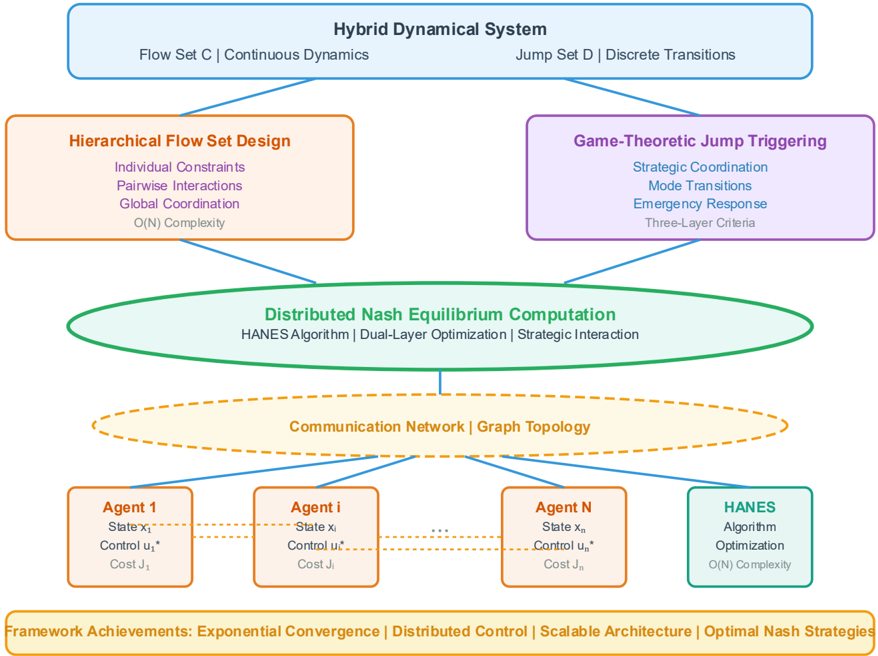
This image is a technical system architecture diagram illustrating a framework for a **Hybrid Dynamical System**. It depicts a hierarchical, multi-layered approach that integrates continuous dynamics and discrete transitions, culminating in distributed control and optimization for multiple agents. The flow moves from high-level system definitions down to individual agent implementations, connected by a communication network.
### Components/Axes
The diagram is structured in a top-down hierarchical flow with the following primary components, listed in order of appearance from top to bottom:
1. **Top-Level System Definition (Blue Rounded Rectangle):**
* **Title:** `Hybrid Dynamical System`
* **Sub-components:**
* `Flow Set C | Continuous Dynamics` (Left side)
* `Jump Set D | Discrete Transitions` (Right side)
2. **Design & Triggering Modules (Two parallel boxes below the top level):**
* **Left Box (Orange Border):** `Hierarchical Flow Set Design`
* Bullet points:
* `Individual Constraints`
* `Pairwise Interactions`
* `Global Coordination`
* `O(N) Complexity`
* **Right Box (Purple Border):** `Game-Theoretic Jump Triggering`
* Bullet points:
* `Strategic Coordination`
* `Mode Transitions`
* `Emergency Response`
* `Three-Layer Criteria`
3. **Core Computation Layer (Green Oval):**
* **Title:** `Distributed Nash Equilibrium Computation`
* **Sub-text:** `HANES Algorithm | Dual-Layer Optimization | Strategic Interaction`
4. **Network Layer (Yellow Dashed Oval):**
* **Title:** `Communication Network | Graph Topology`
5. **Agent & Algorithm Layer (Bottom row of boxes):**
* **Agent Boxes (Orange Borders, left to right):**
* `Agent 1`: Contains `State x₁`, `Control u₁*`, `Cost J₁`
* `Agent i`: Contains `State xᵢ`, `Control uᵢ*`, `Cost Jᵢ`
* `...` (Ellipsis indicating continuation)
* `Agent N`: Contains `State xₙ`, `Control uₙ*`, `Cost Jₙ`
* **Algorithm Box (Teal Border, far right):** `HANES`
* Sub-text: `Algorithm Optimization`, `O(N) Complexity`
6. **Footer Banner (Orange Rounded Rectangle):**
* **Title:** `Framework Achievements:`
* **List:** `Exponential Convergence | Distributed Control | Scalable Architecture | Optimal Nash Strategies`
**Connections (Arrows):**
* Blue arrows flow from the top "Hybrid Dynamical System" box down to both the "Hierarchical Flow Set Design" and "Game-Theoretic Jump Triggering" boxes.
* Blue arrows flow from both of those boxes down to the central "Distributed Nash Equilibrium Computation" oval.
* A blue arrow flows from the computation oval down to the "Communication Network" oval.
* Multiple blue arrows flow from the network oval down to each of the individual "Agent" boxes and the "HANES" algorithm box.
* Dashed orange lines connect the "Agent" boxes horizontally, indicating interaction or data flow between agents.
### Detailed Analysis
The diagram presents a structured methodology for controlling a complex hybrid system.
* **System Definition:** The framework begins by defining the hybrid system's two fundamental components: the continuous evolution within a **Flow Set C** and the discrete jumps governed by a **Jump Set D**.
* **Parallel Design Processes:** Two specialized modules address these components:
* The **Hierarchical Flow Set Design** handles continuous dynamics with a focus on constraints and coordination, promising linear (`O(N)`) computational complexity.
* The **Game-Theoretic Jump Triggering** manages discrete transitions using strategic criteria for coordination and emergency response.
* **Central Optimization:** The outputs of both design modules feed into the core **Distributed Nash Equilibrium Computation**. This layer uses the **HANES Algorithm** to perform dual-layer optimization, seeking a stable strategic interaction point (Nash Equilibrium) among agents.
* **Implementation Layer:** The computed strategies are implemented over a **Communication Network** with a defined graph topology. This network connects to:
* **N Individual Agents (1 through N):** Each agent `i` has its own state (`xᵢ`), computes an optimal control input (`uᵢ*`), and incurs a cost (`Jᵢ`). The dashed lines suggest peer-to-peer communication or coupling between agents.
* The **HANES Algorithm** block, which is also connected to the network, indicating it runs in a distributed manner across the network, again with `O(N)` complexity.
### Key Observations
1. **Hierarchical and Modular Structure:** The design is clearly layered, separating high-level system definition, mid-level design strategies, core computation, and low-level implementation.
2. **Focus on Scalability and Efficiency:** The explicit mention of `O(N) Complexity` in both the flow design and the HANES algorithm highlights a primary design goal: the framework's computational load should scale linearly with the number of agents, making it suitable for large-scale systems.
3. **Integration of Game Theory:** The use of "Game-Theoretic" triggering and "Nash Equilibrium" computation indicates the system models agents as strategic players whose interactions need to be coordinated.
4. **Dual Nature of Hybrid Systems:** The diagram consistently maintains the separation and then integration of continuous (`Flow Set`, `Dynamics`) and discrete (`Jump Set`, `Transitions`, `Mode Transitions`) elements.
5. **Central Role of HANES:** The HANES algorithm is presented both as the core computational engine and as a distributed component within the agent network, underscoring its importance to the framework.
### Interpretation
This diagram outlines a comprehensive research or engineering framework for designing control systems for complex, multi-agent hybrid dynamical systems (e.g., swarms of robots, smart power grids, traffic networks).
The **Peircean investigative reading** suggests the following underlying logic:
* **Sign (The Diagram):** Represents a proposed solution architecture.
* **Object (The Problem):** Controlling large-scale hybrid systems where continuous motion and discrete events interact, and where multiple autonomous agents must coordinate.
* **Interpretant (The Implied Solution):** A scalable, distributed optimization framework that uses game theory to find stable operating points (Nash Equilibria) by hierarchically designing continuous flow constraints and discrete jump rules, all executed efficiently over a communication network.
The framework's stated **achievements** (Exponential Convergence, Distributed Control, etc.) position it as an advanced solution aiming to overcome key challenges in multi-agent systems: scalability, optimality, and robustness to discrete events. The repeated emphasis on `O(N)` complexity is a direct response to the "curse of dimensionality" in large-scale system optimization. The connection between the central HANES computation and the distributed HANES block in the network suggests the algorithm is designed to be implemented in a decentralized fashion, where agents solve parts of the overall optimization problem locally while communicating with neighbors.
DECODING INTELLIGENCE...