## System Architecture Diagram: Hybrid Dynamical Control Framework
### Overview
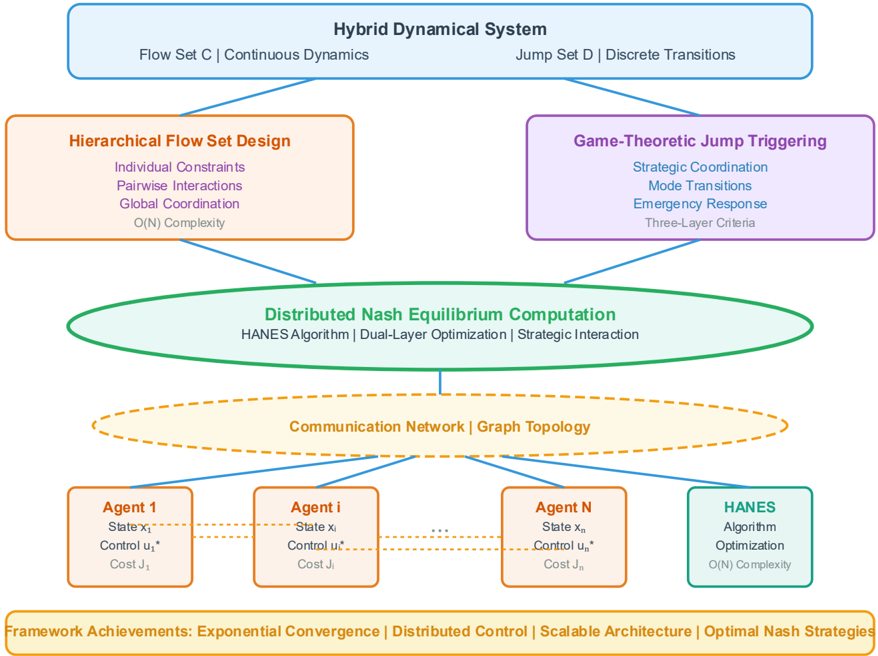
The diagram illustrates a hierarchical control system integrating continuous/discrete dynamics, game-theoretic coordination, and distributed optimization. Key components include flow sets, jump triggers, Nash equilibrium computation, and agent-based control.
### Components/Axes
1. **Top Layer**:
- **Hybrid Dynamical System** (Sky Blue Box)
- Flow Set C | Continuous Dynamics
- Jump Set D | Discrete Transitions
- **Hierarchical Flow Set Design** (Light Orange Box)
- Individual Constraints
- Pairwise Interactions
- Global Coordination
- O(N) Complexity
- **Game-Theoretic Jump Triggering** (Purple Box)
- Strategic Coordination
- Mode Transitions
- Emergency Response
- Three-Layer Criteria
2. **Central Layer**:
- **Distributed Nash Equilibrium Computation** (Green Oval)
- HANES Algorithm | Dual-Layer Optimization | Strategic Interaction
3. **Bottom Layer**:
- **Communication Network** (Dashed Orange Oval)
- Graph Topology
- **Agent Nodes** (Light Orange Squares):
- Agent 1: State x₁, Control u₁*, Cost J₁
- Agent i: State xᵢ, Control uᵢ*, Cost Jᵢ
- Agent N: State xₙ, Control uₙ*, Cost Jₙ
- **HANES Algorithm** (Green Box):
- Optimization
- O(N) Complexity
4. **Framework Achievements** (Bottom Orange Banner):
- Exponential Convergence
- Distributed Control
- Scalable Architecture
- Optimal Nash Strategies
### Spatial Grounding
- **Legend**: Bottom banner (orange background) lists framework achievements.
- **Flow Direction**: Arrows connect components vertically (top → center → bottom) and horizontally (left → right).
- **Color Coding**:
- Sky blue: Hybrid Dynamical System
- Light orange: Flow Set Design/Agent Nodes
- Purple: Game-Theoretic Jump Triggering
- Green: Nash Equilibrium/HANES
### Detailed Analysis
- **Hybrid Dynamics**: Combines continuous (Flow Set C) and discrete (Jump Set D) transitions.
- **Hierarchical Design**: Flow sets manage constraints, interactions, and coordination with linear complexity (O(N)).
- **Game-Theoretic Triggers**: Enables strategic mode transitions and emergency responses via three-layer criteria.
- **Nash Equilibrium**: Centralized computation using HANES algorithm with dual-layer optimization.
- **Agent Communication**: Nodes (Agent 1 to N) share states, controls, and costs via a graph topology.
- **HANES Role**: Provides optimization with linear complexity, ensuring scalability.
### Key Observations
1. **Modularity**: Components are decoupled yet interconnected (e.g., flow sets feed into Nash computation).
2. **Scalability**: O(N) complexity in flow sets and HANES suggests efficient scaling with agent count.
3. **Redundancy**: Three-layer criteria in jump triggering imply robustness in emergency scenarios.
4. **Distributed Control**: Agent nodes operate autonomously but coordinate via the communication network.
### Interpretation
This framework integrates continuous/discrete control with game theory to manage complex systems. The hierarchical structure allows localized decision-making (agents) while maintaining global optimization (HANES). The emphasis on O(N) complexity and distributed control suggests applications in large-scale networks (e.g., power grids, autonomous vehicles). The three-layer jump criteria highlight adaptability to dynamic environments, balancing efficiency and responsiveness.