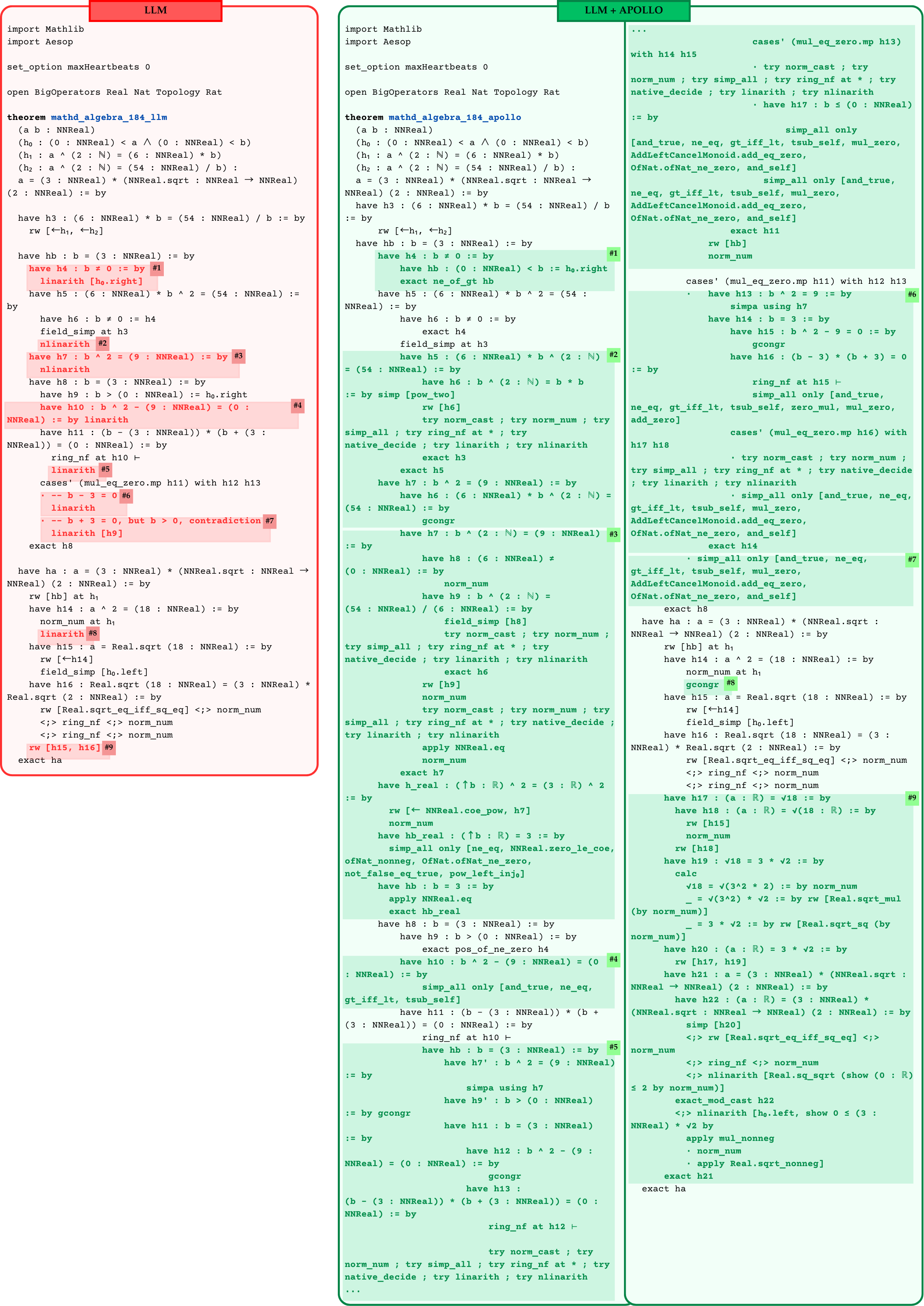
## Screenshot: Code Comparison Between LLM and LLM+APOLLO
### Overview
The image displays two side-by-side code snippets labeled "LLM" (left, red border) and "LLM+APOLLO" (right, green border). Both snippets appear to be Python code using the `mathlib` library for formal verification or theorem proving. The code includes mathematical operations, variable assignments, and logical assertions, with highlighted sections indicating differences between the two versions.
---
### Components/Axes
- **Left Panel (LLM)**:
- **Header**: "LLM" in bold, red border.
- **Code Structure**:
- Imports: `import Mathlib`, `import Aesop`.
- Configuration: `set_option maxHeartbeats 0`.
- Theorem: `theorem mathd_algebra_184_llm`.
- Variables: `a`, `b`, `h`, `h1`, `h2`, `h3`, `h4`, `h5`, `h6`, `h7`, `h8`, `h9`, `h10`.
- Logical assertions: `have`, `linarith`, `rw`, `simp_all`, `try_linarith`, `try_native_decide`.
- Highlighted sections (red): Lines with `linarith`, `rw`, and `simp_all` operations.
- **Right Panel (LLM+APOLLO)**:
- **Header**: "LLM+APOLLO" in bold, green border.
- **Code Structure**:
- Imports: `import Mathlib`, `import Aesop`.
- Configuration: `set_option maxHeartbeats 0`.
- Theorem: `theorem mathd_algebra_184_apollo`.
- Variables: Similar to LLM but with additional annotations (e.g., `h15`, `h16`).
- Logical assertions: Similar to LLM but with extended logic (e.g., `try norm_cast`, `try norm_num`).
- Highlighted sections (green): Lines with `try norm_cast`, `try norm_num`, and `try native_decide`.
---
### Detailed Analysis
#### Left Panel (LLM)
1. **Imports**:
- `import Mathlib`: Imports the Mathlib library for formal mathematics.
- `import Aesop`: Imports the Aesop library (likely for automated theorem proving).
2. **Configuration**:
- `set_option maxHeartbeats 0`: Disables heartbeat monitoring (possibly for performance optimization).
3. **Theorem**:
- `theorem mathd_algebra_184_llm`: Defines a theorem about algebraic properties.
4. **Variables**:
- `a`, `b`: Natural numbers (`NNReal`).
- `h`, `h1`, `h2`, ..., `h10`: Hypotheses or intermediate steps.
5. **Logical Assertions**:
- `have h := ...`: Asserts intermediate steps.
- `linarith`: Applies linear arithmetic to simplify expressions.
- `rw`: Rewrites expressions using known lemmas.
- `simp_all`: Simplifies all expressions.
- `try_linarith`: Attempts linear arithmetic.
- `try_native_decide`: Attempts native decision procedures.
#### Right Panel (LLM+APOLLO)
1. **Imports**:
- Same as LLM but with additional annotations (e.g., `h15`, `h16`).
2. **Configuration**:
- Same as LLM.
3. **Theorem**:
- `theorem mathd_algebra_184_apollo`: Similar to LLM but with extended logic.
4. **Variables**:
- Additional variables like `h15`, `h16` for more complex assertions.
5. **Logical Assertions**:
- Extended use of `try norm_cast`, `try norm_num`, and `try native_decide` for more robust verification.
- Additional `simp_all` and `rw` operations for deeper simplification.
---
### Key Observations
1. **Highlighted Differences**:
- **LLM (Red Highlights)**:
- Focus on `linarith`, `rw`, and `simp_all` for basic simplification.
- **LLM+APOLLO (Green Highlights)**:
- Emphasis on `try norm_cast`, `try norm_num`, and `try native_decide` for advanced verification.
2. **Code Complexity**:
- LLM+APOLLO includes more variables (`h15`, `h16`) and extended logic, suggesting enhanced capabilities for handling complex theorems.
3. **Purpose**:
- Both snippets aim to verify algebraic properties, but LLM+APOLLO appears to use more sophisticated tools for proof automation.
---
### Interpretation
The code snippets represent formal verification processes using the Mathlib library. The "LLM" version focuses on basic simplification and linear arithmetic, while "LLM+APOLLO" introduces advanced decision procedures (`try norm_cast`, `try norm_num`) and extended logic for handling more complex theorems. The highlighted sections indicate that the LLM+APOLLO version is designed to automate more steps in the proof process, potentially improving efficiency or correctness in theorem verification. The differences suggest that the APOLLO component adds layers of automation and robustness to the original LLM framework.