## Diagram: Clustered Group Representation
### Overview
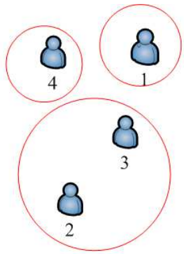
The image is a simple diagram consisting of three red-outlined circles on a white background. Each circle contains one or more blue, gradient-filled human silhouette icons. Each icon is accompanied by a numerical label placed directly below it. The diagram appears to represent groupings or clusters of entities, possibly for illustrating categories, teams, or network nodes.
### Components/Axes
* **Primary Elements:** Three circles with red outlines.
* **Icons:** Blue human silhouette icons with a light-to-dark blue gradient (lighter at the top, darker at the bottom).
* **Labels:** Numerical labels (4, 1, 3, 2) in a black, sans-serif font.
* **Spatial Layout:**
* **Top-Left:** A small circle containing one icon labeled "4".
* **Top-Right:** A small circle containing one icon labeled "1".
* **Bottom-Center:** A larger circle containing two icons. The icon labeled "3" is positioned in the upper-right area of this circle. The icon labeled "2" is positioned in the lower-left area of this circle.
### Detailed Analysis
The diagram is composed of discrete visual components with no connecting lines or flow indicators.
1. **Circle 1 (Top-Left):**
* **Size:** Small.
* **Contents:** One blue human icon.
* **Label:** The number "4" is centered below the icon.
* **Position:** Located in the upper-left quadrant of the image.
2. **Circle 2 (Top-Right):**
* **Size:** Small (similar to Circle 1).
* **Contents:** One blue human icon.
* **Label:** The number "1" is centered below the icon.
* **Position:** Located in the upper-right quadrant of the image.
3. **Circle 3 (Bottom):**
* **Size:** Large (visibly larger than the top two circles).
* **Contents:** Two blue human icons.
* **Labels:**
* The number "3" is centered below the upper-right icon.
* The number "2" is centered below the lower-left icon.
* **Position:** Occupies the lower half of the image, centered horizontally.
### Key Observations
* **Grouping Hierarchy:** The diagram establishes a clear visual hierarchy. The two smaller, separate circles at the top suggest individual or distinct groups. The single larger circle at the bottom suggests a combined or parent group containing two members.
* **Numerical Sequence:** The labels are not in sequential order (4, 1, 3, 2). This may indicate that the numbers are arbitrary identifiers rather than representing a count, order, or magnitude.
* **Visual Consistency:** All icons are identical in shape and color. All circle outlines are the same red color and line weight. The only varying visual property is the size of the bottom circle.
* **No Explicit Relationships:** There are no lines, arrows, or other connectors between the circles or icons, so relationships between the groups are implied solely by spatial grouping and containment.
### Interpretation
This diagram is a abstract representation of categorical grouping. The most straightforward interpretation is that it visualizes a simple set structure: two singleton sets (containing elements 4 and 1) and one set containing two elements (3 and 2).
The lack of contextual labels (e.g., "Team A," "Department," "Node") means the specific domain is unknown. It could represent:
* **Organizational Structure:** Small teams (4, 1) and a larger department (containing 3 and 2).
* **Network Topology:** Isolated nodes (4, 1) and a clustered subnet (3, 2).
* **Data Clustering:** The output of a clustering algorithm showing three distinct clusters.
* **Abstract Set Theory:** A simple Venn diagram-like representation of disjoint and nested sets.
The deliberate use of a larger circle for the bottom group emphasizes its composite nature. The non-sequential numbering is a key detail; it suggests the labels are unique identifiers without inherent order, which is common in diagrams representing entities like user accounts, server nodes, or inventory items. The primary informational content is the **membership and containment relationship** of the elements, not any quantitative data.