## Diagram: Child-Environment Interaction Model
### Overview
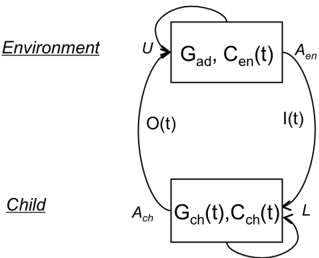
The image presents a diagram illustrating the interaction between a child and their environment. It depicts a cyclical relationship with inputs and outputs between the two entities.
### Components/Axes
* **Environment:** Labeled on the left side of the diagram.
* Represented by a rectangular box containing "G<sub>ad</sub>, C<sub>en</sub>(t)".
* Input from the child: O(t)
* Output to the child: I(t)
* U: Input to the environment from an external source.
* A<sub>en</sub>: Output from the environment to an external source.
* **Child:** Labeled on the left side of the diagram.
* Represented by a rectangular box containing "G<sub>ch</sub>(t), C<sub>ch</sub>(t)".
* Input from the environment: I(t)
* Output to the environment: O(t)
* L: Input to the child from an external source.
* A<sub>ch</sub>: Output from the child to an external source.
### Detailed Analysis
The diagram shows a closed-loop system. The environment influences the child through I(t), and the child influences the environment through O(t). Both the environment and the child have external inputs (U and L, respectively) and outputs (A<sub>en</sub> and A<sub>ch</sub>, respectively). There are also self-loops for both the environment and the child.
* **Environment Box:** Contains "G<sub>ad</sub>, C<sub>en</sub>(t)".
* **Child Box:** Contains "G<sub>ch</sub>(t), C<sub>ch</sub>(t)".
### Key Observations
* The diagram emphasizes the reciprocal relationship between the child and the environment.
* Both the child and the environment are subject to external influences.
* The use of "t" in C<sub>en</sub>(t) and C<sub>ch</sub>(t) suggests that these are time-dependent variables.
### Interpretation
The diagram models the dynamic interaction between a child and their environment. The child's behavior and development (represented by G<sub>ch</sub>(t) and C<sub>ch</sub>(t)) are influenced by the environment (G<sub>ad</sub> and C<sub>en</sub>(t)), and vice versa. The external inputs (U and L) represent factors outside of this direct interaction that can also affect the child and the environment. The self-loops suggest internal dynamics or feedback mechanisms within both the child and the environment. This model could be used to understand how changes in the environment or external factors can impact a child's development, and how a child's actions can, in turn, modify their environment.