## Diagram: Adaptive System Interaction Model
### Overview
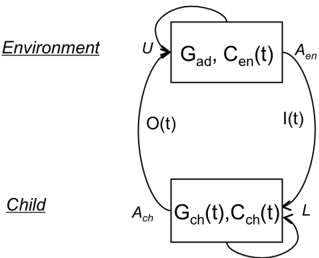
The image displays a technical block diagram illustrating a closed-loop interaction system between two primary entities: an "Environment" and a "Child." The diagram uses standard control theory or systems modeling notation, featuring blocks, directed arrows representing signals or influences, and mathematical symbols denoting functions or parameters. The overall structure suggests a dynamic, time-dependent feedback system.
### Components/Axes
The diagram is composed of the following labeled elements:
1. **Main Blocks (Entities):**
* **Top Block:** Labeled **"Environment"** (underlined). Inside the block are the symbols: **G_ad, C_en(t)**.
* **Bottom Block:** Labeled **"Child"** (underlined). Inside the block are the symbols: **G_ch(t), C_ch(t)**.
2. **Signals/Connections (Arrows):**
* **U:** An arrow pointing **into** the left side of the "Environment" block.
* **A_en:** An arrow pointing **from** the right side of the "Environment" block **to** the right side of the "Child" block.
* **I(t):** An arrow pointing **from** the right side of the "Child" block **to** the right side of the "Environment" block.
* **O(t):** An arrow pointing **from** the left side of the "Child" block **to** the left side of the "Environment" block.
* **A_ch:** An arrow pointing **into** the left side of the "Child" block.
* **L:** A self-loop arrow on the right side of the "Child" block, pointing from the block back to itself.
### Detailed Analysis
* **Spatial Layout:** The "Environment" block is positioned in the upper half of the diagram, and the "Child" block is in the lower half. The primary interaction flow forms a clockwise loop: Environment -> A_en -> Child -> I(t) -> Environment. A secondary counter-clockwise flow exists: Child -> O(t) -> Environment.
* **Symbol Transcription:**
* `G_ad`: Likely a gain or function related to adaptation within the Environment.
* `C_en(t)`: A time-dependent function or parameter of the Environment.
* `G_ch(t)`: A time-dependent gain or function of the Child.
* `C_ch(t)`: A time-dependent function or parameter of the Child.
* `U`, `A_en`, `A_ch`, `L`: Represent external inputs or internal signals/parameters.
* `I(t)`, `O(t)`: Represent time-dependent input and output signals exchanged between the entities.
### Key Observations
* The system is explicitly **time-dependent**, as indicated by the `(t)` notation on four of the internal symbols (`C_en(t)`, `G_ch(t)`, `C_ch(t)`) and two of the signals (`I(t)`, `O(t)`).
* The "Child" block has a **self-loop (L)**, suggesting an internal feedback or learning mechanism independent of the Environment.
* There are **two distinct pathways** connecting the blocks: one on the right (`A_en` and `I(t)`) and one on the left (`O(t)`). This may represent different types of interaction (e.g., action and observation).
* The diagram is **abstract and symbolic**; it contains no numerical data, specific values, or empirical trends. It is a conceptual model.
### Interpretation
This diagram models a **dynamic, adaptive interaction** between an external "Environment" and an internal "Child" agent. The structure is characteristic of models in fields like adaptive control theory, cognitive science, or machine learning (e.g., reinforcement learning).
* **What it suggests:** The "Child" is not passive. It receives inputs (`A_en`, `A_ch`) and an internal signal (`L`), processes them through its own time-varying functions (`G_ch(t)`, `C_ch(t)`), and generates outputs (`I(t)`, `O(t)`) that influence the "Environment." The "Environment" similarly has its own adaptive component (`G_ad`) and state (`C_en(t)`), and is influenced by the Child's outputs and an external input `U`.
* **Relationships:** The system is a **closed-loop feedback system**. The Child's state and outputs affect the Environment, which in turn affects the Child. The presence of `G_ad` and `G_ch(t)` implies both entities can adapt or change their behavior over time based on the interaction.
* **Notable Anomalies/Patterns:** The asymmetry is notable. The Environment has a fixed adaptive gain (`G_ad`), while the Child's gain (`G_ch(t)`) is explicitly time-varying. This could imply the Child is the primary learning or evolving agent within the system. The model does not specify the exact mathematical relationships, leaving it as a general framework for analysis.