# Technical Document Extraction: Diagram Analysis
## Overview
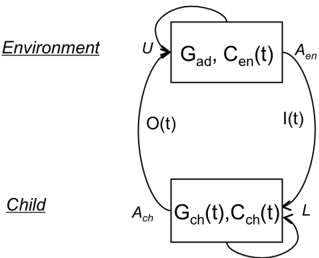
The diagram illustrates a dynamic interaction system between two components: **Environment** and **Child**. It depicts bidirectional flows of variables and processes, with feedback loops and temporal dependencies. Below is a detailed breakdown of components, labels, and relationships.
---
## Component Breakdown
### 1. **Environment**
- **Box Label**: `Environment` (top-left corner).
- **Variables**:
- `G_ad`: Likely represents an "adaptive gain" or environmental parameter.
- `C_en(t)`: Environmental context or condition at time `t`.
- `A_en`: Environmental action or output.
- **Arrows**:
- **Input**: `U` (external input to the environment).
- **Output**: `A_en` (action from the environment).
- **Feedback**: `O(t)` (output feedback to the child).
### 2. **Child**
- **Box Label**: `Child` (bottom-left corner).
- **Variables**:
- `G_ch(t)`: Child's gain or processing parameter at time `t`.
- `C_ch(t)`: Child's context or state at time `t`.
- `A_ch`: Child's action or output.
- **Arrows**:
- **Input**: `A_en` (action from the environment).
- **Output**: `A_ch` (action from the child).
- **Feedback**: `L` (loss or error signal).
- **Internal Feedback**: `I(t)` (internal state or input at time `t`).
---
## Flow and Relationships
1. **Environment → Child**:
- `A_en` (environmental action) is transmitted to the child as input.
- The child processes this input using `G_ch(t)` and `C_ch(t)` to generate `A_ch`.
2. **Child → Environment**:
- `A_ch` (child's action) is sent back to the environment as feedback.
- The environment uses `G_ad` and `C_en(t)` to adjust its behavior (`A_en`).
3. **Feedback Loops**:
- **Environmental Feedback**: `O(t)` (output from the environment) loops back to the child.
- **Loss Signal**: `L` (loss/error) is generated by the child and fed back into its internal state (`G_ch(t), C_ch(t)`).
- **Internal Feedback**: `I(t)` (internal input) influences the child's processing.
---
## Key Observations
- **Temporal Dependency**: Variables like `C_en(t)`, `G_ch(t)`, and `I(t)` explicitly depend on time `t`, indicating dynamic system behavior.
- **Bidirectional Interaction**: The system forms a closed loop with mutual influence between the environment and child.
- **Adaptive Mechanism**: `G_ad` (environment) and `G_ch(t)` (child) suggest adaptive or learning processes.
---
## Diagram Structure
- **Regions**:
- **Header**: Labels `Environment` and `Child` (left side).
- **Main Chart**: Two interconnected boxes with variables and arrows.
- **Footer**: No explicit footer; diagram ends at the bottom.
- **Spatial Grounding**:
- All labels and arrows are positioned relative to their respective components (e.g., `U` points to `G_ad`, `L` points to `G_ch(t)`).
---
## Notes
- No numerical data, charts, or tables are present. The diagram focuses on conceptual relationships and system architecture.
- All text is in English; no additional languages detected.
---
## Conclusion
This diagram models a closed-loop adaptive system where the environment and child dynamically interact through feedback mechanisms. Key variables include environmental context (`C_en(t)`), child processing (`G_ch(t)`), and error signals (`L`), with time-dependent behavior emphasized through `t`-indexed parameters.