## Diagram: Multi-Agent Communication Network
### Overview
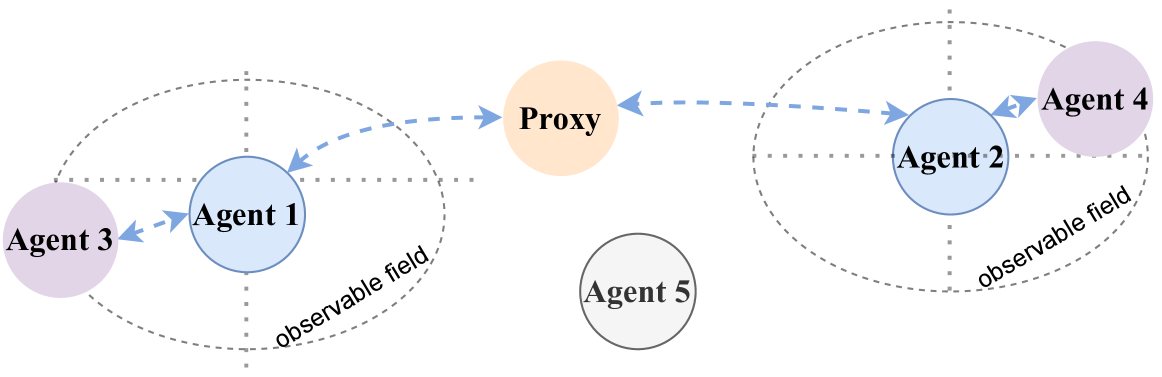
The image is a schematic diagram illustrating a network of five agents (Agent 1 through Agent 5) and a central "Proxy" node. It depicts communication pathways and observational boundaries within a multi-agent system. The diagram uses color-coded circles for entities and dashed arrows to represent directional communication links.
### Components/Axes
**Entities (Circles):**
* **Agent 1:** Light blue circle, positioned in the left-center region.
* **Agent 2:** Light blue circle, positioned in the right-center region.
* **Agent 3:** Light purple circle, positioned to the left of Agent 1.
* **Agent 4:** Light purple circle, positioned to the right of Agent 2.
* **Agent 5:** White circle with a black outline, positioned below and between the Proxy and Agent 2.
* **Proxy:** Light orange circle, positioned centrally between the two main agent clusters.
**Communication Links (Dashed Blue Arrows):**
* A bidirectional arrow connects **Agent 3** and **Agent 1**.
* A unidirectional arrow points from **Agent 1** to the **Proxy**.
* A unidirectional arrow points from the **Proxy** to **Agent 2**.
* A bidirectional arrow connects **Agent 2** and **Agent 4**.
**Observable Fields (Dashed Ellipses):**
* A large dashed ellipse encircles **Agent 1** and **Agent 3**. The label "observable field" is written along its lower-right curve.
* A second large dashed ellipse encircles **Agent 2** and **Agent 4**. The label "observable field" is written along its lower-right curve.
**Background Grid:**
* Faint, dashed gray lines form a crosshair or grid pattern behind the elements, suggesting a coordinate system or spatial reference frame.
### Detailed Analysis
**Spatial Layout & Relationships:**
* The diagram is organized into two primary clusters separated by the central Proxy.
* **Left Cluster:** Contains Agent 3 (leftmost) and Agent 1, enclosed within an "observable field." Agent 3 communicates directly with Agent 1.
* **Central Mediator:** The Proxy sits between the two clusters. It receives information from Agent 1 (left cluster) and sends information to Agent 2 (right cluster).
* **Right Cluster:** Contains Agent 2 and Agent 4 (rightmost), enclosed within a separate "observable field." Agent 2 communicates directly with Agent 4.
* **Isolated Agent:** Agent 5 is positioned outside both observable fields and has no depicted communication links, suggesting it is either inactive, in a different scope, or an observer.
**Flow Direction:**
The communication flow is asymmetric. Information appears to originate in the left cluster (Agent 3 -> Agent 1), pass through the Proxy for mediation or translation, and then be disseminated to the right cluster (Agent 2 -> Agent 4). The bidirectional links within each cluster suggest local, reciprocal communication.
### Key Observations
1. **Proxy as a Bridge:** The Proxy is the sole connection point between the two agent clusters, indicating a hub-and-spoke or mediated communication architecture.
2. **Separation of Observability:** The two "observable field" ellipses explicitly define the perceptual or operational boundaries for each cluster. Agents within a field can likely perceive each other directly.
3. **Color Coding:** Agents are color-coded by role or type: light blue for primary cluster nodes (Agent 1, Agent 2), light purple for peripheral nodes (Agent 3, Agent 4), and white for the isolated node (Agent 5). The Proxy has a unique color (light orange).
4. **Agent 5's Isolation:** Agent 5's lack of connections and placement outside the defined fields is a significant anomaly, implying it is not integrated into the current communication process.
### Interpretation
This diagram models a **decentralized yet partitioned multi-agent system**. The key insight is the use of a **Proxy to facilitate controlled, indirect communication between two otherwise isolated groups of agents**. Each group operates within its own "observable field," meaning agents within a group have direct awareness of each other, but cross-group awareness is mediated.
The structure suggests a design for scalability, security, or specialization. For example:
* The Proxy could be a gateway translating protocols or filtering information between different sub-networks.
* The observable fields might represent physical proximity, network subnets, or task-specific domains.
* Agent 5's isolation could represent a monitoring agent, a new agent not yet integrated, or a node that has lost connectivity.
The overall system prioritizes modularity and controlled interaction over fully connected, flat communication. The flow from left to right (Agent 3 -> Agent 1 -> Proxy -> Agent 2 -> Agent 4) may indicate a specific data pipeline or command chain within this snapshot of the system's operation.