\n
## Diagram: Agent-Proxy System Architecture
### Overview
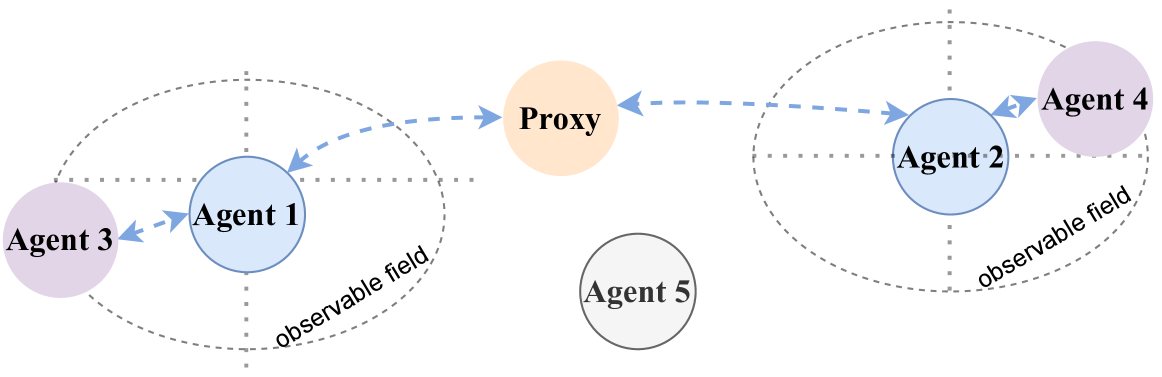
The image depicts a diagram illustrating an agent-proxy system architecture. It shows five agents (Agent 1 through Agent 5) interacting with a central "Proxy" component. The agents are represented as circles, and the interactions are shown as dashed arrows. Each agent, except Agent 5, is contained within a dotted circle labeled "observable field".
### Components/Axes
The diagram consists of the following components:
* **Agents:** Agent 1, Agent 2, Agent 3, Agent 4, Agent 5.
* **Proxy:** A central component facilitating interaction between agents.
* **Observable Field:** Dotted circles encompassing Agents 1, 2, 3, and 4.
* **Arrows:** Dashed arrows indicating communication or interaction pathways.
### Detailed Analysis or Content Details
The diagram shows the following interactions:
* **Agent 1** and **Agent 3** communicate bidirectionally, indicated by two-headed dashed arrows.
* **Agent 1** communicates with the **Proxy** via a dashed arrow.
* **Agent 2** and **Agent 4** communicate bidirectionally, indicated by two-headed dashed arrows.
* **Agent 2** communicates with the **Proxy** via a dashed arrow.
* **Agent 5** has no direct connections to other agents or the Proxy. It is isolated.
* The text "observable field" appears twice, once near Agents 1 and 3, and once near Agents 2 and 4.
The agents are visually differentiated by color:
* Agent 1 & Agent 2: Light Blue
* Agent 3 & Agent 4: Light Purple
* Agent 5: Gray
* Proxy: Peach/Light Orange
### Key Observations
* Agents 1 and 3, and Agents 2 and 4, form isolated pairs with bidirectional communication.
* The Proxy acts as a central hub, receiving information from Agents 1 and 2.
* Agent 5 is completely isolated and does not participate in the observed interactions.
* The "observable field" label suggests a limited scope of awareness or interaction for Agents 1, 2, 3, and 4.
### Interpretation
This diagram likely represents a distributed system where agents operate within defined observable fields and interact through a central proxy. The proxy could be responsible for mediating communication, enforcing security policies, or providing a common interface for the agents. The isolation of Agent 5 suggests it may have a different role or operate outside the main system. The bidirectional communication between Agent pairs indicates a potential for direct collaboration or data exchange. The observable field concept implies that agents are only aware of or can interact with entities within their designated field. This architecture could be used in various applications, such as multi-agent systems, sensor networks, or distributed control systems. The diagram does not provide quantitative data, but rather a qualitative representation of the system's structure and relationships.