# Technical Flowchart Analysis
## Overview
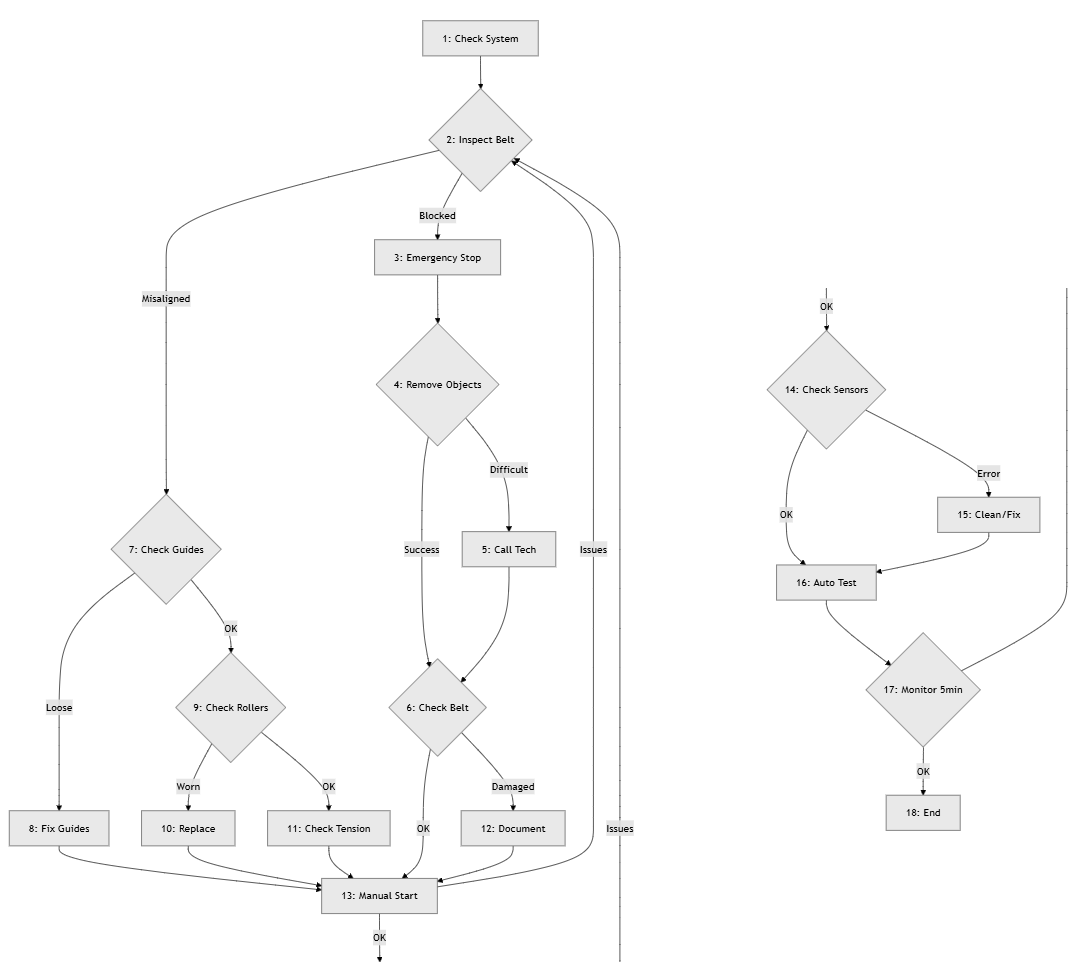
The image depicts a two-section flowchart for a mechanical/system inspection and maintenance process. The left section outlines a primary workflow, while the right section details a secondary sensor-related process. Both sections converge at step 18: End.
---
## Left Section: Primary Workflow
### Step 1: Check System
- **Action**: Initial system verification
- **Output**: Proceeds to Step 2
### Step 2: Inspect Belt
- **Decision Point**:
- **Blocked**: Proceeds to Step 3
- **Misaligned**: Proceeds to Step 7
- **Other Issues**: Proceeds to Step 14 (right section)
### Step 3: Emergency Stop
- **Action**: Immediate system halt
- **Output**: Proceeds to Step 4
### Step 4: Remove Objects
- **Decision Point**:
- **Difficult**: Proceeds to Step 5
- **Success**: Proceeds to Step 6
### Step 5: Call Tech
- **Action**: Escalate to technical support
- **Output**: Returns to Step 13
### Step 6: Check Belt
- **Decision Point**:
- **OK**: Proceeds to Step 11
- **Damaged**: Proceeds to Step 12
### Step 7: Check Guides
- **Decision Point**:
- **Loose**: Proceeds to Step 8
- **OK**: Proceeds to Step 9
### Step 8: Fix Guides
- **Action**: Repair guide components
- **Output**: Returns to Step 13
### Step 9: Check Rollers
- **Decision Point**:
- **Worn**: Proceeds to Step 10
- **OK**: Proceeds to Step 11
### Step 10: Replace
- **Action**: Replace worn rollers
- **Output**: Returns to Step 13
### Step 11: Check Tension
- **Decision Point**:
- **OK**: Proceeds to Step 13
- **Issues**: Proceeds to Step 12
### Step 12: Document
- **Action**: Record maintenance actions
- **Output**: Returns to Step 13
### Step 13: Manual Start
- **Decision Point**:
- **OK**: Proceeds to Step 18
- **Issues**: Returns to Step 1
### Step 18: End
- **Action**: Process completion
---
## Right Section: Sensor-Related Process
### Step 14: Check Sensors
- **Decision Point**:
- **OK**: Proceeds to Step 16
- **Error**: Proceeds to Step 15
### Step 15: Clean/Fix
- **Action**: Resolve sensor errors
- **Output**: Returns to Step 16
### Step 16: Auto Test
- **Action**: Automated system testing
- **Output**: Proceeds to Step 17
### Step 17: Monitor 5min
- **Action**: 5-minute system observation
- **Output**: Proceeds to Step 18
### Step 18: End
- **Action**: Process completion
---
## Key Observations
1. **Cyclical Nature**: Steps 13 and 18 form a loop for iterative troubleshooting.
2. **Parallel Paths**: The left and right sections represent independent but interconnected workflows.
3. **Decision Logic**: All diamond-shaped nodes represent conditional checks with binary outcomes (OK/Non-OK).
4. **Escalation Path**: Technical intervention (Step 5) and sensor error resolution (Step 15) feed back into the main process.
---
## Critical Data Points
- **Primary Workflow Steps**: 1–13, 18
- **Secondary Workflow Steps**: 14–18
- **Total Unique Steps**: 18
- **Decision Points**: 7 (Steps 2, 4, 6, 7, 9, 11, 14)
- **Action Steps**: 11 (Steps 3, 5, 8, 10, 12, 15, 16, 17)
- **Final Convergence**: All paths terminate at Step 18
---
## Process Flow Summary
```
Left Section:
1 → 2 → [Blocked→3→4→[Difficult→5→13, Success→6→[OK→11→13, Damaged→12→13]]
→ [Misaligned→7→[Loose→8→13, OK→9→11→13]]
→ [Other Issues→14→[OK→16→17→18, Error→15→16→17→18]]
Right Section:
14 → [OK→16→17→18, Error→15→16→17→18]
```
---
## Technical Implications
1. **Preventive Maintenance**: Regular belt and guide inspections (Steps 2, 7) reduce emergency stops.
2. **Sensor Reliability**: Sensor errors (Step 14) require immediate correction before automated testing.
3. **Documentation**: Step 12 ensures traceability of maintenance actions.
4. **System Resilience**: Multiple feedback loops (Steps 13, 15) enable continuous operation.