## Diagram: Multi-Agent System Paradigms
### Overview
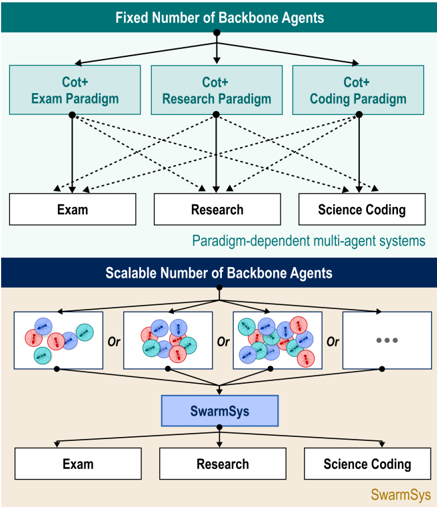
The image presents a diagram illustrating two approaches to multi-agent systems: one with a fixed number of backbone agents and another with a scalable number of backbone agents. Both approaches are linked to three paradigms: Exam, Research, and Science Coding. The diagram outlines the flow and relationships between these components.
### Components/Axes
* **Top Section Title:** Fixed Number of Backbone Agents
* **Top Level Paradigms (light blue boxes):**
* Cot+ Exam Paradigm
* Cot+ Research Paradigm
* Cot+ Coding Paradigm
* **Middle Level Paradigms (white boxes):**
* Exam
* Research
* Science Coding
* **Middle Section Title:** Paradigm-dependent multi-agent systems
* **Bottom Section Title:** Scalable Number of Backbone Agents
* **Agent Representations:** Three boxes containing graphical representations of agents (red and blue circles with arrows) and a fourth box with an ellipsis (...). The boxes are connected by the word "Or".
* **SwarmSys (light blue box):** Represents the SwarmSys system.
* **Bottom Level Paradigms (white boxes):**
* Exam
* Research
* Science Coding
* **Bottom Right Label:** SwarmSys
### Detailed Analysis
* **Fixed Number of Backbone Agents:**
* The "Fixed Number of Backbone Agents" section starts with a single node that branches out to three paradigms: "Cot+ Exam Paradigm", "Cot+ Research Paradigm", and "Cot+ Coding Paradigm".
* Each of these paradigms is connected to all three of the "Exam", "Research", and "Science Coding" paradigms via dashed lines.
* Each of the "Cot+" paradigms is also connected to its corresponding "Exam", "Research", or "Science Coding" paradigm via a solid line.
* **Scalable Number of Backbone Agents:**
* The "Scalable Number of Backbone Agents" section starts with a single node that branches out to four boxes. The first three boxes contain graphical representations of agents, and the fourth box contains an ellipsis (...).
* These boxes are connected to the "SwarmSys" node.
* The "SwarmSys" node is connected to the "Exam", "Research", and "Science Coding" paradigms.
### Key Observations
* The diagram highlights two distinct approaches to multi-agent systems: one with a fixed number of backbone agents and another with a scalable number of backbone agents.
* The "Fixed Number of Backbone Agents" approach uses "Cot+" paradigms, while the "Scalable Number of Backbone Agents" approach uses "SwarmSys".
* Both approaches ultimately connect to the same three paradigms: "Exam", "Research", and "Science Coding".
* The dashed lines in the "Fixed Number of Backbone Agents" section suggest a more complex relationship between the "Cot+" paradigms and the "Exam", "Research", and "Science Coding" paradigms.
### Interpretation
The diagram illustrates two different architectural approaches to designing multi-agent systems. The "Fixed Number of Backbone Agents" approach seems to suggest a more traditional, pre-defined structure where the "Cot+" paradigms act as high-level strategies that influence the lower-level "Exam", "Research", and "Science Coding" tasks. The dashed lines indicate a complex interplay, possibly representing different strategies being applied to different tasks.
The "Scalable Number of Backbone Agents" approach, on the other hand, suggests a more dynamic and adaptive system where the number of agents can change based on the needs of the task. The "SwarmSys" system likely represents a swarm intelligence approach where agents collaborate to solve problems. The ellipsis (...) suggests that the number of agents can scale indefinitely.
The fact that both approaches ultimately connect to the same three paradigms ("Exam", "Research", and "Science Coding") suggests that these paradigms represent the core tasks or applications that the multi-agent systems are designed to address. The choice of architecture (fixed vs. scalable) likely depends on the specific requirements of the application.