\n
## Diagram: Multi-Agent System Architectures
### Overview
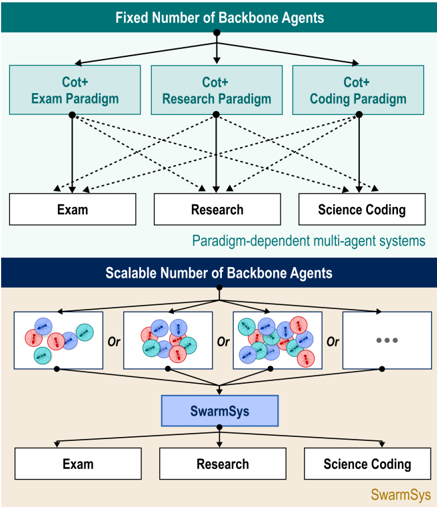
The image presents a comparative diagram illustrating two different architectures for multi-agent systems: one with a fixed number of backbone agents and another with a scalable number. The diagram visually contrasts the approaches to paradigm-dependent multi-agent systems.
### Components/Axes
The diagram is divided into two main sections, visually separated by color: a light blue section representing the "Fixed Number of Backbone Agents" architecture and a light tan section representing the "Scalable Number of Backbone Agents" architecture.
**Fixed Number Section:**
* **Title:** "Fixed Number of Backbone Agents" (top-center)
* **Input:** A single downward-pointing arrow labeled implicitly as the initial input.
* **Intermediate Nodes:** Three rectangular boxes labeled:
* "Cot+ Exam Paradigm"
* "Cot+ Research Paradigm"
* "Cot+ Coding Paradigm"
* **Output Nodes:** Three rectangular boxes labeled:
* "Exam"
* "Research"
* "Science Coding"
* **Connections:** Dotted arrows connecting each of the intermediate nodes to each of the output nodes.
* **Label:** "Paradigm-dependent multi-agent systems" (below the output nodes)
**Scalable Number Section:**
* **Title:** "Scalable Number of Backbone Agents" (top-center)
* **Input:** Multiple sets of circular nodes (representing agents) connected by "Or" labels. The number of sets is indicated by "...".
* **Intermediate Node:** A rectangular box labeled "SwarmSys".
* **Output Nodes:** Three rectangular boxes labeled:
* "Exam"
* "Research"
* "Science Coding"
* **Connections:** Arrows connecting the "SwarmSys" node to each of the output nodes.
* **Label:** "SwarmSys" (below the output nodes)
Within the scalable section, the agent sets contain:
* Red circular nodes
* Blue circular nodes
* Teal circular nodes
### Detailed Analysis or Content Details
**Fixed Number Architecture:**
This architecture features a fixed set of three "Cot+" paradigms (Exam, Research, and Coding). Each paradigm acts as an intermediary, with connections to all three output tasks (Exam, Research, and Science Coding). The dotted lines suggest a non-exclusive relationship – each paradigm can contribute to all tasks.
**Scalable Number Architecture:**
This architecture utilizes a scalable number of agents, grouped into sets connected by "Or" operators. These agent sets feed into a central "SwarmSys" node, which then distributes the workload to the three output tasks (Exam, Research, and Science Coding). The "..." indicates that the number of agent sets can be increased indefinitely. The agent sets contain a mix of red, blue, and teal agents.
### Key Observations
* The fixed architecture relies on a predefined set of paradigms, while the scalable architecture leverages a dynamic swarm of agents.
* The scalable architecture appears more flexible due to its ability to accommodate an increasing number of agents.
* The dotted lines in the fixed architecture suggest a more complex, potentially overlapping relationship between paradigms and tasks.
* The scalable architecture uses a centralized "SwarmSys" node to manage the distribution of tasks.
### Interpretation
The diagram illustrates two contrasting approaches to building multi-agent systems. The fixed architecture represents a more traditional, rule-based approach where a limited number of predefined paradigms are used to solve different tasks. The scalable architecture, on the other hand, represents a more modern, swarm-intelligence-based approach where a large number of agents collaborate to solve tasks.
The choice between these two architectures depends on the specific requirements of the application. If the tasks are well-defined and the relationships between paradigms are clear, the fixed architecture may be sufficient. However, if the tasks are complex and the relationships between paradigms are uncertain, the scalable architecture may be more appropriate.
The use of "Cot+" suggests a "Chain of Thought" prompting approach, likely within a large language model context. The diagram highlights how this prompting strategy can be applied in different paradigms (Exam, Research, Coding) and how a scalable system can leverage a swarm of agents to enhance performance. The "Or" operator in the scalable architecture suggests that different agent configurations can be explored to optimize task performance. The color-coding of the agents within the scalable architecture might represent different roles or specializations within the swarm.