## Diagram: Multi-Agent System Paradigms Comparison
### Overview
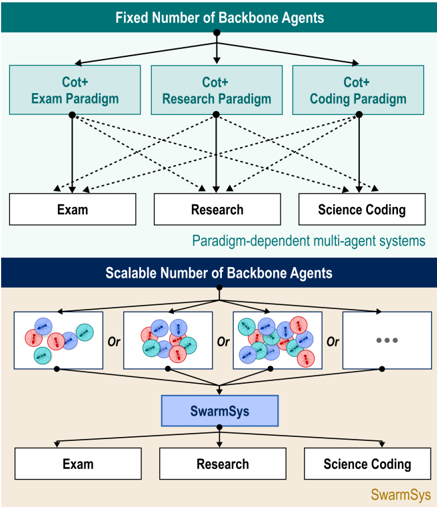
The image is a technical diagram comparing two architectural approaches for multi-agent systems. The top section illustrates a "Fixed Number of Backbone Agents" paradigm, while the bottom section presents a "Scalable Number of Backbone Agents" paradigm, specifically highlighting a system named "SwarmSys." The diagram uses a flowchart style with boxes, arrows, and labels to show the relationship between agent paradigms and task domains.
### Components/Axes
The diagram is divided into two distinct horizontal sections, each with a title bar.
**Top Section: Fixed Number of Backbone Agents**
* **Title Bar:** "Fixed Number of Backbone Agents" (white text on a teal background).
* **Paradigm Layer:** Three light blue boxes, each representing a specific paradigm:
1. "Cot+ Exam Paradigm" (left)
2. "Cot+ Research Paradigm" (center)
3. "Cot+ Coding Paradigm" (right)
* **Task Layer:** Three white boxes representing task domains:
1. "Exam" (left)
2. "Research" (center)
3. "Science Coding" (right)
* **Connections:** Dotted black lines connect each paradigm box to all three task boxes, indicating a many-to-many relationship where any paradigm can be applied to any task.
* **Legend/Label:** Below the task boxes, centered text reads: "Paradigm-dependent multi-agent systems" (in teal).
**Bottom Section: Scalable Number of Backbone Agents**
* **Title Bar:** "Scalable Number of Backbone Agents" (white text on a dark blue background).
* **Agent Cluster Layer:** Four boxes depicting possible configurations of agent swarms. The first three contain illustrations of interconnected nodes (circles) in red, blue, and green, labeled with small text (e.g., "Cot", "Tool", "Ref"). They are separated by the word "Or". The fourth box contains an ellipsis ("..."), indicating other possible configurations.
* **System Box:** A single blue box labeled "SwarmSys" is positioned below the agent cluster layer.
* **Task Layer:** The same three white task boxes from the top section are repeated: "Exam", "Research", "Science Coding".
* **Connections:** Solid black arrows flow from the agent cluster layer down to the "SwarmSys" box. From "SwarmSys", three solid black arrows point down to each of the three task boxes.
* **Legend/Label:** In the bottom-right corner, the text "SwarmSys" appears in orange.
### Detailed Analysis
The diagram presents a clear visual contrast between two system architectures.
**Top Section (Fixed Paradigm):**
* **Structure:** Hierarchical and rigid. A fixed set of three specialized paradigms (Exam, Research, Coding) is defined upfront.
* **Flow:** The dotted lines suggest a flexible but predetermined assignment. The system selects one of the fixed paradigms to apply to a given task (Exam, Research, or Science Coding). The paradigm is dependent on the task type.
* **Visual Trend:** The connections form a dense, crisscrossing web, emphasizing the combinatorial but fixed nature of the approach.
**Bottom Section (Scalable SwarmSys):**
* **Structure:** Dynamic and centralized. Instead of predefined paradigms, the system starts with a variable, scalable collection of backbone agents (represented by the clusters).
* **Flow:** These agents are organized or managed by a central system called "SwarmSys." SwarmSys then directs the collective capability towards the same three task domains. The "Or" connectors between agent clusters imply that the composition and number of agents can change.
* **Visual Trend:** The flow is linear and funnel-like: from many possible agent configurations -> to one managing system -> to multiple tasks. This suggests a unified, adaptive system that can reconfigure its agent pool to handle different tasks.
### Key Observations
1. **Task Consistency:** Both architectures are designed to address the exact same three task domains: "Exam," "Research," and "Science Coding." This provides a direct basis for comparison.
2. **Paradigm vs. System:** The top approach is defined by its *paradigms* (methodologies like "Cot+ Exam"). The bottom approach is defined by a *system name* ("SwarmSys"), implying the paradigm or strategy may be emergent or managed internally.
3. **Connection Semantics:** The use of dotted lines (top) versus solid arrows (bottom) is significant. Dotted lines often indicate a logical or potential connection, while solid arrows indicate a direct flow of control or data. This visually reinforces the fixed vs. scalable, assignment vs. management dichotomy.
4. **Scalability Representation:** Scalability is depicted not just by the title but by the "Or" sequence and the ellipsis box, explicitly showing that the agent pool is not fixed to three types but can vary in composition and number.
### Interpretation
This diagram argues for the advantages of a scalable, swarm-based multi-agent system (SwarmSys) over a traditional paradigm-dependent approach.
The **fixed paradigm model** is presented as a library of specialized tools. You pick the "Exam" tool for an exam task, the "Research" tool for a research task, etc. Its weakness, implied by the rigid structure, is a lack of flexibility; it requires pre-defining and maintaining separate paradigms for each domain, and may not adapt well to novel tasks outside these three.
The **SwarmSys model** proposes a more holistic and adaptive solution. Instead of pre-packaged paradigms, it maintains a dynamic pool of versatile backbone agents. The central "SwarmSys" layer acts as an orchestrator or meta-system that can dynamically configure these agents into an effective team for the task at hand, whether it's an exam, research, or science coding problem. The key innovation suggested is **unification and scalability**: one system (SwarmSys) manages a variable agent workforce to tackle multiple problem domains, potentially offering greater robustness, adaptability, and efficiency than maintaining three separate, fixed-paradigm systems. The diagram positions SwarmSys as a more advanced and flexible architectural evolution.