\n
## Text Block: AI Thought Process
### Overview
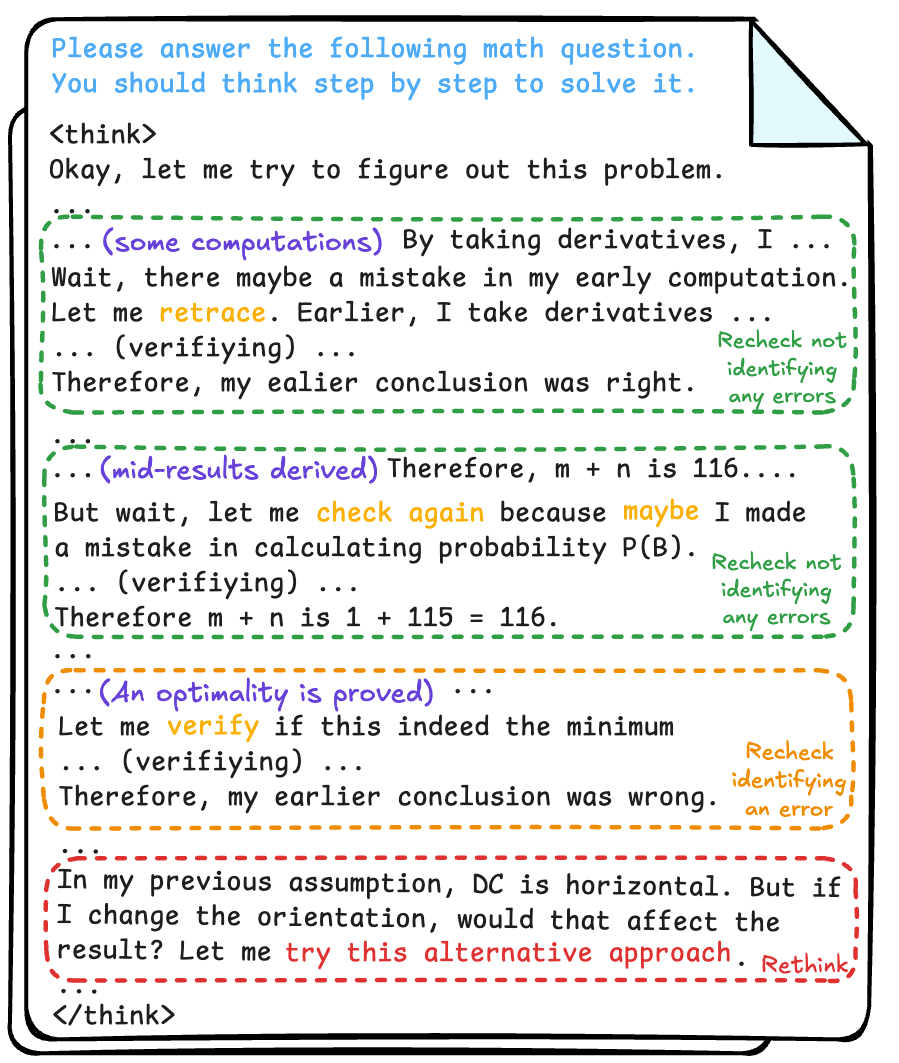
The image presents a transcript of an AI's internal thought process while attempting to solve a math problem. The text is formatted as a conversation within `<think>` tags, and includes annotations indicating the AI's self-assessment of its reasoning ("Recheck not identifying any errors", "Rethink"). The text is contained within dashed-line "speech bubbles".
### Components/Axes
There are no axes or charts in this image. The primary components are the text blocks representing the AI's thoughts, and the annotations.
### Detailed Analysis or Content Details
The transcript details the AI's step-by-step reasoning, including:
1. **Initial Attempt:** "Okay, let me try to figure out this problem... (some computations) By taking derivatives, I... Wait, there maybe a mistake in my early computation. Let me retrace. Earlier, I take derivatives..."
2. **Verification 1:** "...(verifying)... Therefore, my earlier conclusion was right." - accompanied by the annotation "Recheck not identifying any errors".
3. **Mid-Results:** "...(mid-results derived) Therefore, m + n is 116..."
4. **Second Check:** "But wait, let me check again because maybe I made a mistake in calculating probability P(B). ... (verifying)... Therefore m + n is 1 + 115 = 116." - accompanied by the annotation "Recheck not identifying any errors".
5. **Optimality Check:** "...(Can optimality is proved) Let me verify if this indeed the minimum... (verifying)... Therefore, my earlier conclusion was wrong." - accompanied by the annotation "Recheck identifying an error".
6. **Re-evaluation:** "In my previous assumption, DC is horizontal. But if I change the orientation, would that affect the result? Let me try this alternative approach. Rethink." - accompanied by the annotation "Rethink".
### Key Observations
The AI demonstrates a process of hypothesis, calculation, verification, and revision. It explicitly acknowledges potential errors and attempts to correct them. The annotations provide insight into the AI's confidence level in its reasoning at different stages. The AI initially believes its conclusion is correct, then revises its assessment after further verification.
### Interpretation
This transcript illustrates a rudimentary form of problem-solving in an AI. It highlights the importance of iterative refinement and self-assessment in achieving accurate results. The AI's internal monologue reveals a process similar to human reasoning, including acknowledging uncertainty and exploring alternative approaches. The annotations are particularly interesting, as they suggest a level of meta-cognition – the AI is not only solving the problem but also evaluating its own thought process. The "Rethink" annotation suggests the AI is capable of recognizing the need for a fundamentally different strategy. The fact that the AI initially concludes something is correct, then finds an error, and then revises its conclusion is a key demonstration of its problem-solving ability. The transcript does not provide the actual math problem or the final solution, but it offers valuable insight into the AI's reasoning process.