## Screenshot: Math Problem-Solving Process
### Overview
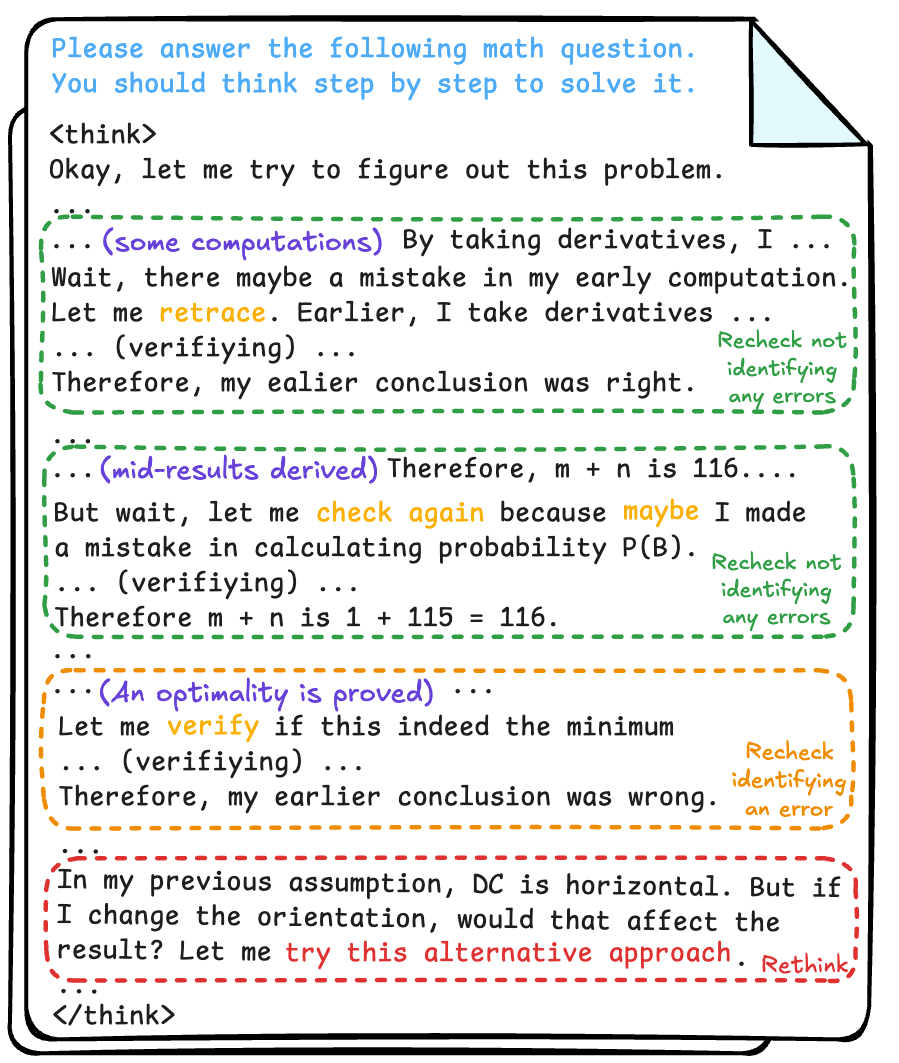
The image depicts a chat interface where a user is solving a math problem step-by-step. The conversation includes color-coded annotations (green, orange, red) to indicate verification steps, error checks, and rethinking phases.
### Components/Axes
- **Header**: Blue text instructing the user to "think step by step."
- **Chat Bubbles**:
- **Green Dashed Bubble**: Contains initial computations, retractions, and verification steps.
- **Orange Dashed Bubble**: Focuses on verifying optimality and identifying errors.
- **Red Dashed Bubble**: Highlights rethinking assumptions and alternative approaches.
- **Annotations**:
- Green: "Recheck not identifying any errors"
- Orange: "Recheck identifying an error"
- Red: "Rethink"
### Detailed Analysis
1. **Initial Computations (Green Bubble)**:
- The user begins by taking derivatives and verifying calculations.
- Annotation: "Recheck not identifying any errors" (green).
- Conclusion: "m + n is 116."
2. **Mid-Results Verification (Green Bubble)**:
- The user rechecks probability calculations (P(B)) and confirms "m + n = 116."
- Annotation: "Recheck not identifying any errors" (green).
3. **Optimality Proof (Orange Bubble)**:
- The user attempts to verify if the minimum is proven but concludes the earlier result was wrong.
- Annotation: "Recheck identifying an error" (orange).
4. **Rethinking Assumptions (Red Bubble)**:
- The user questions the orientation of "DC" (horizontal vs. alternative) and proposes a new approach.
- Annotation: "Rethink" (red).
### Key Observations
- The user iteratively revises their approach, starting with confidence in "m + n = 116" but later doubting it due to potential errors in probability calculations.
- The shift from green to orange to red annotations reflects increasing uncertainty and the need for deeper re-evaluation.
- The final red bubble indicates a fundamental reassessment of initial assumptions.
### Interpretation
The conversation illustrates a dynamic problem-solving process where the user:
1. **Validates computations** (green) but remains open to errors.
2. **Identifies contradictions** (orange) when optimality is challenged.
3. **Reevaluates foundational assumptions** (red) to propose an alternative method.
This reflects a Peircean investigative approach: hypothesizing, testing, and refining ideas through iterative doubt and verification. The color-coded annotations serve as a visual metaphor for the scientific method, emphasizing the importance of skepticism and adaptability in technical reasoning.