## Diagram: Impact of Meaningless Tokens on LLM Processing
### Overview
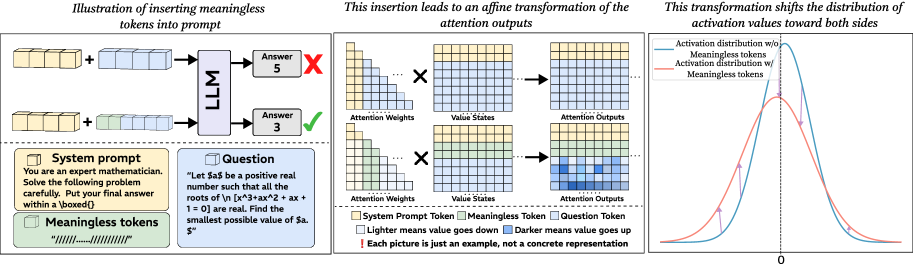
The image illustrates how inserting meaningless tokens into a prompt affects a large language model's (LLM) processing, attention mechanisms, and activation distributions. It is divided into three sections:
1. **Prompt Insertion**: Shows a system prompt, question, and meaningless tokens.
2. **Attention Mechanism Transformation**: Visualizes changes in attention weights, value states, and outputs.
3. **Activation Distribution Shift**: Compares activation distributions with/without meaningless tokens.
---
### Components/Axes
#### Left Section (Prompt Insertion)
- **System Prompt**:
- Text: *"You are an expert mathematician. Solve the following problem carefully. Put your final answer within a \boxed{}."*
- **Question**:
- Text: *"Let $a$ be a positive real number such that all the roots of \\(n[x^3 + ax^2 + 1 = 0]\\) are real. Find the smallest possible value of $a$."*
- **Meaningless Tokens**:
- Represented as green boxes labeled `"/////....//////"`.
- **LLM Output**:
- Two answers:
- Incorrect: `5` (marked with red X).
- Correct: `3` (marked with green check).
#### Middle Section (Attention Mechanism)
- **Legend**:
- Yellow: System Prompt Token
- Green: Meaningless Token
- Blue: Question Token
- **Components**:
- **Attention Weights**: Heatmaps showing token interactions.
- **Value States**: Gridded representations of token values.
- **Attention Outputs**: Modified grids after token insertion.
- **Arrows**: Indicate transformations between components.
- **Note**: *"Each picture is just an example, not a concrete representation."*
#### Right Section (Activation Distribution)
- **Graph**:
- **X-axis**: Labeled `0` (activation value).
- **Y-axis**: Labeled `Activation distribution`.
- **Lines**:
- Blue: Activation distribution *without* meaningless tokens.
- Red: Activation distribution *with* meaningless tokens.
- **Legend**:
- Blue: *Without* tokens.
- Red: *With* tokens.
---
### Detailed Analysis
#### Left Section
- The system prompt instructs the LLM to solve a math problem involving real roots of a cubic equation.
- The question includes a LaTeX-formatted equation: \\(n[x^3 + ax^2 + 1 = 0]\\).
- Inserting meaningless tokens (green boxes) leads to an incorrect answer (`5` vs. correct `3`).
#### Middle Section
- **Attention Weights**:
- Yellow (system prompt) and green (meaningless tokens) tokens show lighter/darker shading, indicating value changes.
- **Value States**:
- Grids with blue shading represent darker value shifts.
- **Attention Outputs**:
- Modified grids show altered token interactions post-insertion.
#### Right Section
- **Graph Trends**:
- Blue line (no tokens) peaks sharply at `0`.
- Red line (with tokens) has a broader, bimodal distribution, peaking at `0` and `1`.
- **Key Insight**:
- Meaningless tokens shift activation values toward both extremes (`0` and `1`), suggesting increased model uncertainty or distraction.
---
### Key Observations
1. **Incorrect Answer**: Inserting meaningless tokens causes the LLM to output `5` instead of the correct `3`.
2. **Attention Shifts**:
- System prompt tokens (yellow) and question tokens (blue) dominate attention weights without tokens.
- With tokens, green meaningless tokens disrupt attention, altering value states.
3. **Activation Distribution**:
- Tokens introduce bimodality, indicating fragmented focus or noise in processing.
---
### Interpretation
- **Mechanism of Failure**:
Meaningless tokens disrupt the LLM's attention by introducing irrelevant tokens, causing the model to misallocate computational resources. This leads to incorrect answers and distorted activation distributions.
- **Attention Dynamics**:
The heatmaps suggest that meaningless tokens (green) interfere with the system prompt (yellow) and question (blue) tokens, reducing coherence in value states.
- **Activation Bimodality**:
The red line’s broader distribution implies that tokens force the model to consider conflicting or irrelevant information, reducing confidence in the correct answer.
- **Practical Implication**:
Inserting meaningless tokens could be a form of adversarial attack or prompt injection, degrading model performance by corrupting attention and activation patterns.
---
**Note**: All textual content (e.g., system prompt, question, labels) is transcribed verbatim. Colors in diagrams align with the legend (yellow/green/blue for tokens, blue/red for activation lines). No numerical data beyond axis labels and line trends is provided in the image.