# Technical Document: Question-Answering Methodologies with Language Models and Verifiers
## Diagram Overview
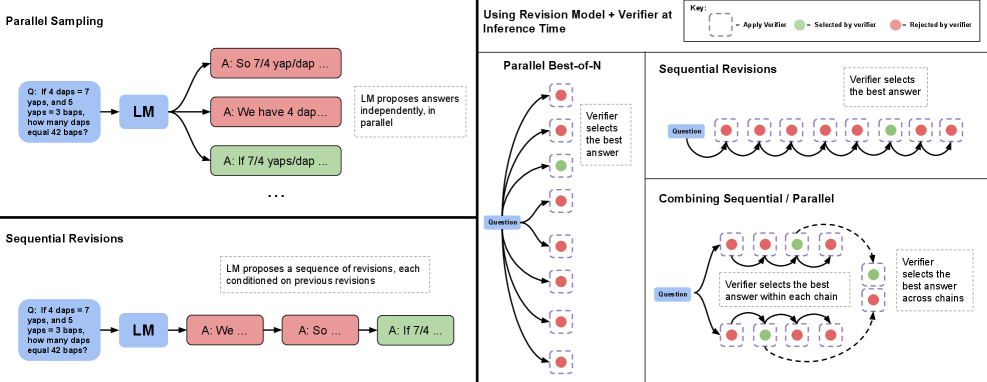
The image presents four methodologies for generating and refining answers to a math problem using language models (LMs) and verifiers. The problem is:
**"If 4 daps = 7 yaps, and 5 yaps = 3 baps, how many daps equal 42 baps?"**
---
### 1. **Parallel Sampling**
**Components**:
- **Input**: Question box labeled "Q: If 4 daps = 7 yaps..."
- **Process**: LM generates answers in parallel.
- **Outputs**:
- Red box: "A: So 7/4 yap/dap..."
- Red box: "A: We have 4 dap..."
- Green box: "A: If 7/4 yaps/dap..."
- **Legend**:
- Red: Rejected by verifier
- Green: Selected by verifier
**Flow**:
```
Question → LM → [Parallel Answers] → Verifier selects best answer
```
---
### 2. **Sequential Revisions**
**Components**:
- **Input**: Same question box.
- **Process**: LM generates a sequence of revisions, each conditioned on prior answers.
- **Outputs**:
- Red box: "A: We..."
- Red box: "A: So..."
- Green box: "A: If 7/4..."
- **Legend**:
- Red: Rejected by verifier
- Green: Selected by verifier
**Flow**:
```
Question → LM → [Sequential Revisions] → Verifier selects best answer
```
---
### 3. **Parallel Best-of-N**
**Components**:
- **Input**: Question box.
- **Process**:
- LM generates `N` answers in parallel.
- Verifier evaluates each answer (dashed boxes).
- **Output**: Verifier selects the best answer (green box).
- **Legend**:
- Red: Rejected by verifier
- Green: Selected by verifier
- Dashed box: Apply verifier
**Flow**:
```
Question → LM → [N Parallel Answers] → Verifier → Best Answer
```
---
### 4. **Combining Sequential/Parallel**
**Components**:
- **Input**: Question box.
- **Process**:
- Multiple chains of answers (sequential and parallel).
- Verifier selects the best answer within each chain.
- Final verifier selects the best answer across chains.
- **Legend**:
- Red: Rejected by verifier
- Green: Selected by verifier
**Flow**:
```
Question → [Sequential/Parallel Chains] → Verifier (per chain) → Verifier (global)
```
---
### Key Trends and Data Points
- **Color Coding**:
- Red: Rejected answers
- Green: Selected answers
- Dashed boxes: Verifier application points
- **LM Behavior**:
- Parallel methods generate multiple answers simultaneously.
- Sequential methods refine answers iteratively.
- **Verifier Role**:
- Filters answers at multiple stages (per answer, per chain, globally).
---
### Spatial Grounding
- **Legend Position**: Top-right corner.
- **Color Consistency**:
- Red answers in diagrams match "Rejected by verifier" in legend.
- Green answers match "Selected by verifier."
---
### Notes
- No numerical data or charts present; focus is on methodological flow.
- All text is in English.
- Diagrams emphasize decision-making processes in LM-based QA systems.