## Density Contour Plot: General Text vs. Medical Text
### Overview
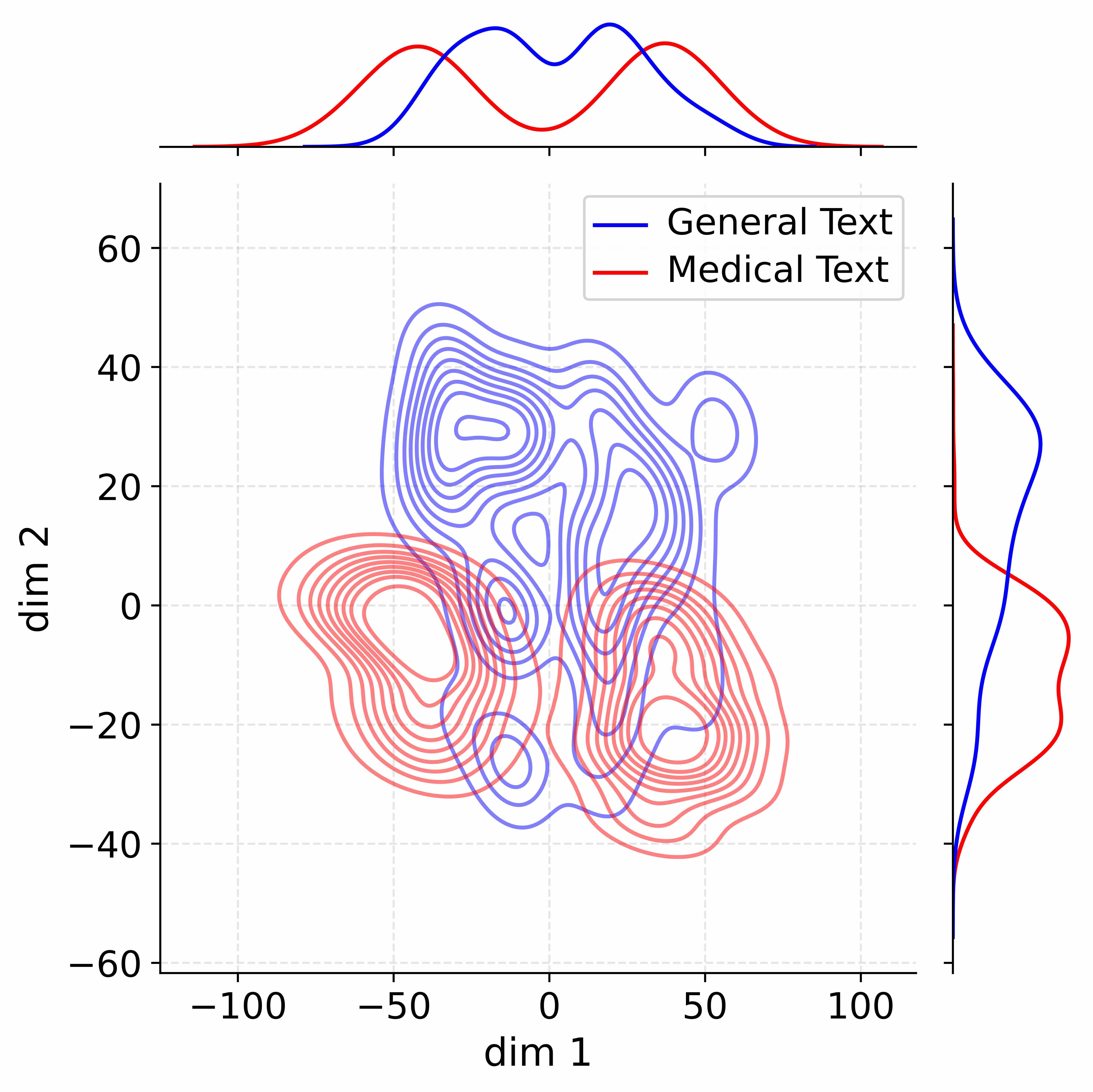
The image is a density contour plot comparing "General Text" and "Medical Text" across two dimensions (dim 1 and dim 2). It includes marginal density plots along the top (dim 1) and right side (dim 2). The plot visualizes the distribution and concentration of data points for each text type.
### Components/Axes
* **Main Plot:** Density contour plot showing the distribution of "General Text" (blue) and "Medical Text" (red) in a two-dimensional space.
* **X-axis (dim 1):** Ranges from -100 to 100, with tick marks at -100, -50, 0, 50, and 100.
* **Y-axis (dim 2):** Ranges from -60 to 60, with tick marks at -60, -40, -20, 0, 20, 40, and 60.
* **Top Marginal Plot:** Density plot showing the distribution of "General Text" (blue) and "Medical Text" (red) along the x-axis (dim 1).
* **Right Marginal Plot:** Density plot showing the distribution of "General Text" (blue) and "Medical Text" (red) along the y-axis (dim 2).
* **Legend:** Located in the top-center of the plot.
* Blue line: "General Text"
* Red line: "Medical Text"
### Detailed Analysis
**1. Main Density Contour Plot:**
* **General Text (Blue):**
* The highest density area is centered around x = -40 and y = 30.
* The contours extend from approximately x = -80 to x = 40 and y = 0 to y = 50.
* A secondary, less dense area is located around x = 30 and y = 10.
* **Medical Text (Red):**
* The highest density area is centered around x = -40 and y = -10.
* The contours extend from approximately x = -80 to x = 40 and y = -40 to y = 10.
* A secondary, less dense area is located around x = 30 and y = -20.
**2. Top Marginal Density Plot (dim 1):**
* **General Text (Blue):**
* Shows two peaks, one around x = -40 and another around x = 30.
* **Medical Text (Red):**
* Shows two peaks, one around x = -40 and another around x = 30. The peak at x=-40 is smaller than the peak at x=30.
**3. Right Marginal Density Plot (dim 2):**
* **General Text (Blue):**
* Shows a single peak around y = 30.
* **Medical Text (Red):**
* Shows a single peak around y = -10.
### Key Observations
* The "General Text" distribution is shifted towards higher values of dim 2 compared to "Medical Text".
* Both "General Text" and "Medical Text" show a bimodal distribution along dim 1, with peaks around -40 and 30.
* The marginal distributions confirm the shift in dim 2 and the bimodal nature of dim 1.
### Interpretation
The density contour plot suggests that "General Text" and "Medical Text" have distinct distributions in the two-dimensional space defined by dim 1 and dim 2. "General Text" tends to have higher values along dim 2 compared to "Medical Text". The bimodal distribution along dim 1 for both text types indicates the presence of two distinct clusters or sub-categories within each text type. The plot could represent a feature space derived from text embeddings, where dim 1 and dim 2 are principal components or other relevant dimensions. The separation between the distributions suggests that these dimensions are useful for distinguishing between "General Text" and "Medical Text".