## Text Document: Environmental and Economic Considerations of Bottled Water
### Overview
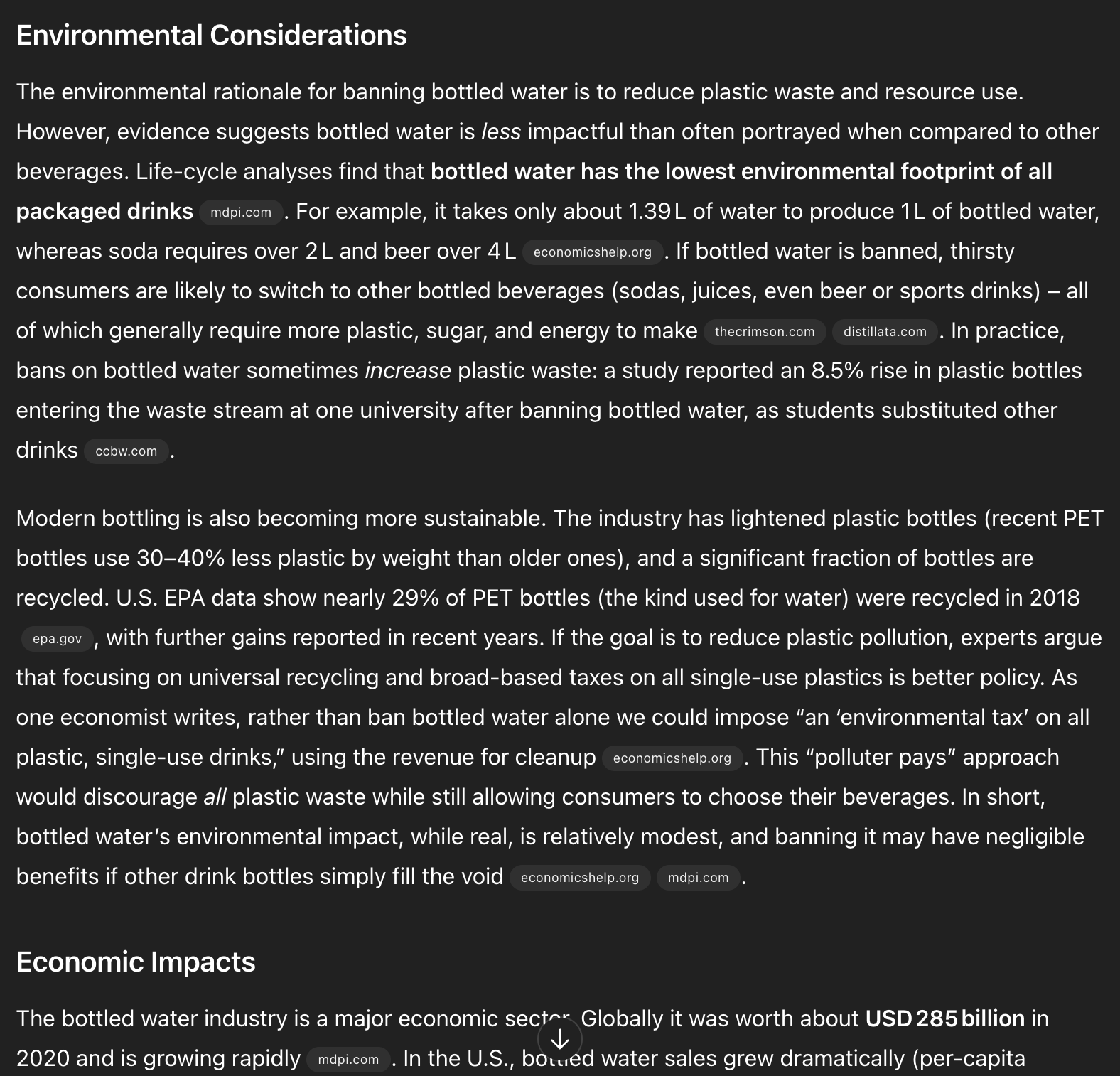
The image presents a text document discussing the environmental and economic considerations of bottled water. It argues that banning bottled water may not be the most effective solution for reducing plastic waste and highlights the economic significance of the bottled water industry.
### Components/Axes
The document is divided into two main sections:
1. **Environmental Considerations:** This section discusses the environmental impact of bottled water compared to other beverages, the potential increase in plastic waste due to bans, and the sustainability efforts in modern bottling.
2. **Economic Impacts:** This section briefly mentions the economic value of the bottled water industry.
### Detailed Analysis or ### Content Details
**Environmental Considerations:**
* The document states that bottled water is *less* impactful than often portrayed compared to other beverages.
* Life-cycle analyses suggest that bottled water has the lowest environmental footprint of all packaged drinks. A citation to `mdpi.com` is included.
* It takes approximately 1.39L of water to produce 1L of bottled water, while soda requires over 2L and beer over 4L. A citation to `economicshelp.org` is included.
* Banning bottled water may lead consumers to switch to other beverages (sodas, juices, beer, sports drinks), which require more plastic, sugar, and energy. Citations to `thecrimson.com` and `distillata.com` are included.
* A study reported an 8.5% rise in plastic bottles entering the waste stream at one university after banning bottled water. A citation to `ccbw.com` is included.
* Modern bottling is becoming more sustainable, with recent PET bottles using 30-40% less plastic by weight than older ones.
* Approximately 29% of PET bottles (used for water) were recycled in 2018, according to U.S. EPA data. A citation to `epa.gov` is included.
* The document suggests that universal recycling and broad-based taxes on single-use plastics may be a better policy than banning bottled water.
* An economist suggests imposing an "environmental tax" on all plastic, single-use drinks, using the revenue for cleanup. A citation to `economicshelp.org` is included.
* The document concludes that bottled water's environmental impact is relatively modest, and banning it may have negligible benefits if other drink bottles simply fill the void. Citations to `economicshelp.org` and `mdpi.com` are included.
**Economic Impacts:**
* The bottled water industry is a major economic sector.
* Globally, it was worth about USD 285 billion in 2020 and is growing rapidly. A citation to `mdpi.com` is included.
* In the U.S., bottled water sales grew dramatically (per-capita).
### Key Observations
* The document presents a nuanced view on the environmental impact of bottled water, suggesting it may be less harmful than commonly perceived.
* It highlights the potential unintended consequences of banning bottled water, such as increased consumption of other beverages with higher environmental footprints.
* The document emphasizes the economic significance of the bottled water industry.
### Interpretation
The document argues against a simple ban on bottled water, suggesting that a more comprehensive approach focusing on recycling and broader plastic waste reduction strategies may be more effective. It also points out the economic importance of the bottled water industry, implying that a ban could have negative economic consequences. The document suggests that the environmental impact of bottled water should be considered in the context of other beverage options and that focusing on reducing overall plastic consumption is a more sustainable solution.