\n
## Text Document: Environmental and Economic Impacts of Bottled Water
### Overview
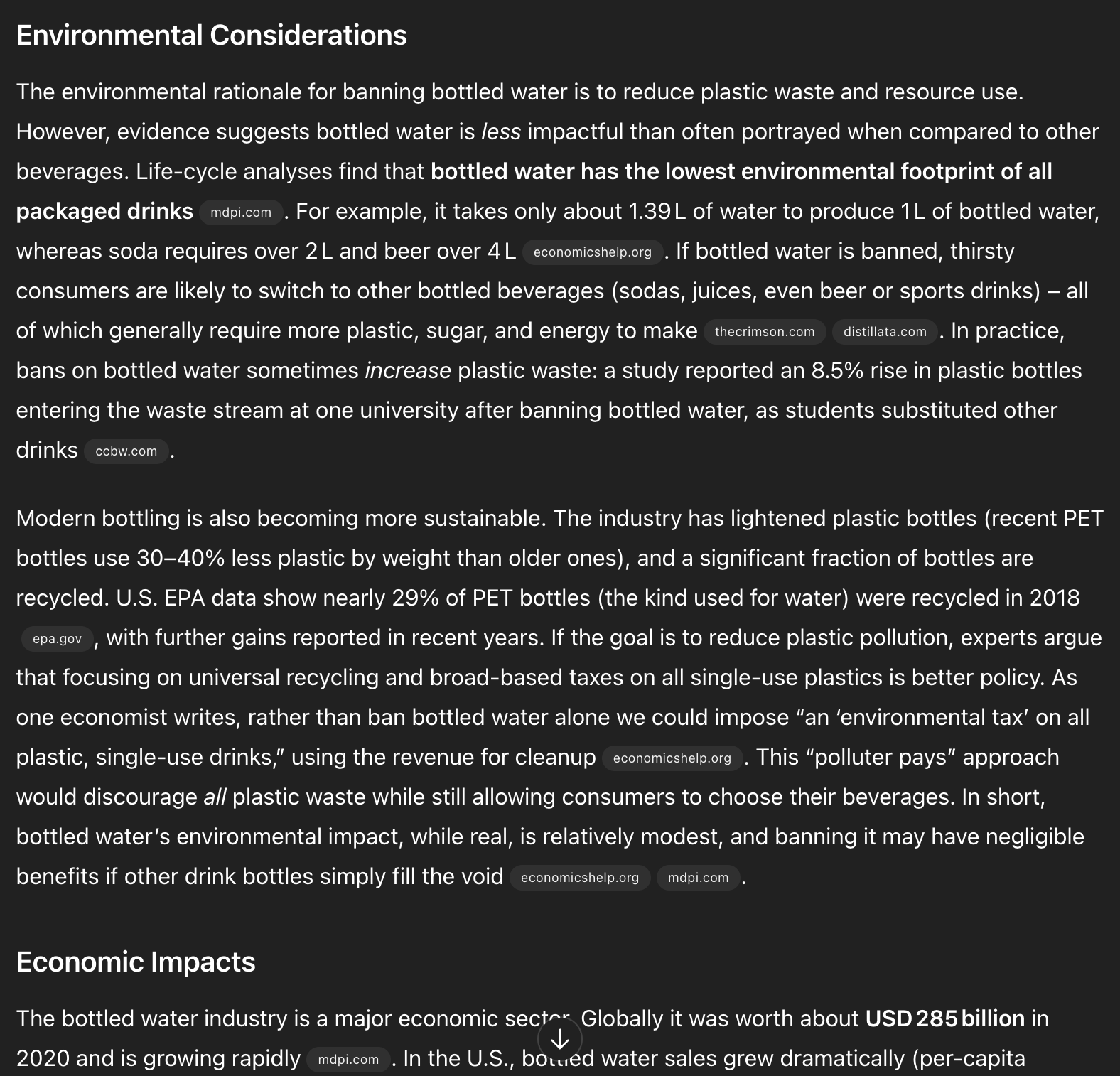
This document presents arguments regarding the environmental and economic impacts of banning bottled water. It discusses life-cycle analyses, plastic waste, recycling rates, and economic considerations. The document cites various sources through embedded hyperlinks.
### Components/Axes
The document is structured into two main sections: "Environmental Considerations" and "Economic Impacts". There are no explicit axes or charts, but the text presents data points related to water usage, plastic waste, and economic value. Hyperlinks are embedded throughout the text, pointing to external sources.
### Detailed Analysis or Content Details
The document contains the following key points:
* **Environmental Impact:** Bottled water has the lowest environmental footprint of all packaged drinks (mdpi.com). It takes only 1.39L of water to produce 1L of bottled water, whereas soda requires over 2L and beer over 4L (economicshelp.org).
* **Plastic Waste:** Banning bottled water can lead to increased plastic waste as consumers switch to other beverages (ccbw.com). A study reported an 8.5% rise in plastic bottles entering the waste stream at one university after banning bottled water.
* **Recycling:** Modern plastic bottles are becoming more sustainable. PET bottles are 30-40% less plastic by weight than older ones. In 2018, nearly 29% of PET bottles were recycled (epa.gov), with gains reported in recent years.
* **Alternative Solutions:** Experts argue for gains-based recycling and broad-based taxes on all single-use plastics instead of banning bottled water. An "environmental tax" could fund cleanup (economicshelp.org).
* **Economic Impact:** The bottled water industry is a major economic sector. Globally, it was worth USD 285 billion in 2020 and is growing rapidly (mdpi.com). Bottled water sales grew dramatically in the U.S.
### Key Observations
* The document presents a nuanced view, acknowledging the environmental concerns associated with plastic bottles but also highlighting the potential drawbacks of banning bottled water.
* The document emphasizes the importance of considering the full life-cycle impact of different beverages, not just the water itself.
* The document suggests that economic factors play a significant role in the bottled water industry.
### Interpretation
The document suggests that a complete ban on bottled water may not be the most effective solution to reduce plastic waste. It argues that focusing on recycling infrastructure, implementing taxes on all single-use plastics, and promoting more sustainable bottle designs could be more beneficial. The document also highlights the economic importance of the bottled water industry, suggesting that any policy changes should consider the potential economic consequences. The inclusion of numerous hyperlinks indicates a reliance on external research and data to support its claims. The document appears to be advocating for a more comprehensive and nuanced approach to addressing the environmental and economic challenges associated with bottled water consumption. The document is presenting a balanced argument, acknowledging the downsides of bottled water while also pointing out the potential negative consequences of a ban.