## Text Document: Environmental and Economic Analysis of Bottled Water
### Overview
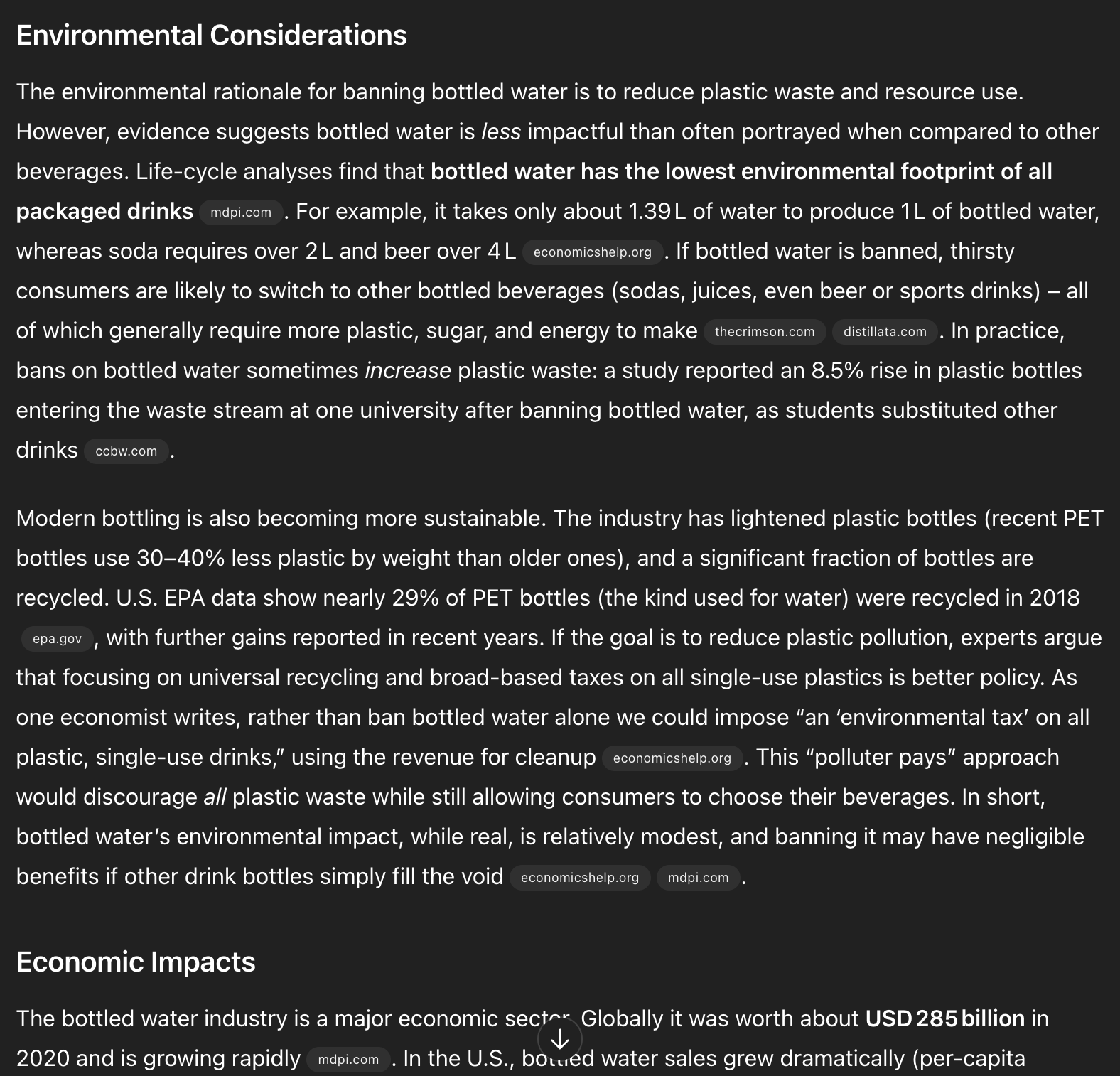
The image is a screenshot of a digital document or article discussing the environmental and economic aspects of bottled water, specifically arguing against bans on the product. The text is presented in a dark mode interface with white text on a dark gray background. It contains two main sections: "Environmental Considerations" and the beginning of "Economic Impacts." The text includes inline citations with source URLs displayed in small, rounded rectangular badges.
### Content Details (Full Transcription)
**Language:** English
**Section 1: Environmental Considerations**
**Paragraph 1:**
The environmental rationale for banning bottled water is to reduce plastic waste and resource use. However, evidence suggests bottled water is *less* impactful than often portrayed when compared to other beverages. Life-cycle analyses find that **bottled water has the lowest environmental footprint of all packaged drinks** `mdpi.com`. For example, it takes only about 1.39L of water to produce 1L of bottled water, whereas soda requires over 2L and beer over 4L `economicshelp.org`. If bottled water is banned, thirsty consumers are likely to switch to other bottled beverages (sodas, juices, even beer or sports drinks) – all of which generally require more plastic, sugar, and energy to make `thecrimson.com` `distillata.com`. In practice, bans on bottled water sometimes *increase* plastic waste: a study reported an 8.5% rise in plastic bottles entering the waste stream at one university after banning bottled water, as students substituted other drinks `ccbw.com`.
**Paragraph 2:**
Modern bottling is also becoming more sustainable. The industry has lightened plastic bottles (recent PET bottles use 30–40% less plastic by weight than older ones), and a significant fraction of bottles are recycled. U.S. EPA data show nearly 29% of PET bottles (the kind used for water) were recycled in 2018 `epa.gov`, with further gains reported in recent years. If the goal is to reduce plastic pollution, experts argue that focusing on universal recycling and broad-based taxes on all single-use plastics is better policy. As one economist writes, rather than ban bottled water alone we could impose "an 'environmental tax' on all plastic, single-use drinks," using the revenue for cleanup `economicshelp.org`. This "polluter pays" approach would discourage *all* plastic waste while still allowing consumers to choose their beverages. In short, bottled water's environmental impact, while real, is relatively modest, and banning it may have negligible benefits if other drink bottles simply fill the void `economicshelp.org` `mdpi.com`.
**Section 2: Economic Impacts (Incomplete)**
**Paragraph 1 (Partial):**
The bottled water industry is a major economic sector. Globally it was worth about **USD 285 billion** in 2020 and is growing rapidly `mdpi.com`. In the U.S., bottled water sales grew dramatically (per-capita...
*(The text cuts off at this point.)*
### Key Observations
1. **Argumentative Structure:** The text presents a counter-argument to bottled water bans, using comparative environmental data and economic incentives as its foundation.
2. **Data Points Cited:**
* Water usage for production: 1.39L water per 1L bottled water (vs. >2L for soda, >4L for beer).
* Plastic reduction: Recent PET bottles use 30–40% less plastic by weight.
* Recycling rate: ~29% of PET bottles recycled in the U.S. in 2018.
* Unintended consequence: An 8.5% increase in plastic bottle waste at one university post-ban.
* Global market value: USD 285 billion in 2020.
3. **Source Attribution:** Claims are supported by inline citations to sources like `mdpi.com`, `economicshelp.org`, `epa.gov`, `thecrimson.com`, `distillata.com`, and `ccbw.com`.
4. **Visual Layout:** The text is left-aligned in a single column. Citations are visually distinct, appearing as small, dark gray badges with white text, placed immediately after the relevant claim. A scroll-down arrow icon is partially visible at the bottom, indicating more content below.
### Interpretation
The document constructs a pragmatic, economics-and-data-driven case against single-product bans on bottled water. Its core thesis is that such bans are a poorly targeted policy tool that may yield negligible environmental benefits or even backfire.
* **Peircean Investigation (Reading Between the Lines):** The text uses a **abductive** reasoning pattern. It starts with the common claim (banning bottled water helps the environment) and then presents **signs** (comparative lifecycle data, substitution effects, recycling rates) that suggest a different, more complex **fact** (bottled water is relatively efficient, and bans may shift consumption to worse alternatives). The argument moves from observation to the most likely explanation: broad-based policies (like taxes or universal recycling) are more effective than narrow bans.
* **Underlying Message:** The piece implies that environmental policy should be guided by full lifecycle analysis and systemic thinking rather than by symbolic actions targeting a single, highly visible product. It frames bottled water not as a unique villain, but as part of a larger system of packaged beverages, where it currently represents the least impactful option.
* **Notable Omission/Anomaly:** The text focuses exclusively on *comparative* environmental impact (vs. other drinks) and *production* metrics. It does not address the significant issue of post-consumer waste management, litter, or the environmental cost of transporting water over long distances, which are common criticisms of the industry. The argument hinges on the assumption that consumers will switch to other bottled drinks if water is banned, rather than to tap water or refillable containers.