## Screenshot: Environmental and Economic Considerations of Banning Bottled Water
### Overview
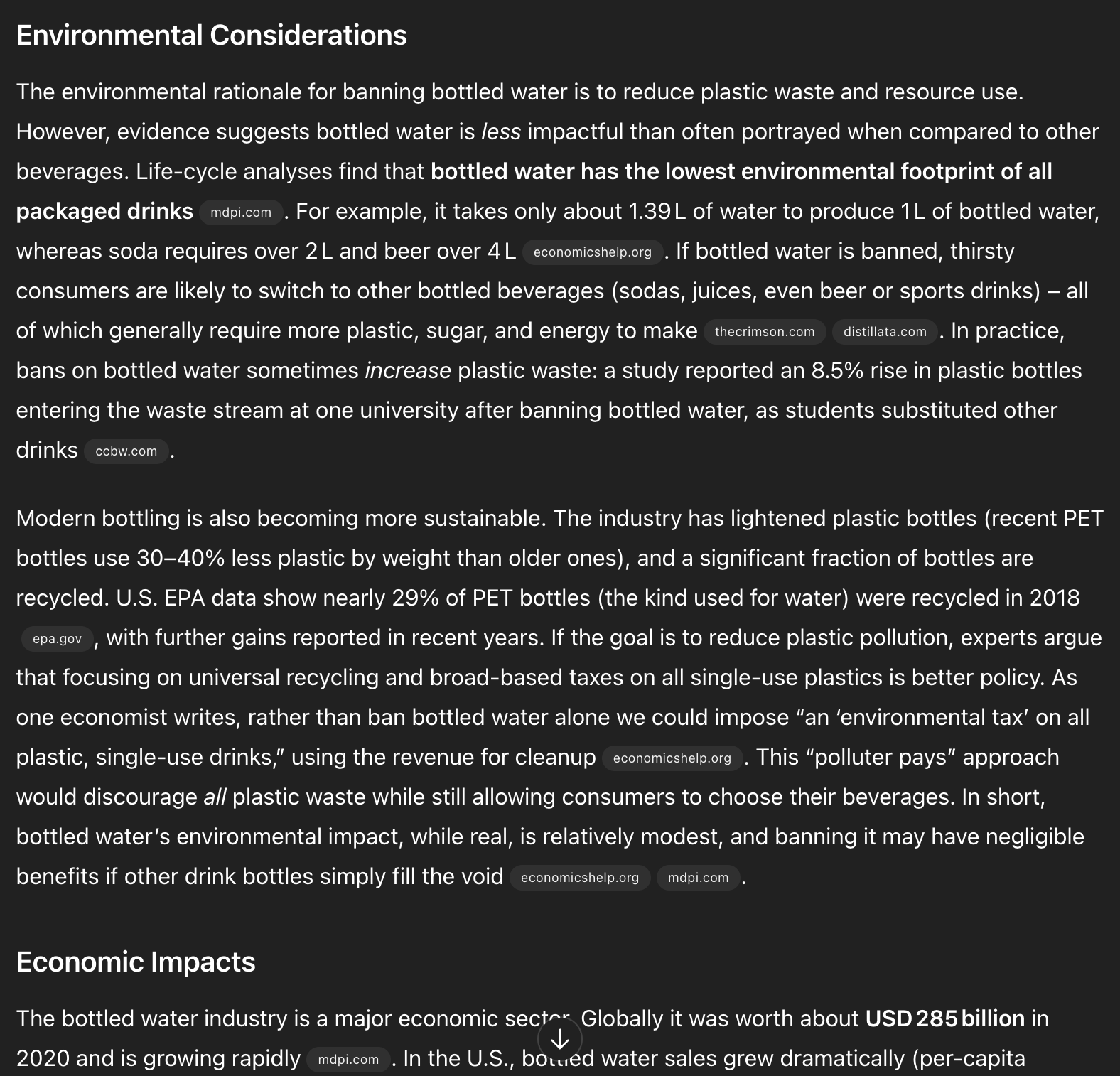
The image contains a text excerpt discussing the environmental rationale for banning bottled water, counterarguments about its environmental impact compared to other beverages, and economic implications of the bottled water industry. It cites multiple sources (e.g., mdpi.com, economicshelp.org) and includes statistics on plastic waste, recycling rates, and industry revenue.
---
### Components/Axes
- **Headings**:
- "Environmental Considerations" (bold, top-left)
- "Economic Impacts" (bold, bottom-left)
- **Text Blocks**:
- Two paragraphs under "Environmental Considerations"
- One paragraph under "Economic Impacts"
- **References**:
- Embedded URLs in parentheses (e.g., `(mdpi.com)`, `(economicshelp.org)`, `(ccbw.com)`, `(epa.gov)`)
- **Formatting**:
- Bold text for emphasis (e.g., "bottled water," "packaged drinks")
- Hyperlinked URLs (e.g., `thecrimson.com`, `distillata.com`)
---
### Detailed Analysis
#### Environmental Considerations
1. **Plastic Waste Reduction**:
- Banning bottled water aims to reduce plastic waste and resource use.
- Evidence suggests bottled water has a **lower environmental footprint** than other beverages (e.g., soda requires >2L water per liter, beer >4L).
- Life-cycle analyses show bottled water uses **1.39L of water per liter produced**, compared to higher water usage for alternatives.
2. **Substitution Effects**:
- Bans may increase plastic waste if consumers switch to other bottled beverages (e.g., sodas, juices).
- A university study reported an **8.5% rise in plastic bottles** entering waste streams after a bottled water ban.
3. **Industry Sustainability**:
- Modern PET bottles use **30–40% less plastic** by weight than older designs.
- **29% of PET bottles** were recycled in the U.S. in 2018 (EPA data), with improvements reported recently.
4. **Policy Recommendations**:
- Experts advocate for **universal recycling policies** and taxes on all single-use plastics rather than targeting bottled water alone.
- A "polluter pays" approach (taxing all plastic drinks) could reduce waste while allowing consumer choice.
#### Economic Impacts
- The bottled water industry is a **major economic sector**, valued at **USD 285 billion globally** in 2020.
- U.S. bottled water sales grew **dramatically per capita** (source: mdpi.com).
---
### Key Observations
1. **Environmental Trade-offs**:
- Banning bottled water risks unintended consequences (e.g., increased use of other plastic drinks).
- Bottled water’s environmental impact is **relatively modest** compared to alternatives.
2. **Recycling Progress**:
- PET bottle recycling rates are improving, but universal policies are needed for broader impact.
3. **Economic Significance**:
- The industry’s economic scale suggests bans could have **negligible benefits** if substitutes fill the void.
---
### Interpretation
The text argues that banning bottled water may not effectively reduce plastic pollution due to consumer substitution with other bottled beverages. While bottled water has a lower environmental footprint than alternatives like soda or beer, its prohibition could paradoxically increase waste. The industry’s economic importance (USD 285 billion globally) and recycling advancements (e.g., lighter PET bottles, 29% recycling rate) highlight the need for holistic policies targeting all single-use plastics rather than isolated bans. The "polluter pays" approach—taxing all plastic drinks—is proposed as a more effective strategy to reduce waste while preserving consumer choice.
**Notable Outliers**:
- The 8.5% rise in plastic waste after a university ban underscores the risk of substitution effects.
- The economic data (USD 285 billion) emphasizes the industry’s scale, suggesting bans may have limited impact without addressing broader plastic use.