## Diagram: Adaptive Dependency Graph with Failure-Aware Action Memory
### Overview
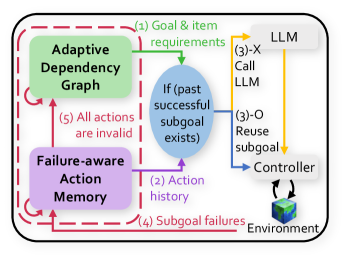
The image presents a diagram illustrating an adaptive dependency graph integrated with a failure-aware action memory system, interacting with a Large Language Model (LLM) and a controller within an environment. The diagram outlines the flow of information and control between these components.
### Components/Axes
* **Adaptive Dependency Graph:** Located in the top-left, represented by a green box.
* **Failure-aware Action Memory:** Located in the bottom-left, represented by a purple box.
* **LLM:** Located in the top-right, represented by a gray box.
* **Controller:** Located in the center-right, connected to the environment.
* **Environment:** Located in the bottom-right, represented by a cube.
* **Conditional Check:** An oval shape in the center, labeled "If (past successful subgoal exists)".
* **Arrows:** Indicate the flow of information and control.
### Detailed Analysis
1. **(1) Goal & item requirements:** A green arrow flows from the Adaptive Dependency Graph to the conditional check.
2. **(2) Action history:** A purple arrow flows from the Failure-aware Action Memory to the conditional check.
3. **(3)-X Call LLM:** A yellow arrow flows from the conditional check to the LLM.
4. **(3)-O Reuse subgoal:** A yellow arrow flows from the conditional check to the Controller.
5. **(4) Subgoal failures:** A purple arrow flows from the Controller to the Failure-aware Action Memory.
6. **(5) All actions are invalid:** A green arrow flows from the Failure-aware Action Memory back to the Adaptive Dependency Graph.
7. **Environment Interaction:** The Controller interacts with the Environment.
8. **Feedback Loops:** Red arrows indicate feedback loops between the Adaptive Dependency Graph and the Failure-aware Action Memory.
### Key Observations
* The Adaptive Dependency Graph provides goal and item requirements.
* The Failure-aware Action Memory stores action history and receives subgoal failures.
* The conditional check determines whether to call the LLM or reuse a subgoal based on past successful subgoals.
* The Controller interacts with the environment and provides feedback on subgoal failures.
### Interpretation
The diagram illustrates a system designed to adapt and learn from failures. The Adaptive Dependency Graph manages the goals, while the Failure-aware Action Memory stores and utilizes past action history to avoid repeating unsuccessful actions. The conditional check acts as a decision point, leveraging past successes to either reuse subgoals or call the LLM for new solutions. The feedback loops between the components enable the system to continuously learn and improve its performance within the environment. The system aims to optimize the interaction with the environment by learning from past failures and adapting its strategies accordingly.