## Diagram: Handler Behavior
### Overview
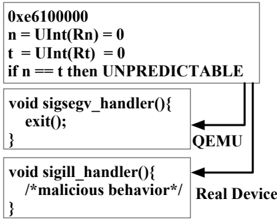
The image depicts a diagram illustrating the behavior of two different handlers, `sigsegv_handler` and `sigill_handler`, in two different environments, QEMU and a Real Device. The diagram also includes a conditional statement that leads to an "UNPREDICTABLE" outcome.
### Components/Axes
* **Top Block:** Contains hexadecimal value and variable assignments.
* `0xe6100000`
* `n = UInt(Rn) = 0`
* `t = UInt(Rt) = 0`
* `if n == t then UNPREDICTABLE`
* **Middle Block:** Represents the `sigsegv_handler` function.
* `void sigsegv_handler(){`
* `exit();`
* `}`
* Label: `QEMU`
* **Bottom Block:** Represents the `sigill_handler` function.
* `void sigill_handler(){`
* `/*malicious behavior*/`
* `}`
* Label: `Real Device`
* **Arrows:** Two arrows connect the top block to the middle and bottom blocks, indicating a flow of control or execution.
### Detailed Analysis
* The top block initializes two variables, `n` and `t`, both assigned the value 0. It then presents a conditional statement: "if n == t then UNPREDICTABLE".
* The middle block defines the `sigsegv_handler` function, which simply calls the `exit()` function. This handler is associated with the QEMU environment.
* The bottom block defines the `sigill_handler` function, which contains a comment indicating "/*malicious behavior*/". This handler is associated with a Real Device.
* The arrows indicate that if the condition `n == t` is met, the execution flow branches to either the `sigsegv_handler` in QEMU or the `sigill_handler` on a Real Device.
### Key Observations
* The `sigsegv_handler` in QEMU leads to a clean exit.
* The `sigill_handler` on a Real Device is associated with potentially malicious behavior.
* The "UNPREDICTABLE" outcome suggests that the behavior after the condition `n == t` is met is not deterministic and depends on the environment.
### Interpretation
The diagram illustrates how different environments (QEMU vs. Real Device) handle specific signals or events. When the condition `n == t` is true, the system's behavior diverges. In QEMU, a segmentation fault (`sigsegv`) leads to a controlled exit. However, on a real device, an illegal instruction (`sigill`) triggers a handler that is flagged as potentially malicious. This highlights the importance of environment-specific handling of exceptions and the potential security risks associated with undefined behavior on real hardware. The "UNPREDICTABLE" outcome emphasizes the need for careful error handling and security considerations in software development, especially when dealing with low-level operations or hardware interactions.