## Flowchart: Signal Handler Decision Process
### Overview
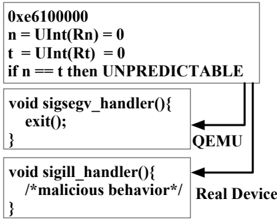
The diagram illustrates a conditional logic flow for handling signals in a technical system, with branches leading to different handler functions. It includes code snippets, conditional checks, and references to QEMU and Real Device environments.
### Components/Axes
1. **Top Box (Decision Logic)**:
- Contains hexadecimal value: `0xe6100000`
- Variable assignments:
- `n = UInt(Rn) = 0`
- `t = UInt(Rt) = 0`
- Conditional check: `if n == t then UNPREDICTABLE`
- Arrows labeled `QEMU` (left) and `Real Device` (right).
2. **Middle Box (Signal Handler)**:
- Function: `void sigsegv_handler(){ exit(); }`
- Connected to the top box via the `QEMU` arrow.
3. **Bottom Box (Malicious Handler)**:
- Function: `void sigill_handler(){ /*malicious behavior*/ }`
- Connected to the top box via the `Real Device` arrow.
### Detailed Analysis
- **Top Box**:
- The hexadecimal value `0xe6100000` likely represents a memory address or register value.
- Variables `n` and `t` are initialized to 0 using `UInt` (unsigned integer) operations on registers `Rn` and `Rt`.
- The condition `if n == t` triggers an `UNPREDICTABLE` state, implying undefined behavior or a critical decision point.
- **Arrows**:
- The `QEMU` arrow directs to the `sigsegv_handler`, which calls `exit()` to terminate the process.
- The `Real Device` arrow directs to the `sigill_handler`, annotated with `/*malicious behavior*/`, suggesting this path is associated with adversarial actions.
### Key Observations
- The flowchart bifurcates based on whether `n` equals `t`, with distinct outcomes for QEMU (controlled environment) and Real Device (potentially untrusted environment).
- The `UNPREDICTABLE` label indicates a critical failure or edge case requiring special handling.
- The `sigill_handler` is explicitly marked as malicious, implying it may execute unauthorized or harmful code.
### Interpretation
This diagram models a security-critical decision process in low-level system programming. The `QEMU` path represents a safe, predictable environment where signal handling terminates the process gracefully. In contrast, the `Real Device` path introduces risk, as the `sigill_handler` could exploit the `UNPREDICTABLE` condition to execute malicious code. The use of `exit()` in the `sigsegv_handler` ensures stability in controlled environments, while the absence of such safeguards in the `sigill_handler` highlights vulnerabilities in real-world deployments. The diagram emphasizes the importance of isolating untrusted code execution paths to prevent security breaches.