## Code Snippet: Rust atoi Implementation
### Overview
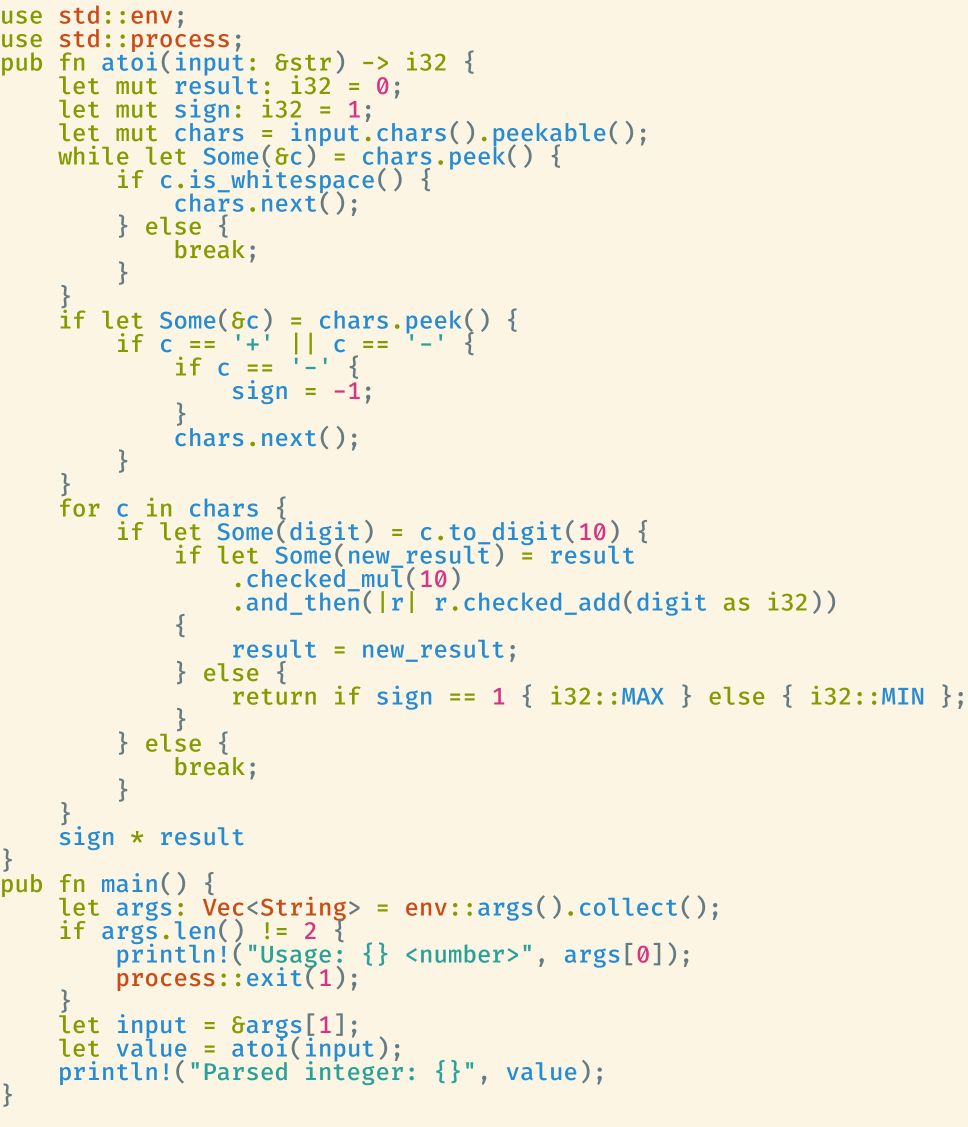
The image presents a Rust code snippet that implements a function `atoi` (ASCII to integer) which converts a string slice (`&str`) into a 32-bit integer (`i32`). It also includes a `main` function that takes a command-line argument, converts it to an integer using the `atoi` function, and prints the result.
### Components/Axes
* **Header:** Includes `use` statements for `std::env` and `std::process`.
* **`atoi` function:**
* Input: `input: &str` (string slice)
* Output: `i32` (32-bit integer)
* Local variables:
* `result: i32 = 0` (mutable, stores the resulting integer)
* `sign: i32 = 1` (mutable, stores the sign of the integer, initially positive)
* `chars` (mutable, peekable iterator over the characters of the input string)
* **`main` function:**
* Takes command-line arguments.
* Calls the `atoi` function.
* Prints the parsed integer.
### Detailed Analysis or ### Content Details
**`atoi` function:**
1. **Initialization:**
* `result` is initialized to 0.
* `sign` is initialized to 1 (positive).
* `chars` is initialized as a peekable iterator over the input string's characters.
2. **Whitespace Handling:**
* A `while` loop skips leading whitespace characters.
3. **Sign Handling:**
* Checks for an optional '+' or '-' sign.
* If a '-' is found, `sign` is set to -1.
4. **Digit Conversion:**
* A `for` loop iterates through the remaining characters.
* `c.to_digit(10)` attempts to convert each character to a base-10 digit (0-9).
* If the conversion is successful:
* `result.checked_mul(10)` attempts to multiply the current `result` by 10, checking for overflow.
* `.and_then(|r| r.checked_add(digit as i32))` attempts to add the new digit to the multiplied result, also checking for overflow.
* If both operations are successful, `result` is updated with the new value.
* If either operation results in overflow, the function returns `i32::MAX` if the sign is positive, or `i32::MIN` if the sign is negative.
* If a non-digit character is encountered, the loop breaks.
5. **Return Value:**
* The function returns `sign * result`.
**`main` function:**
1. **Argument Parsing:**
* `env::args().collect()` collects command-line arguments into a vector of strings.
* It checks if the number of arguments is not equal to 2. If it is not, it prints a usage message and exits with code 1.
2. **`atoi` Call:**
* `&args[1]` gets the second command-line argument (the number to convert).
* `atoi(input)` calls the `atoi` function to convert the input string to an integer.
3. **Output:**
* `println!("Parsed integer: {}", value)` prints the parsed integer.
### Key Observations
* The `atoi` function handles leading whitespace and optional '+' or '-' signs.
* It uses `checked_mul` and `checked_add` to prevent integer overflow.
* It returns `i32::MAX` or `i32::MIN` in case of overflow, depending on the sign.
* The `main` function expects exactly one command-line argument (the number to convert).
### Interpretation
The code implements a robust string-to-integer conversion function in Rust. The use of `checked_mul` and `checked_add` is crucial for preventing integer overflow, which can lead to unexpected behavior or security vulnerabilities. The `main` function provides a simple example of how to use the `atoi` function. The code demonstrates good error handling by checking the number of command-line arguments and exiting with an error message if the input is invalid.