\n
## Code Snippet: Rust `atoi` Implementation
### Overview
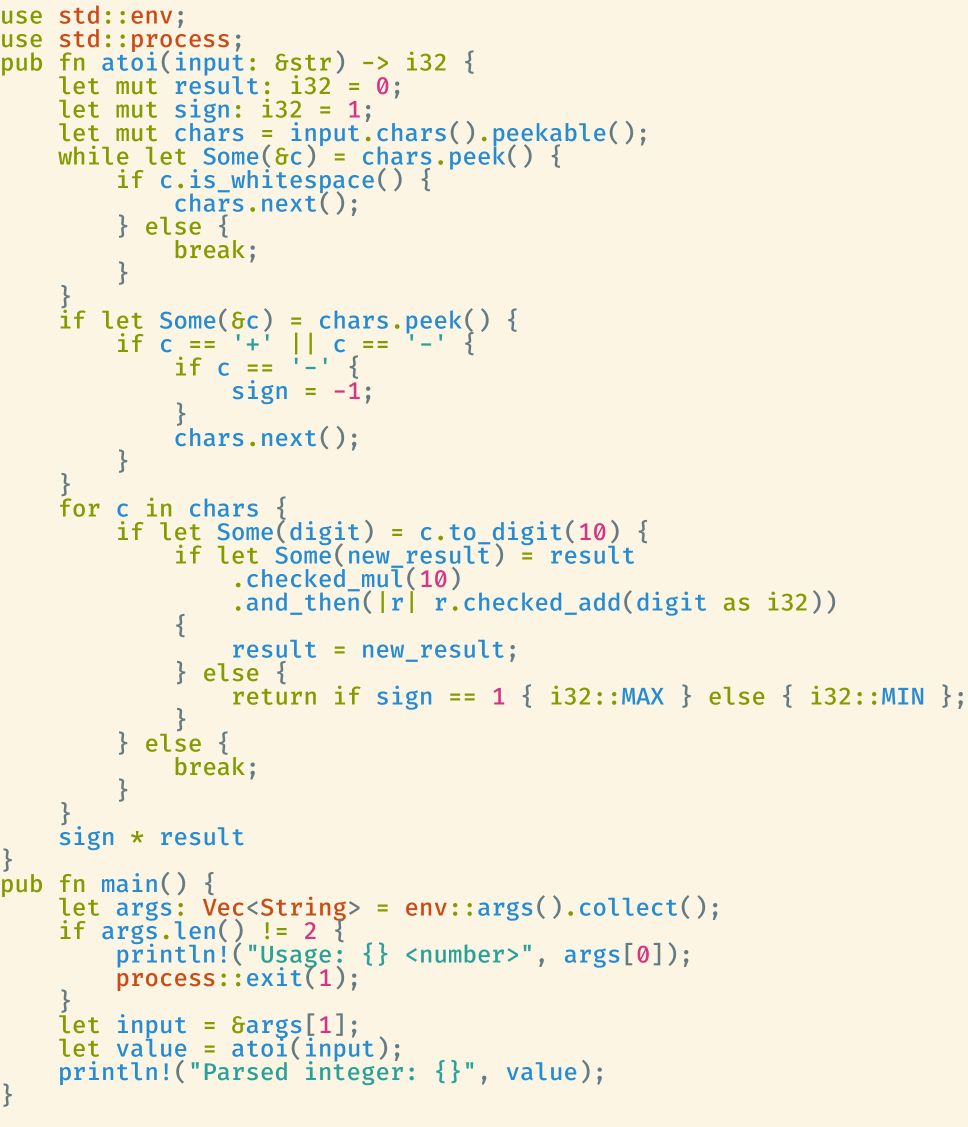
The image displays a complete Rust source code file containing two public functions: `atoi` (ASCII to integer) and `main`. The code implements a custom string-to-`i32` integer parser with robust error handling for overflow and invalid input, designed to be used as a command-line utility.
### Components/Axes
The code is structured into two primary components:
1. **`atoi` function**: The core parsing logic.
2. **`main` function**: The command-line interface that utilizes `atoi`.
**Imports (Lines 1-2):**
* `use std::env;`
* `use std::process;`
### Detailed Analysis
#### **`atoi` Function (Lines 3-44)**
* **Signature**: `pub fn atoi(input: &str) -> i32`
* **Purpose**: Converts a string slice (`&str`) into a 32-bit signed integer (`i32`).
* **Logic Flow**:
1. **Initialization (Lines 4-6)**: Initializes `result` to 0, `sign` to 1, and creates a peekable character iterator from the input string.
2. **Whitespace Skipping (Lines 7-13)**: A `while` loop consumes and discards leading whitespace characters.
3. **Sign Detection (Lines 14-22)**: An `if let` block checks the next character for a '+' or '-' sign. If a '-' is found, `sign` is set to -1. The sign character is consumed.
4. **Digit Parsing & Accumulation (Lines 23-39)**: A `for` loop iterates over the remaining characters.
* For each character, it attempts to convert it to a digit (base 10) using `c.to_digit(10)`.
* If successful, it performs a checked multiplication of the current `result` by 10, followed by a checked addition of the new digit. This prevents integer overflow.
* **Overflow Handling (Lines 30-32)**: If either the multiplication or addition operation would overflow, the function immediately returns `i32::MAX` if the sign was positive, or `i32::MIN` if the sign was negative.
* If the character is not a digit, the loop breaks (Line 38).
5. **Return (Line 41)**: The final result is computed as `sign * result`.
#### **`main` Function (Lines 43-53)**
* **Signature**: `pub fn main()`
* **Purpose**: Serves as the program entry point, handling command-line arguments.
* **Logic Flow**:
1. **Argument Collection (Line 44)**: Collects all command-line arguments into a `Vec<String>`.
2. **Argument Check (Lines 45-49)**: Checks if exactly two arguments are present (the program name and one input number). If not, it prints a usage message (`"Usage: {} <number>"`) and exits with status code 1.
3. **Parsing and Output (Lines 50-52)**: Takes the second argument (`args[1]`), passes it to the `atoi` function, and prints the result in the format `"Parsed integer: {}"`.
### Key Observations
1. **Robustness**: The code explicitly handles leading whitespace, optional signs, and non-digit characters by terminating parsing gracefully.
2. **Overflow Safety**: The use of `checked_mul` and `checked_add` with `and_then` is a idiomatic Rust pattern to safely handle arithmetic that could overflow, returning the maximum or minimum `i32` value as specified by the C standard's `atoi` behavior.
3. **Error Handling**: The `main` function provides basic user feedback for incorrect argument counts but does not propagate or handle parsing errors from `atoi` (e.g., an empty string or a string with only a sign would return 0).
4. **Code Style**: The code uses Rust's pattern matching (`if let`, `while let`) and iterator methods effectively. The indentation and brace style are consistent.
### Interpretation
This code snippet is a self-contained, educational implementation of a fundamental string parsing function. It demonstrates several important Rust concepts: ownership and borrowing (`&str`), iterators, pattern matching for control flow, and safe arithmetic to prevent undefined behavior from overflow.
The `atoi` function's behavior mirrors the classic C library function of the same name, including its specific overflow semantics (saturating at `i32::MAX`/`MIN`). This makes it predictable for developers familiar with the C standard. The `main` function wraps it into a simple CLI tool, though a production version would likely include more comprehensive error reporting (e.g., distinguishing between "no digits found" and "valid number parsed").
The primary utility of this code is as a clear example of how to implement a stateful parser in Rust with safety as a primary concern. It serves as a building block that could be extended to handle different integer types, bases (hexadecimal, octal), or more sophisticated error types.