## Diagram: Secure and Trusted Evaluation Proof & Model Inference Verification
### Overview
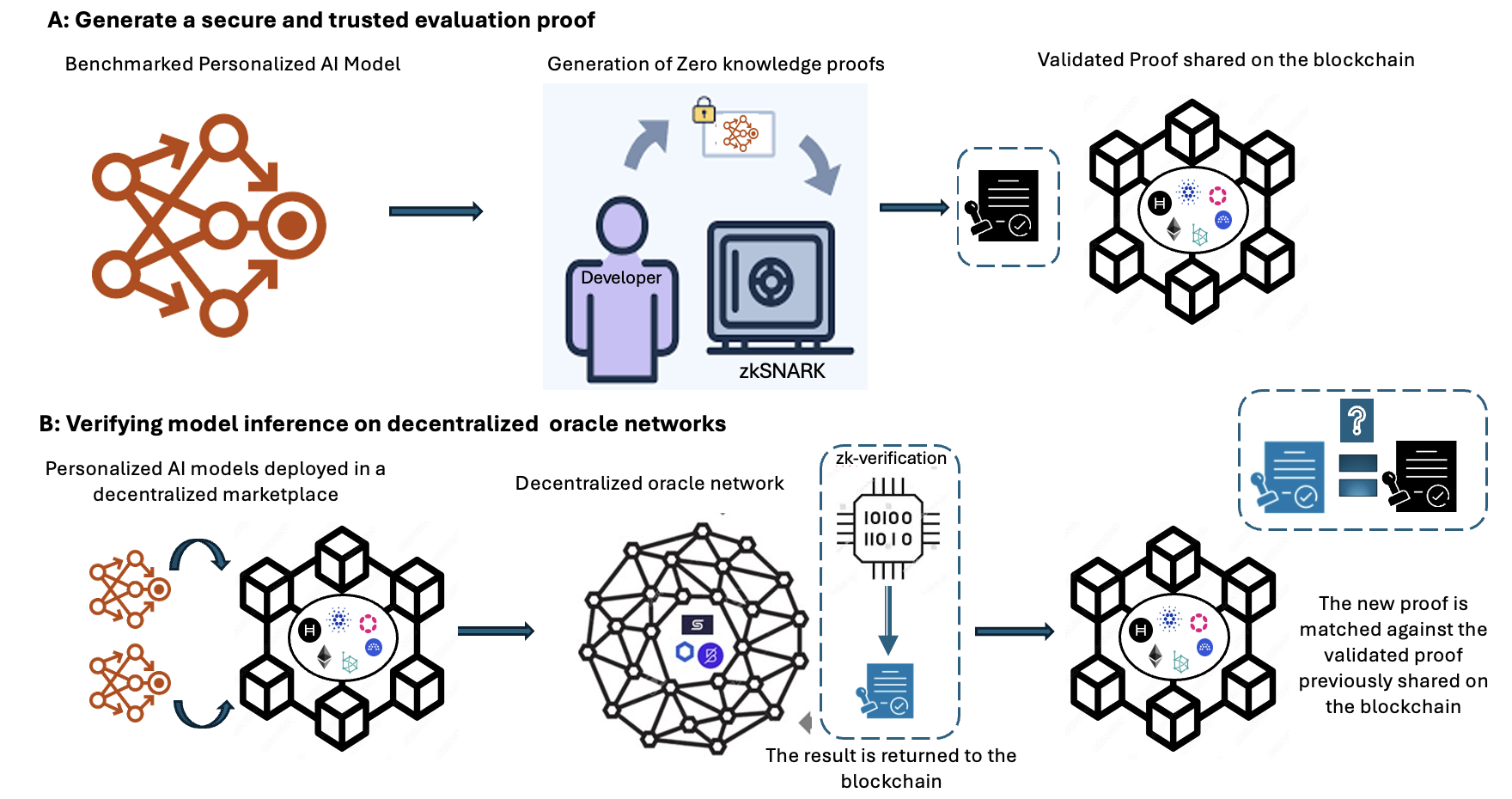
The image presents two diagrams, labeled A and B, illustrating processes related to secure evaluation proof generation and model inference verification on decentralized oracle networks. Diagram A focuses on generating a secure and trusted evaluation proof using zero-knowledge proofs, while diagram B details the verification of model inference on decentralized oracle networks.
### Components/Axes
**Diagram A: Generate a secure and trusted evaluation proof**
* **Title:** A: Generate a secure and trusted evaluation proof
* **Subtitle:** Benchmarked Personalized AI Model
* **Process Flow:**
* **Step 1 (Left):** A network of interconnected circles with arrows indicating data flow. This represents a "Benchmarked Personalized AI Model."
* **Step 2 (Middle):** A "Developer" figure interacts with a "zkSNARK" (Zero-Knowledge Succinct Non-Interactive Argument of Knowledge) system, represented by a safe. An arrow indicates the generation of zero-knowledge proofs. A lock icon above the developer and safe suggests security.
* **Step 3 (Right):** A document with a stamp, representing a validated proof.
* **Step 4 (Far Right):** A blockchain network represented by interconnected cubes, containing various cryptocurrency logos (e.g., Bitcoin "B", Ethereum "E", Cardano "A", etc.). The text indicates that the "Validated Proof" is shared on the blockchain.
**Diagram B: Verifying model inference on decentralized oracle networks**
* **Title:** B: Verifying model inference on decentralized oracle networks
* **Subtitle:** Personalized AI models deployed in a decentralized marketplace
* **Process Flow:**
* **Step 1 (Left):** A network of interconnected circles, representing "Personalized AI models deployed in a decentralized marketplace." This network is connected to a blockchain network (similar to Diagram A) via a curved arrow.
* **Step 2 (Middle):** A "Decentralized oracle network" represented by a network of interconnected circles. Inside the network are the logos of two cryptocurrencies.
* **Step 3 (Center):** A "zk-verification" process, depicted as a simplified circuit board with binary code (10100, 11010). An arrow points downwards to a document with a stamp, indicating the result being returned to the blockchain.
* **Step 4 (Right):** A blockchain network (similar to Diagram A).
* **Step 5 (Far Right):** A dashed box containing two documents, one with a question mark. The text states, "The new proof is matched against the validated proof previously shared on the blockchain."
### Detailed Analysis or Content Details
**Diagram A:**
* The AI model network consists of approximately 7 circles, with arrows indicating data flow between them.
* The "zkSNARK" system is depicted as a safe with a digital display.
* The blockchain network consists of 8 cubes interconnected, with cryptocurrency logos inside a central circle.
**Diagram B:**
* The decentralized oracle network consists of approximately 20 interconnected circles.
* The "zk-verification" circuit board has approximately 10 vertical lines and the binary code "10100" and "11010".
* The blockchain network consists of 8 cubes interconnected, with cryptocurrency logos inside a central circle.
### Key Observations
* Both diagrams utilize blockchain networks as a final step, indicating the importance of blockchain technology in secure evaluation and verification processes.
* Zero-knowledge proofs and zk-verification are central to both processes, highlighting the focus on privacy and security.
* Diagram B emphasizes the decentralized nature of the oracle network and the marketplace for AI models.
### Interpretation
The diagrams illustrate the process of ensuring the security and trustworthiness of AI models and their inferences in decentralized environments. Diagram A focuses on generating a secure evaluation proof using zero-knowledge proofs, ensuring that the evaluation process itself is trustworthy. Diagram B focuses on verifying the inference of AI models on decentralized oracle networks, ensuring that the results are accurate and reliable. The use of blockchain technology in both diagrams provides a transparent and immutable record of the processes, further enhancing trust and security. The diagrams suggest a move towards more secure and decentralized AI systems, where privacy and verifiability are paramount.