\n
## Diagram: Secure and Trusted AI Evaluation & Verification
### Overview
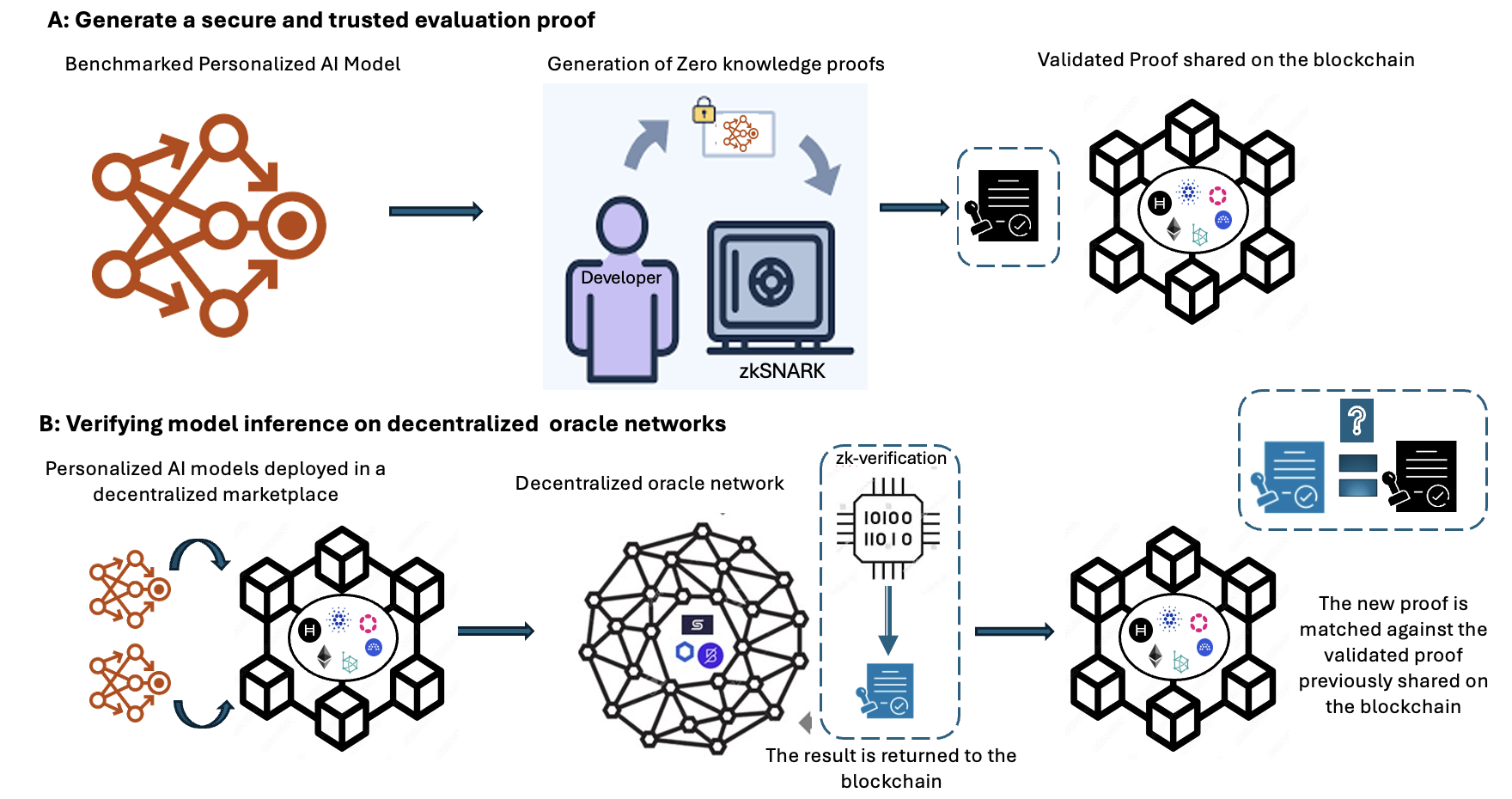
The image presents a two-part diagram illustrating a process for generating secure and trusted evaluation proofs for AI models, and verifying model inference on decentralized oracle networks. Part A focuses on generating a proof, while Part B details the verification process. Both parts utilize visual metaphors of networks and blockchain structures to represent data flow and security.
### Components/Axes
The diagram is divided into two main sections, labeled "A: Generate a secure and trusted evaluation proof" and "B: Verifying model inference on decentralized oracle networks". Each section contains three stages, visually connected by arrows indicating the flow of information. Key components include:
* **Personalized AI Model:** Represented by a network of interconnected nodes with red lines.
* **Developer:** A stick figure icon.
* **Zero-Knowledge Proofs:** Represented by a lock icon.
* **zkSNARK:** A labeled box.
* **Blockchain:** Represented by a cube-like structure with internal symbols.
* **Decentralized Oracle Network:** Represented by a network of interconnected nodes with blue lines.
* **zk-verification:** A labeled box with binary code (10100110110).
* **Question Mark with Checkmarks:** Representing verification status.
### Detailed Analysis or Content Details
**Part A: Generate a secure and trusted evaluation proof**
1. **Benchmarked Personalized AI Model:** A network of approximately 15 nodes connected by red lines. The nodes are circular.
2. **Generation of Zero Knowledge proofs:** A circular icon with a lock inside, positioned above a box labeled "zkSNARK". A "Developer" icon is placed to the left of the box. An arrow points from the AI model to this stage.
3. **Validated Proof shared on the blockchain:** A cube-like structure representing a blockchain, with internal symbols. An arrow points from the "zkSNARK" box to this stage.
**Part B: Verifying model inference on decentralized oracle networks**
1. **Personalized AI models deployed in a decentralized marketplace:** A blockchain structure with internal symbols. An arrow points from this stage to the next.
2. **Decentralized oracle network:** A network of approximately 15 nodes connected by blue lines. The nodes are circular. An arrow points from the blockchain to this stage.
3. **zk-verification:** A box labeled "zk-verification" containing binary code "10100110110". An arrow points from the oracle network to this stage.
4. **The new proof is matched against the validated proof previously shared on the blockchain:** A blockchain structure with internal symbols. A question mark with checkmarks is positioned to the left of the blockchain. An arrow points from the "zk-verification" box to this stage. The text "The result is returned to the blockchain" is positioned below the "zk-verification" box.
### Key Observations
* The diagram emphasizes the use of zero-knowledge proofs (zkSNARKs) for secure AI evaluation.
* The blockchain is presented as a central component for both generating and verifying proofs.
* The use of network diagrams for AI models and oracle networks suggests a distributed and decentralized approach.
* The binary code within the "zk-verification" box indicates a computational process.
### Interpretation
The diagram illustrates a system designed to enhance the trustworthiness of AI models by leveraging zero-knowledge proofs and blockchain technology. The process begins with a benchmarked AI model, generates a proof of its evaluation using zkSNARKs, and stores this proof on the blockchain. Subsequently, when the model is deployed in a decentralized marketplace, its inference is verified against the previously stored proof on the blockchain, ensuring integrity and security. The use of decentralized oracle networks suggests a robust and tamper-proof verification mechanism. The binary code likely represents the cryptographic verification process. The question mark with checkmarks indicates a successful verification outcome. The overall system aims to address concerns about the reliability and transparency of AI models in decentralized environments.