## Screenshot: Human Annotated Reasoning Chain of a GSMK8 Example
### Overview
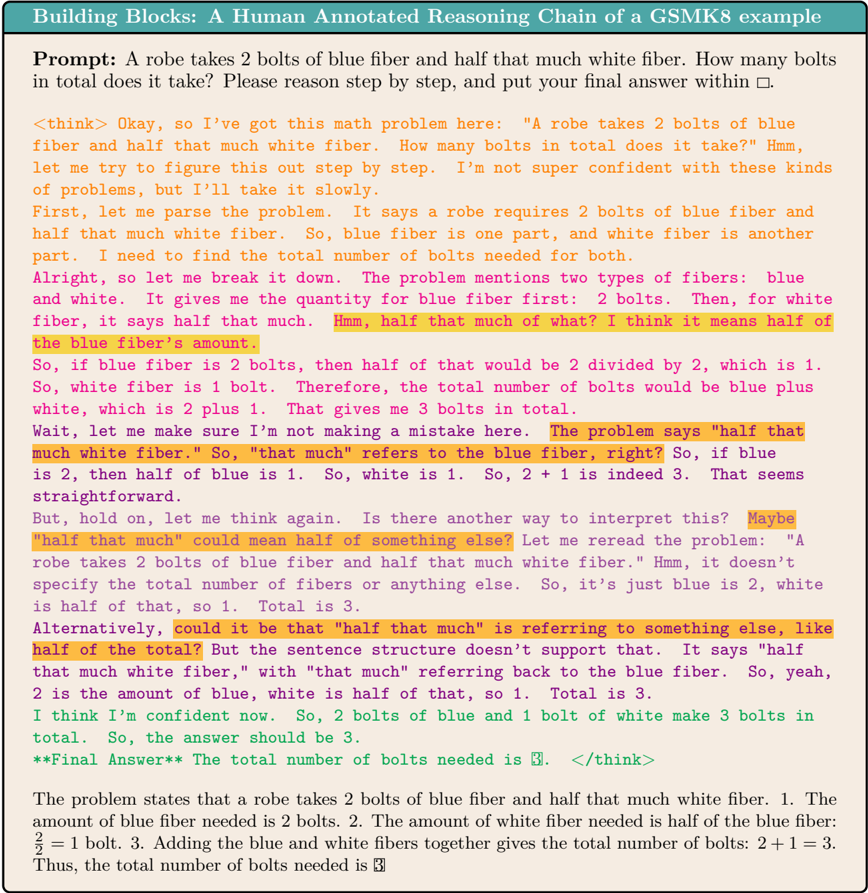
The image displays a technical reasoning chain annotated with color-coded text to demonstrate problem-solving steps for a GSMK8 example. The content includes a math problem, step-by-step analysis, and a final answer, with annotations highlighting key interpretations and uncertainties.
---
### Components/Axes
- **Title**: "Building Blocks: A Human Annotated Reasoning Chain of a GSMK8 example" (top-center, bold black text).
- **Prompt**: A math problem about calculating total bolts for a rope requiring blue and white fiber (orange text, top-left).
- **Reasoning Steps**: Color-coded text (orange, pink, green) with annotations explaining problem parsing, ambiguity resolution, and calculations.
- **Final Answer**: Highlighted in bold with a box (bottom-center).
---
### Detailed Analysis
#### Problem Statement
- **Text**: "A rope takes 2 bolts of blue fiber and half that much white fiber. How many bolts in total does it take?"
- **Color**: Orange (problem statement).
- **Key Phrase**: "half that much white fiber" (highlighted in orange).
#### Reasoning Process
1. **Initial Parsing** (pink text):
- Blue fiber = 2 bolts.
- White fiber = half of blue fiber = 1 bolt.
- Total = 2 + 1 = 3 bolts.
- **Highlight**: "half that much" refers to blue fiber (orange underline).
2. **Ambiguity Check** (green text):
- Re-evaluates whether "half that much" could refer to the total.
- Concludes the sentence structure ties "half that much" to blue fiber.
- **Highlight**: "half that much" (orange underline).
3. **Final Confirmation** (green text):
- Confirms total bolts = 3.
- **Highlight**: "half that much" (orange underline).
#### Final Answer
- **Text**: "The total number of bolts needed is 3."
- **Formatting**: Bold, boxed, and centered.
---
### Key Observations
- **Color-Coding**:
- Orange highlights emphasize critical phrases (e.g., "half that much").
- Pink and green text denote problem parsing and ambiguity resolution.
- **Logical Flow**:
- Step-by-step breakdown resolves ambiguity in the problem statement.
- Final answer aligns with the initial interpretation after re-evaluation.
- **Annotations**:
- Explicitly address potential misinterpretations (e.g., whether "half that much" refers to the total or blue fiber).
---
### Interpretation
The annotated reasoning chain demonstrates a structured approach to solving ambiguous problems. By explicitly highlighting key phrases and re-evaluating assumptions, the process ensures clarity in interpreting "half that much" as referring to the blue fiber quantity. This method reduces errors in problem-solving by:
1. **Breaking down quantities** (blue = 2, white = 1).
2. **Verifying assumptions** (rejecting alternative interpretations).
3. **Confirming the total** (3 bolts) through iterative reasoning.
The use of color and annotations serves as a visual aid to track logical steps and uncertainties, which is critical for technical documentation and model training in GSMK8 systems.