## Text Analysis: Human Annotated Reasoning Chain
### Overview
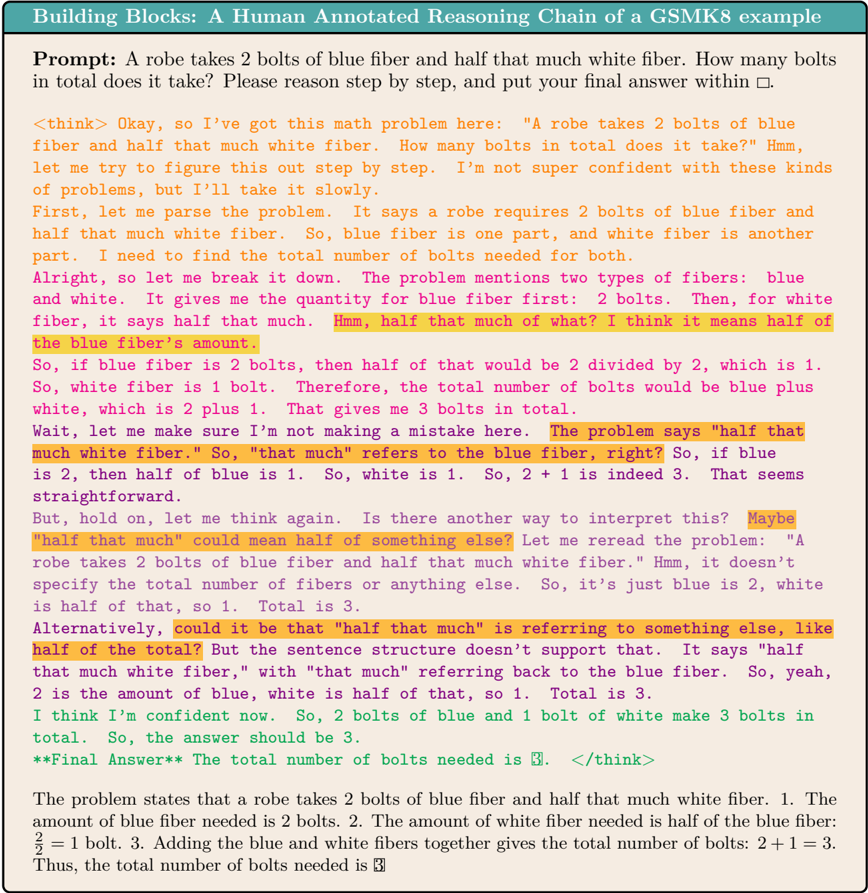
The image presents a human-annotated reasoning chain for solving a math problem. It includes the problem statement, a step-by-step thought process to arrive at the solution, and a final answer. The problem involves calculating the total number of bolts needed for a robe, given the amounts of blue and white fiber.
### Components/Axes
* **Title:** Building Blocks: A Human Annotated Reasoning Chain of a GSMK8 example
* **Prompt:** A robe takes 2 bolts of blue fiber and half that much white fiber. How many bolts in total does it take? Please reason step by step, and put your final answer within [a square box].
* **Reasoning Chain:** A block of text enclosed in `"
**Problem Restatement and Solution:**
* "The problem states that a robe takes 2 bolts of blue fiber and half that much white fiber. 1. The amount of blue fiber needed is 2 bolts. 2. The amount of white fiber needed is half of the blue fiber: 2/2 = 1 bolt. 3. Adding the blue and white fibers together gives the total number of bolts: 2+1 = 3. Thus, the total number of bolts needed is 3"
### Key Observations
* The reasoning chain demonstrates a human-like approach to problem-solving, including initial uncertainty, step-by-step analysis, and consideration of alternative interpretations.
* The final answer is consistent across the reasoning chain and the problem restatement.
* Several phrases are highlighted in yellow, indicating key steps or considerations in the reasoning process. These include:
* "half that much of what? I think it means half of the blue fiber's amount."
* "The problem says "half that much white fiber." So, "that much" refers to the blue fiber, right?"
* "Maybe "half that much" could mean half of something else?"
* "could it be that "half that much" is referring to something else, like half of the total?"
### Interpretation
The image illustrates a human's thought process when solving a simple math problem. It highlights the importance of careful parsing of the problem statement, considering different interpretations, and verifying the solution. The annotations provide insights into the reasoning steps and the decision-making process. The highlighted phrases emphasize the critical points where the solver is actively thinking through the problem and considering different possibilities. The example demonstrates a clear and logical approach to problem-solving, making it a valuable example for understanding human reasoning.