## Technical Document Extraction: Annotated Reasoning Chain Example
### Overview
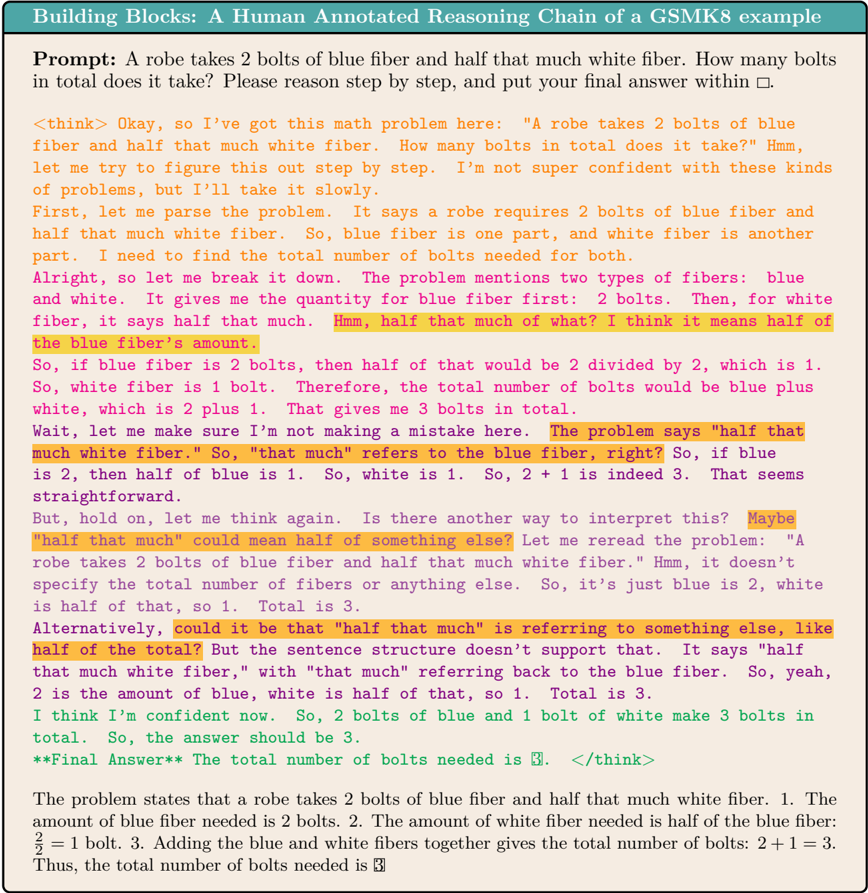
The image is a screenshot or digital document titled "Building Blocks: A Human Annotated Reasoning Chain of a GSM8K example." It displays a step-by-step reasoning process for solving a simple arithmetic word problem, with specific phrases highlighted in orange and green to annotate the thought process. The document serves as an educational or technical example of how a reasoning chain is constructed.
### Components/Axes
The document is structured as a single block of text with the following distinct sections:
1. **Title Header:** A teal-colored bar at the top containing the title.
2. **Prompt Section:** A bolded problem statement.
3. **Thinking Process (`<think>` block):**
4. **Summarized Solution (Outside `<think>` block):**
* Text: "The problem states that a robe takes 2 bolts of blue fiber and half that much white fiber. 1. The amount of blue fiber needed is 2 bolts. 2. The amount of white fiber needed is half of the blue fiber: 2/2 = 1 bolt. 3. Adding the blue and white fibers together gives the total number of bolts: 2 + 1 = 3. Thus, the total number of bolts needed is 3."
### Key Observations
1. **Annotated Reasoning:** The core feature is the use of color-coded highlights (orange for questioning/interpretation, green for conclusion) to visually map the structure of the reasoning process.
2. **Self-Correction Loop:** The thinking process explicitly demonstrates a verification step where the initial interpretation is questioned ("Maybe 'half that much' could mean half of something else?") before being reaffirmed.
3. **Structured Output:** The process follows a clear sequence: parse problem -> initial interpretation -> calculation -> verification -> final answer. The final output is presented both within the narrative and as a separate, concise summary.
4. **Language:** The entire document is in English.
### Interpretation
This image is a pedagogical tool designed to deconstruct and make visible the often-implicit steps of mathematical reasoning. It doesn't present raw data or a chart trend but rather a **meta-analysis of a problem-solving process**.
* **Purpose:** To illustrate how a complex reasoning chain can be broken down into discrete, annotatable steps for purposes like training AI models, teaching problem-solving strategies, or evaluating logical consistency.
* **Relationship Between Elements:** The "Prompt" is the input. The `<think>` block is the transparent, annotated processing unit. The highlighted phrases act as metadata, labeling the *type* of reasoning occurring at each point (e.g., interpretation, doubt, conclusion). The final summarized solution is the clean output derived from the messy internal process.
* **Notable Pattern:** The most significant pattern is the **explicit modeling of uncertainty and verification**. The orange highlights specifically call out moments of potential ambiguity ("half that much of what?") and alternative hypothesis testing, which are critical components of robust reasoning that are often omitted in final answers. This makes the document valuable for understanding not just *what* the answer is, but *how* a reasoner arrives at it with confidence.