\n
## Bar Chart: Generative Accuracy of GPT-3 and Humans on Rule-Based Problems
### Overview
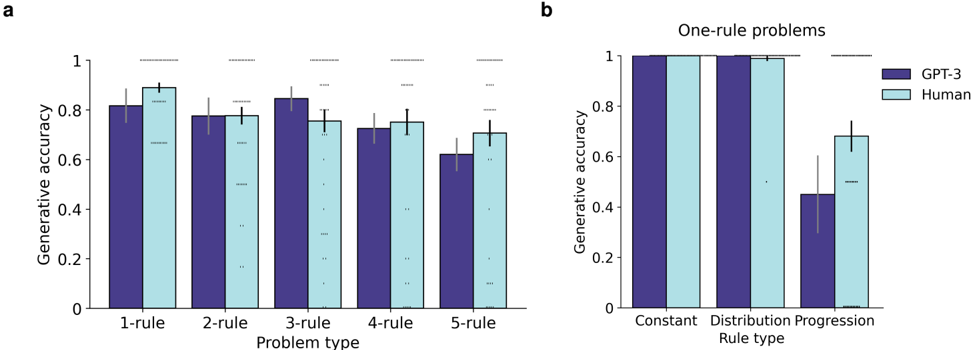
The image presents two bar charts (labeled 'a' and 'b') comparing the generative accuracy of GPT-3 and humans on different types of rule-based problems. Chart 'a' shows accuracy across varying numbers of rules (1-rule to 5-rule problems), while chart 'b' focuses on accuracy for different rule types (Constant, Distribution, Progression) within one-rule problems. Error bars are present on each bar, indicating variability.
### Components/Axes
**Chart a:**
* **X-axis:** "Problem type" with categories: 1-rule, 2-rule, 3-rule, 4-rule, 5-rule.
* **Y-axis:** "Generative accuracy" ranging from 0 to 1.
* **Legend (top-right):**
* Dark Purple: GPT-3
* Light Blue: Human
* Error bars are displayed on top of each bar.
**Chart b:**
* **X-axis:** "Rule type" with categories: Constant, Distribution, Progression.
* **Y-axis:** "Generative accuracy" ranging from 0 to 1.
* **Legend (top-right):**
* Dark Purple: GPT-3
* Light Blue: Human
* Error bars are displayed on top of each bar.
### Detailed Analysis or Content Details
**Chart a:**
* **1-rule:** GPT-3 accuracy is approximately 0.84 ± 0.04, Human accuracy is approximately 0.88 ± 0.03.
* **2-rule:** GPT-3 accuracy is approximately 0.79 ± 0.04, Human accuracy is approximately 0.78 ± 0.04.
* **3-rule:** GPT-3 accuracy is approximately 0.83 ± 0.04, Human accuracy is approximately 0.79 ± 0.04.
* **4-rule:** GPT-3 accuracy is approximately 0.78 ± 0.04, Human accuracy is approximately 0.76 ± 0.04.
* **5-rule:** GPT-3 accuracy is approximately 0.72 ± 0.04, Human accuracy is approximately 0.68 ± 0.04.
**Chart b:**
* **Constant:** GPT-3 accuracy is approximately 0.42 ± 0.08, Human accuracy is approximately 0.94 ± 0.03.
* **Distribution:** GPT-3 accuracy is approximately 0.44 ± 0.08, Human accuracy is approximately 0.92 ± 0.03.
* **Progression:** GPT-3 accuracy is approximately 0.66 ± 0.08, Human accuracy is approximately 0.68 ± 0.04.
### Key Observations
* In Chart 'a', human accuracy is generally higher than GPT-3 accuracy for problems with 1-3 rules. As the number of rules increases, the accuracy of both GPT-3 and humans decreases, but the gap between them narrows.
* In Chart 'b', humans significantly outperform GPT-3 on Constant and Distribution rule types. GPT-3 and humans have comparable accuracy on Progression rule types.
* The error bars indicate that the differences in accuracy between GPT-3 and humans are statistically significant in some cases, but not others.
### Interpretation
The data suggests that humans are better at solving rule-based problems with a smaller number of rules, particularly those involving constant or distributional patterns. As the complexity of the problem (number of rules) increases, GPT-3's performance becomes more competitive with human performance. GPT-3 struggles with constant and distribution rules, but performs comparably to humans on progression rules. This could indicate that GPT-3 has difficulty generalizing from limited examples or identifying underlying patterns in simple rule sets, but can handle more complex sequential patterns. The error bars suggest that individual human performance varies, and the differences observed may not always be statistically significant. The charts highlight the strengths and weaknesses of both GPT-3 and humans in the context of rule-based problem solving.