## Screenshot: LeanCopilot Tactic Suggestion
### Overview
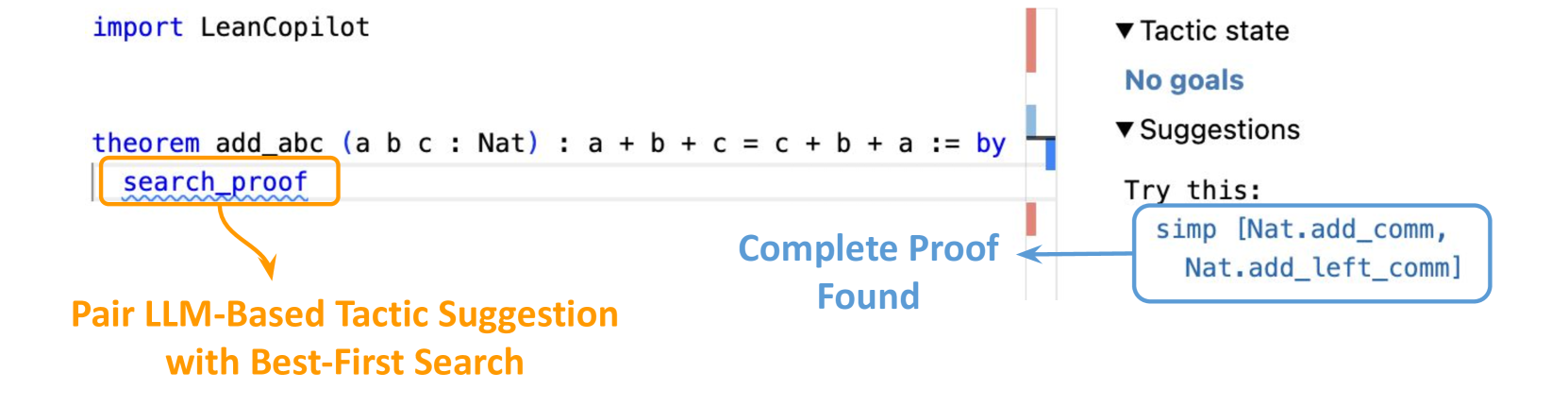
The image is a screenshot of the LeanCopilot interface, showcasing a tactic suggestion for proving a theorem. It highlights the use of LLM-based tactic suggestions paired with best-first search to find a complete proof.
### Components/Axes
* **Code Editor**: Displays the Lean code, including the theorem definition and the "search\_proof" command.
* **Tactic State**: Shows the current state of the proof, indicating "No goals".
* **Suggestions**: Provides tactic suggestions to the user.
* **Annotations**: Arrows and text boxes highlight specific elements and provide explanations.
### Detailed Analysis or ### Content Details
1. **Code Snippet**:
* `import LeanCopilot`
* `theorem add_abc (a b c : Nat) : a + b + c = c + b + a := by`
* `search_proof` (highlighted with an orange box and wavy underline)
2. **Tactic State**:
* `Tactic state` (with a downward-pointing triangle)
* `No goals`
3. **Suggestions**:
* `Suggestions` (with a downward-pointing triangle)
* `Try this:`
* `simp [Nat.add_comm, Nat.add_left_comm]` (enclosed in a rounded blue box)
4. **Annotations**:
* An orange arrow points from the "search\_proof" line to the text: "Pair LLM-Based Tactic Suggestion with Best-First Search".
* A blue arrow points from the right side of the code to the text: "Complete Proof Found".
### Key Observations
* The LeanCopilot suggests the `simp` tactic with `Nat.add_comm` and `Nat.add_left_comm` to prove the theorem.
* The system indicates that a complete proof has been found.
* The "search\_proof" command triggers the tactic suggestion mechanism.
### Interpretation
The screenshot demonstrates the LeanCopilot's ability to suggest relevant tactics for proving theorems in Lean. The combination of LLM-based suggestions and best-first search appears to be effective in finding complete proofs. The "No goals" state indicates that the suggested tactic successfully closed the proof. The use of `Nat.add_comm` (commutativity of addition) and `Nat.add_left_comm` (left commutativity of addition) suggests that the proof relies on rearranging the terms in the addition expression.